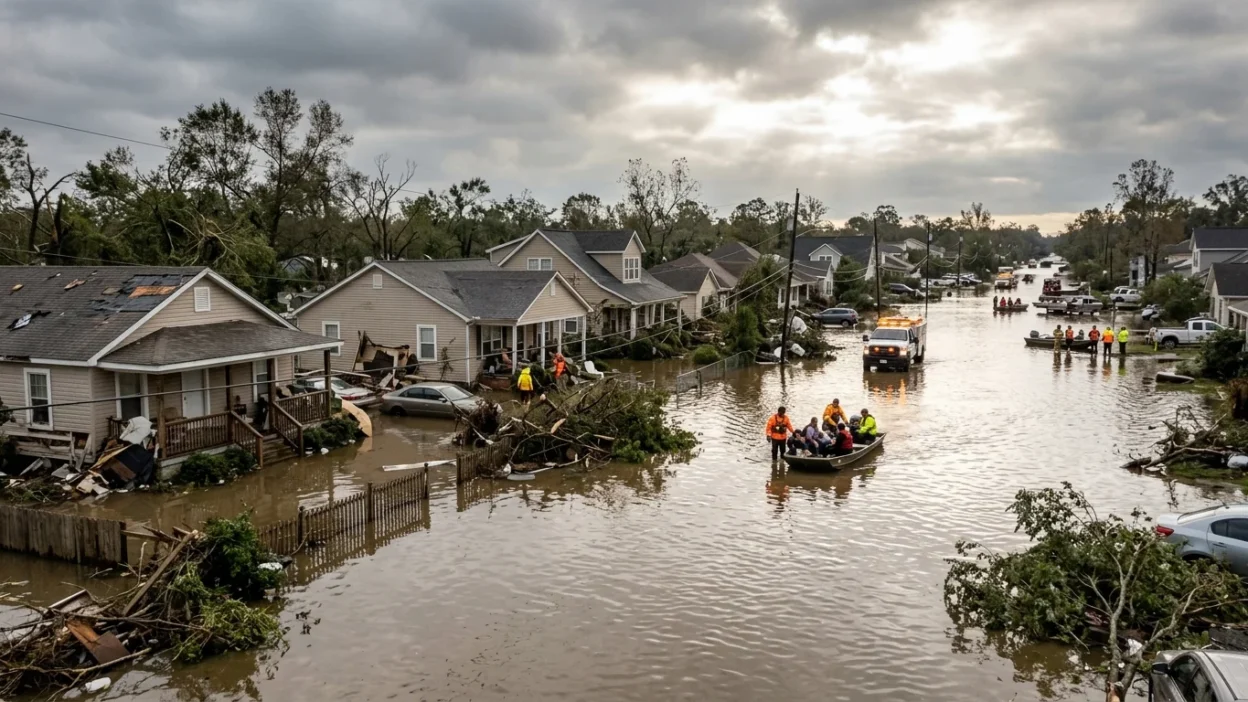
A calamity is a serious event that causes great damage, suffering or distress. It may affect one person, a family, a community or an entire country. Natural disasters, devastating accidents, financial collapses and major personal tragedies can all be described as calamities, depending on their scale and impact.
In this guide, you will discover useful synonyms for calamity, their meanings, pronunciation in the International Phonetic Alphabet (IPA), and practical example sentences. You will also learn how these words differ, which alternatives are most common, and how to use them correctly.
Synonyms of Calamity
The word calamity refers to an event that causes considerable harm, suffering or destruction. Its synonyms range from words describing enormous disasters to those expressing personal hardship or unfortunate circumstances.
The following table contains alternatives, with British English pronunciations where applicable.
| Synonym | Pronunciation (IPA) | Part of Speech | Meaning | Example Sentence |
| Disaster | /dɪˈzɑːstə/ | Noun | An event causing serious damage, loss or disruption. | The flood was a disaster for the farming community. |
| Catastrophe | /kəˈtæstrəfi/ | Noun | An extremely serious event with devastating consequences. | The collapse of the dam became a national catastrophe. |
| Tragedy | /ˈtrædʒədi/ | Noun | An event involving great suffering, grief or loss. | The railway accident was a tragedy for the families involved. |
| Misfortune | /mɪsˈfɔːtʃuːn/ | Noun | Bad luck or an unfortunate circumstance. | Losing his job was a serious misfortune. |
| Adversity | /ədˈvɜːsəti/ | Noun | Difficult or unfavourable circumstances. | The community remained united through years of adversity. |
| Setback | /ˈsetbæk/ | Noun | A problem that delays progress or causes difficulty. | The sudden equipment failure was a major setback. |
| Crisis | /ˈkraɪsɪs/ | Noun | A situation requiring urgent action because of serious danger or difficulty. | The country faced an economic crisis. |
| Calamity | /kəˈlæməti/ | Noun | An event causing great damage, distress or suffering. | The devastating storm was a calamity for the coastal villages. |
| Ruin | /ˈruːɪn/ | Noun | The destruction or collapse of something valuable or established. | The failed investment brought financial ruin to the business. |
| Devastation | /ˌdevəˈsteɪʃən/ | Noun | Widespread destruction or severe damage. | The hurricane left devastation across the island. |
| Cataclysm | /ˈkætəklɪzəm/ | Noun | A violent or far-reaching event that causes fundamental change or destruction. | The fictional eruption triggered a cataclysm that changed the continent. |
| Upheaval | /ʌpˈhiːvəl/ | Noun | A major disturbance or sudden, disruptive change. | The political upheaval disrupted everyday life. |
| Disaster area | /dɪˈzɑːstər ˈeəriə/ | Noun phrase | A place severely affected by a disaster. | Emergency workers delivered supplies to the disaster area. |
| Affliction | /əˈflɪkʃən/ | Noun | A condition or experience that causes suffering. | The illness became a long-lasting affliction for the family. |
| Hardship | /ˈhɑːdʃɪp/ | Noun | A difficult condition involving suffering or deprivation. | Many families experienced hardship after the factory closed. |
| Woe | /wəʊ/ | Noun | Deep sadness, distress or trouble. | The villagers shared their woes after the harvest failed. |
| Plight | /plaɪt/ | Noun | A difficult, troubling or dangerous situation. | The charity raised money to improve the plight of displaced families. |
| Calamity event | /kəˈlæməti ɪˈvent/ | Noun phrase | An event characterised as a calamity; generally less natural than simply saying “calamity” or “disaster”. | The report examined the causes of the calamity. |
| Tribulation | /ˌtrɪbjʊˈleɪʃən/ | Noun | A prolonged period of severe trouble or suffering. | The family endured many tribulations during the war. |
| Ruination | /ˌruːɪˈneɪʃən/ | Noun | The process or result of destroying something or bringing it to ruin. | Years of neglect led to the ruination of the historic building. |
What Does Calamity Mean?
A calamity is a serious and often unexpected event that brings substantial harm, destruction, loss or suffering. It usually has consequences that are difficult to manage and may take considerable time to overcome.
The word can be used in both literal and figurative contexts, although its strongest sense involves genuinely serious consequences.
The meaning of calamity in everyday English
In everyday English, a calamity is more serious than a minor inconvenience. Forgetting an umbrella might be annoying, but it would not normally be described as a calamity. Losing a home in a devastating fire, however, could reasonably be called one.
Consider these examples:
- Natural calamity: A severe earthquake destroys homes and roads.
- Financial calamity: A business collapses, leaving thousands of people unemployed.
- Personal calamity: A family experiences a devastating loss.
- Social calamity: A prolonged conflict causes widespread suffering and displacement.
The key idea is the seriousness of the consequences rather than the type of event itself.
Is calamity always unexpected?
Not necessarily. Calamities often happen suddenly, but an event can also become a calamity after a long period of worsening conditions.
For instance, a drought may develop over several months. If it destroys crops, creates food shortages and leaves communities without reliable water supplies, its effects may be described as a calamity.
Likewise, a financial crisis may develop gradually before reaching a point where its consequences become disastrous.
Is calamity a formal word?
Yes. Calamity is relatively formal and often appears in journalism, literature, historical writing and serious discussions of emergencies.
In casual conversation, people may be more likely to use disaster or terrible event. Nevertheless, calamity remains useful when a writer wants to communicate the gravity of a situation.
Most Common Synonyms of Calamity
Not every synonym is equally suitable for every sentence. The most effective alternative depends on the kind of event, the degree of damage and the point you want to emphasise.
Here are the most useful alternatives and the situations in which they work best.
1. Disaster
Disaster is probably the most versatile everyday synonym for calamity. It can refer to natural events, accidents, failed plans and situations with serious consequences.
Examples:
- The earthquake was a disaster for the entire region.
- The event turned into a public relations disaster.
- Poor planning resulted in a financial disaster.
The word is appropriate in both formal and informal writing. It can also describe a less serious failure when used figuratively, as in “The dinner party was a disaster.”
2. Catastrophe
Catastrophe suggests an exceptionally serious event with far-reaching consequences. It often conveys a greater degree of severity than the ordinary use of disaster.
Examples:
- The oil spill became an environmental catastrophe.
- A failure to contain the disease could lead to a public health catastrophe.
- The collapse of the bridge was a catastrophe for the surrounding communities.
Choose this word when you want to emphasise the scale or devastating impact of an event.
3. Tragedy
Tragedy focuses on suffering, grief or heartbreaking loss. It is particularly appropriate when people have died, families have been separated or lives have been profoundly affected.
Examples:
- The accident was a tragedy that affected the whole town.
- The premature loss of the young athlete was a national tragedy.
- The novel tells the story of a family tragedy.
A tragedy can involve destruction, but destruction is not essential to its meaning. The emphasis is on the human suffering involved.
4. Misfortune
Misfortune is generally milder than calamity. It refers to bad luck or an unfortunate experience rather than necessarily indicating a major disaster.
Examples:
- It was a misfortune that the train was cancelled on the day of the interview.
- Despite several misfortunes, she continued working towards her goal.
- His financial misfortune lasted for several months.
Use misfortune for personal difficulties, unlucky circumstances and setbacks that may not involve widespread destruction.
5. Crisis
A crisis is a critical situation that requires urgent attention or action. Unlike calamity, the word often highlights the need to respond to a dangerous or unstable situation.
Examples:
- The hospital faced a staffing crisis.
- The government introduced measures to address the energy crisis.
- The family sought professional help during a personal crisis.
A crisis can lead to a calamity, but the words are not identical. A crisis describes the critical situation; a calamity emphasises the serious harm or suffering associated with an event.
6. Devastation
Devastation highlights the destruction left behind by a serious event. It is especially useful when discussing damage to buildings, landscapes, communities or livelihoods.
Examples:
- The storm caused widespread devastation along the coast.
- The fire left a scene of complete devastation.
- Residents returned to assess the devastation caused by the flood.
The word often describes the result of a calamity rather than the event itself.
7. Misfortune and adversity
These words are useful when discussing difficult experiences without necessarily suggesting a single disastrous incident.
Misfortune often refers to an unfortunate event or bad luck. Adversity refers more broadly to difficult circumstances that a person or group must face.
For example:
- “She experienced a financial misfortune after losing her job.”
- “She showed remarkable determination in the face of adversity.”
The first sentence describes an unfortunate experience. The second highlights the difficult conditions she had to overcome.
8. Cataclysm
Cataclysm is a powerful, dramatic word for a violent or far-reaching upheaval. It is often used in historical, scientific or literary contexts.
Examples:
- The eruption caused a cataclysm that transformed the surrounding landscape.
- The fictional war brought about a political cataclysm.
- The impact of the asteroid triggered a global cataclysm in the story.
It is not usually the best choice for a minor accident or a routine difficulty. Its dramatic tone makes it suitable for events of exceptional scale.
Difference Between Calamity and Its Synonyms
Although calamity has many alternatives, each word carries a slightly different emphasis. Understanding these distinctions helps you select the most accurate expression.
Calamity vs disaster
Both words describe serious events that cause harm or destruction. However, disaster is more common in everyday speech and can describe both major emergencies and comparatively minor failures.
Calamity often sounds more formal or dramatic and is strongly associated with grave suffering or misfortune.
Compare:
- “The camping trip was a disaster because it rained all weekend.”
- “The earthquake was a calamity that destroyed thousands of homes.”
The first is an informal exaggeration. The second describes a genuinely serious event.
Calamity vs catastrophe
These words are very close in meaning. Both can refer to devastating events, but catastrophe often stresses the magnitude and far-reaching consequences of what happened.
For example:
- “The flood was a calamity for the village.”
- “The failure of the entire safety system resulted in a national catastrophe.”
The difference is subtle rather than absolute. In many contexts, either word may be appropriate.
Calamity vs tragedy
A calamity can involve widespread destruction, economic loss or severe disruption. A tragedy places greater emphasis on grief, suffering and the human cost.
For example, a hurricane that destroys infrastructure may be called a calamity. If it causes the deaths of many people, the loss of life may also be described as a tragedy.
An event can therefore be both a calamity and a tragedy, depending on which aspect the writer wishes to emphasise.
Calamity vs misfortune
Misfortune is a broader and often less intense term. It can refer to bad luck, disappointment or an unfortunate personal experience.
A missed appointment might be a minor misfortune. A devastating earthquake that leaves a community homeless is more likely to be described as a calamity.
Use misfortune when the emphasis is on unfortunate circumstances rather than large-scale destruction.
Calamity vs crisis
A crisis is a critical period or situation that demands urgent attention. A calamity is an event or circumstance associated with grave harm or suffering.
For example, a country experiencing severe shortages may face a humanitarian crisis. If those shortages result in widespread suffering and loss, the consequences may also be described as a calamity.
A crisis may be resolved before it becomes a calamity, so the two words should not automatically be treated as interchangeable.
Calamity vs adversity
Adversity describes difficult conditions rather than necessarily identifying one disastrous event.
A person might face adversity after losing a job, dealing with illness or experiencing prolonged financial problems. The word is particularly useful when discussing resilience, perseverance and overcoming difficulties.
For instance:
- “The community suffered a calamity when the dam collapsed.”
- “The community showed resilience in the face of adversity during the following years.”
The first identifies the devastating event. The second describes the challenges that followed.
Calamity vs upheaval
Upheaval refers to significant disruption or sudden change. It is frequently used in political, social, economic and personal contexts.
A political revolution may cause upheaval even if it does not result in widespread physical destruction. A calamity, by contrast, generally conveys serious harm or distress.
Choose upheaval when disruption or dramatic change is the central idea.
Calamity vs affliction
Affliction often refers to something that causes ongoing suffering, such as an illness or a persistent difficulty. It is less commonly used to describe a sudden disaster affecting an entire region.
For example, a serious illness may be described as an affliction. A major earthquake would normally be called a disaster or calamity.
Quick comparison
| Word | Main emphasis | Typical context |
| Calamity | Serious harm, suffering or loss | Major disasters and grave misfortunes |
| Disaster | Damage, failure or disruption | Natural events, accidents and failed plans |
| Catastrophe | Exceptional severity and consequences | Major emergencies and devastating events |
| Tragedy | Grief and human suffering | Deaths, loss and heartbreaking events |
| Misfortune | Bad luck or unfortunate circumstances | Personal difficulties and unlucky events |
| Crisis | Urgent danger or instability | Health, economic, political and personal situations |
| Devastation | Widespread destruction | The aftermath of disasters |
| Adversity | Difficult conditions | Long-term struggles and resilience |
| Upheaval | Major disruption or change | Political, social and economic transformations |
| Cataclysm | Violent or far-reaching change | Exceptional events, history and dramatic fiction |
Common Mistakes When Using Calamity
Using synonyms correctly requires more than choosing words with similar dictionary definitions. Context, tone and the scale of an event all matter.
Here are some common mistakes to avoid.
1. Treating every problem as a calamity
A calamity normally involves serious consequences. Using it for every small inconvenience can make your writing sound exaggerated.
Incorrect or exaggerated: “Forgetting my notebook was a calamity.”
More natural: “Forgetting my notebook was an inconvenience.”
However, in a humorous or deliberately dramatic context, the exaggerated version may be acceptable.
2. Using tragedy and disaster as exact equivalents
Although the words overlap, tragedy often emphasises human loss, while disaster focuses more broadly on damage, disruption or failure.
For example, a badly managed project may be a disaster, but it would not usually be called a tragedy unless serious suffering or loss were involved.
Always consider what aspect of the event you want to communicate.
3. Choosing an overly dramatic synonym
Words such as cataclysm and catastrophe can make a sentence sound powerful, but they may be inappropriate for an ordinary setback.
Instead of writing, “The delayed delivery was a cataclysm,” write, “The delayed delivery was a setback.”
Reserve stronger expressions for situations that justify them.
4. Confusing a crisis with its consequences
A crisis is a critical situation that may require immediate action. A calamity describes an event or circumstance involving serious harm or suffering.
For example, a company may experience a financial crisis without collapsing. If it eventually becomes insolvent and causes extensive losses, the outcome might be described as a financial calamity.
The words are related, but they highlight different aspects of the situation.
5. Using a noun where a different grammatical form is needed
Calamity is a noun. Its related adjective is calamitous, which describes something that causes or involves a calamity.
Correct examples:
- “The region suffered a calamity.”
- “The region experienced a calamitous flood.”
Incorrect: “The flood was very calamity.”
Better: “The flood was disastrous” or “The flood was a calamity.”
Remember to check whether the sentence requires a noun, adjective or another part of speech.
6. Forgetting the difference between singular and plural
The plural form of calamity is calamities.
Examples:
- “The community faced a calamity.”
- “The region experienced several calamities over the decade.”
Use the singular for one event and the plural for multiple events.
7. Repeating the same synonym unnecessarily
In longer articles, repeatedly using disaster or catastrophe can make the writing monotonous. However, replacing every instance with an unfamiliar word can make the text harder to understand.
Instead, vary your vocabulary naturally. Use devastation when discussing destruction, tragedy when focusing on grief and hardship when describing difficult living conditions.
Accuracy is more important than variety for its own sake.
Tips for Using Calamity and Its Synonyms Correctly
The best synonym is the one that communicates your intended meaning clearly. These practical tips can help you make the right choice in essays, reports, stories and everyday communication.
1. Consider the scale of the event
Think about how much harm or disruption the event caused.
- Minor difficulty: inconvenience, problem or setback.
- Personal difficulty: misfortune or hardship.
- Serious emergency: disaster or calamity.
- Exceptionally devastating event: catastrophe or cataclysm.
These are useful general guidelines rather than rigid rules. Context can change the strength of a word.
2. Identify the main consequence
Ask yourself what you want the reader to notice.
If the main issue is physical destruction, devastation may be appropriate. If the emphasis is grief, tragedy may be more effective. If the situation demands urgent action, crisis may be the clearest choice.
For example:
“The earthquake caused widespread devastation, creating a humanitarian crisis and leaving many families facing hardship.”
Each expression describes a different aspect of the same event.
3. Match the tone to your audience
Formal reports often use catastrophe, calamity or devastation when discussing major emergencies. Everyday conversations may favour disaster, problem or misfortune.
In creative writing, more dramatic words can create a strong emotional effect. In professional communication, precision is usually more important than dramatic language.
4. Use the correct adjective
Several related adjectives are useful when you need to describe an event rather than name it.
| Noun | Related adjective | Example |
| Calamity | Calamitous | It was a calamitous decision. |
| Disaster | Disastrous | The project had a disastrous outcome. |
| Catastrophe | Catastrophic | The failure had catastrophic consequences. |
| Tragedy | Tragic | It was a tragic accident. |
| Devastation | Devastating | The storm had a devastating impact. |
These adjectives are not always interchangeable. For example, tragic generally emphasises suffering or grief, while disastrous can also describe a failed plan or poor result.
5. Read the sentence aloud
A synonym may be technically correct but sound unnatural in context. Reading the sentence aloud can help you identify awkward phrasing or excessive drama.
Compare:
“The cancelled meeting was a catastrophe.”
“The cancelled meeting was an inconvenience.”
The second sentence is usually more appropriate unless the meeting’s cancellation had exceptionally serious consequences.
6. Avoid unnecessary exaggeration
Strong words have more impact when used selectively. If every problem is described as catastrophic, the word gradually loses its force.
Choose vocabulary that reflects the actual circumstances. This is particularly important in news reporting, academic writing and discussions of real emergencies.
7. Use synonyms to improve clarity, not just variety
A thesaurus can help you find alternatives, but it cannot always determine which word suits your sentence.
Before replacing calamity, check the definition, tone and usual context of the alternative. A natural, precise sentence is better than one containing an impressive but unsuitable word.
Summary
Calamity describes a serious event or circumstance that causes substantial harm, suffering, destruction or loss. Its closest synonyms include disaster, catastrophe, tragedy, misfortune and crisis, but each word communicates a slightly different idea.
By understanding these distinctions, you can use synonyms for calamity more confidently and make your writing clearer, more varied and more effective.
FAQs
1. What is the best synonym for calamity?
Disaster is usually the best general synonym because it applies to many situations involving serious damage, loss or disruption. Catastrophe is a strong alternative when the consequences are exceptionally severe.
2. What are five synonyms for calamity?
Five common synonyms are disaster, catastrophe, tragedy, misfortune and crisis. The most appropriate choice depends on whether you want to emphasise destruction, suffering, bad luck or an urgent situation.
3. What is a stronger word than calamity?
Catastrophe and cataclysm can convey an exceptionally serious or far-reaching event. However, neither is automatically stronger in every context. The best choice depends on the scale and nature of the event.
4. Is calamity the same as disaster?
The words have very similar meanings, but they are not always identical. Disaster is more common in everyday English and can describe minor failures figuratively. Calamity often has a more formal or grave tone.
5. What is the difference between calamity and tragedy?
A calamity emphasises serious harm, destruction or misfortune. A tragedy focuses more strongly on grief, suffering or loss, especially the loss of human life. One event can be both a calamity and a tragedy.
6. What is the opposite of calamity?
Depending on the context, possible opposites include good fortune, blessing, success, prosperity and relief. There is no single opposite that works naturally in every sentence.
7. What is the adjective form of calamity?
The adjective is calamitous, meaning disastrous or involving serious harm. For example: “The region experienced a calamitous storm.”
8. Can calamity be used in formal writing?
Yes. Calamity is suitable for formal articles, reports, historical accounts and serious discussions of destructive events. For everyday situations, simpler alternatives such as problem, setback or misfortune may sound more natural.