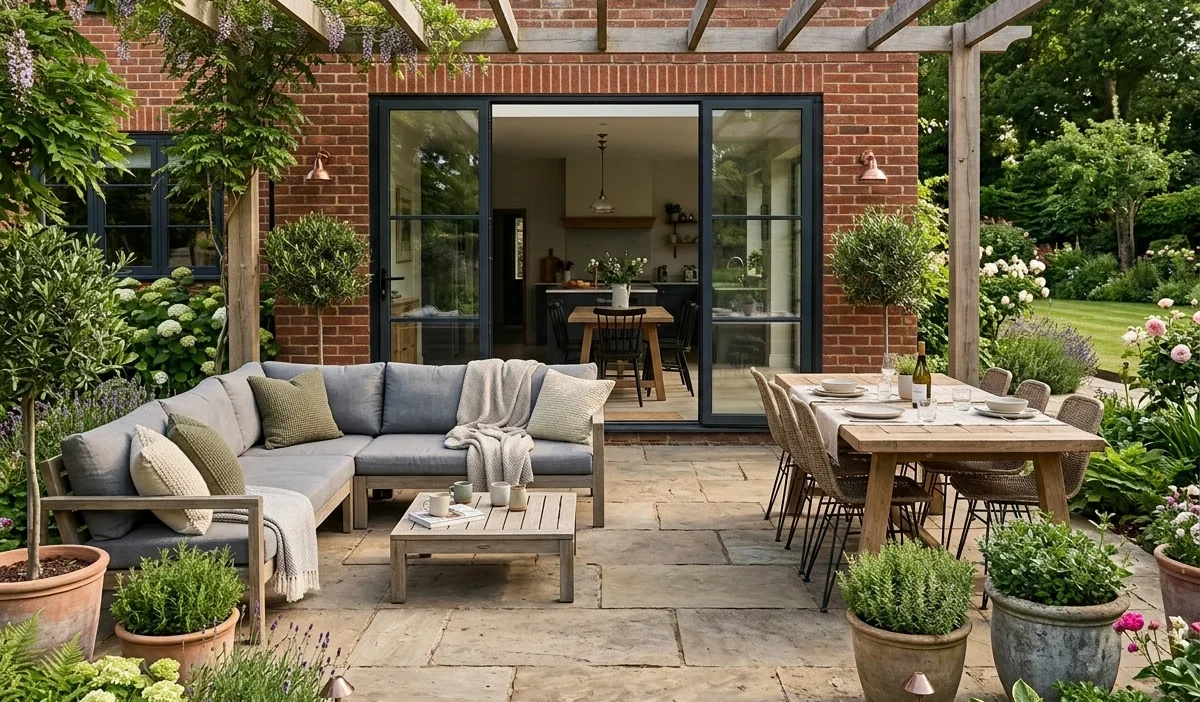
Finding the right synonyms for patio can make your writing more varied, descriptive and natural. The word patio usually refers to a paved or hard-surfaced outdoor area next to a house or building.
It is often used for relaxing, dining, entertaining guests or enjoying outdoor space.
However, not every outdoor area can be called a patio. Words such as terrace, courtyard, deck, veranda and garden area describe spaces that may look or function like a patio, but each has a slightly different meaning.
Choosing the correct word depends on the design, location, surface and purpose of the space. A deck, for example, is commonly made from timber or composite materials and may be raised above the ground.
A courtyard is usually an open area surrounded by walls or buildings. A veranda is normally a covered, roofed space attached to a building.
Synonyms of Synonyms for Patio
The word patio has several closely related alternatives. Some are direct substitutes in certain contexts, while others describe outdoor spaces with different structures or features.
| Synonym | Pronunciation (IPA) | Part of Speech | Meaning | Example Sentence |
| Terrace | /ˈterəs/ | Noun | A level outdoor area beside or on a building | We had breakfast on the sunny terrace. |
| Courtyard | /ˈkɔːtjɑːd/ | Noun | An open area surrounded partly or completely by buildings or walls | The hotel has a peaceful courtyard. |
| Deck | /dek/ | Noun | A flat outdoor platform, often made of timber or composite material | They built a wooden deck behind the house. |
| Veranda | /vəˈrændə/ | Noun | A covered platform along the outside of a building | We sat on the veranda during the evening. |
| Porch | /pɔːtʃ/ | Noun | A covered entrance or small outdoor area attached to a building | She left the parcel on the porch. |
| Outdoor area | /ˌaʊtˈdɔː ˈeəriə/ | Noun phrase | A general term for an outside space | The restaurant has a comfortable outdoor area. |
| Outdoor space | /ˌaʊtˈdɔː speɪs/ | Noun phrase | An area designed or used for outdoor activities | The new house has plenty of outdoor space. |
| Garden terrace | /ˈɡɑːdən ˈterəs/ | Noun phrase | A level outdoor area connected with a garden | The garden terrace overlooks the lawn. |
| Paved area | /peɪvd ˈeəriə/ | Noun phrase | An outdoor area covered with paving materials | We created a paved area for outdoor dining. |
| Paved terrace | /peɪvd ˈterəs/ | Noun phrase | A terrace covered with paving | The paved terrace is ideal for summer meals. |
| Sitting area | /ˈsɪtɪŋ ˈeəriə/ | Noun phrase | An area arranged for sitting and relaxing | The garden includes a small sitting area. |
| Entertainment area | /ˌentəˈteɪnmənt ˈeəriə/ | Noun phrase | An outdoor space designed for social activities | The entertainment area has comfortable seating. |
| Al fresco area | /ˌæl ˈfreskə ˈeəriə/ | Noun phrase | An area intended for eating or relaxing outdoors | Guests enjoyed the restaurant’s al fresco area. |
| Garden seating area | /ˈɡɑːdən ˈsiːtɪŋ ˈeəriə/ | Noun phrase | A garden space arranged with seating | We added chairs to the garden seating area. |
| Outdoor platform | /ˌaʊtˈdɔː ˈplætfɔːm/ | Noun phrase | A level outdoor structure used as a functional space | The outdoor platform overlooks the garden. |
| Recreation area | /ˌrekriˈeɪʃən ˈeəriə/ | Noun phrase | An area used for leisure and outdoor activities | The property includes a private recreation area. |
What Does Synonyms for Patio Mean?
The phrase synonyms for patio refers to words and expressions that can describe a patio or a similar outdoor living area.
A patio is usually a hard-surfaced area located beside a house, flat or other building. It can be made from materials such as paving slabs, stone, concrete, tiles or bricks.
Patios are commonly used for:
- outdoor dining;
- relaxing;
- entertaining guests;
- placing garden furniture;
- enjoying warm weather;
- spending time with family;
- creating an extension of indoor living space.
The word patio originally comes from Spanish and has become a familiar English word, particularly when describing residential outdoor areas.
A patio does not necessarily have to be covered. In fact, many patios are completely open to the sky.
This is one reason why patio differs from veranda and porch, which are generally associated with some form of covering or roof.
Patio as an Outdoor Living Space
Modern homes often treat a patio as an extension of the living area.
A family might place a dining table, chairs, sofas, lighting and plants on a patio. This creates a comfortable space for socialising.
For example:
The family transformed the patio into a comfortable outdoor dining space.
In this sentence, patio refers to a specific hard-surfaced outdoor area.
Patio in Property Descriptions
The word is also common in property descriptions.
For example:
The house features a spacious patio overlooking the garden.
Here, patio immediately suggests a usable outdoor area connected with the property.
A writer could replace it with terrace in some situations, but the two words are not always identical.
Most Common Synonyms for Patio
Terrace
Terrace is probably one of the closest alternatives to patio in many contexts.
A terrace is a level outdoor area that may be attached to a building or positioned elsewhere on a property.
For example:
The apartment has a large terrace overlooking the city.
The word is particularly common in British English and property descriptions.
However, terrace can also refer to a raised or stepped area, so the exact meaning depends on context.
Courtyard
A courtyard is an open space surrounded by buildings or walls.
For example:
The restaurant has a charming courtyard where customers can dine outside.
A courtyard may contain paving, plants, tables and chairs, much like a patio.
The main difference is its enclosed or partly enclosed setting.
A patio does not need to be surrounded by walls.
Deck
A deck is an outdoor platform.
It is traditionally associated with timber, although modern decks can be made from composite materials and other products.
For example:
They installed a wooden deck at the back of the house.
A deck may serve the same purpose as a patio, but its construction is different.
A raised timber structure would normally be called a deck rather than a patio.
Veranda
A veranda is a roofed platform or walkway along the outside of a building.
For example:
We relaxed on the veranda while listening to the rain.
The roof is an important feature.
This means veranda should not be used as a direct replacement for patio when describing a completely open paved area.
Porch
A porch is usually associated with the entrance of a house.
For example:
The children sat on the front porch.
A porch can be large enough for seating, but its main connection is often with the entrance.
A patio is usually intended more broadly for outdoor living, dining or recreation.
Outdoor Area
Outdoor area is a broad expression.
It can describe almost any usable space outside a building.
For example:
The hotel has a spacious outdoor area for guests.
The phrase is useful when you do not need to specify the exact structure.
However, it is less precise than patio.
Outdoor Space
Outdoor space is another general expression.
It is particularly useful in property, lifestyle and interior design writing.
For example:
The house offers plenty of outdoor space for entertaining.
Unlike patio, this phrase does not tell the reader exactly what type of outdoor space is being described.
Garden Terrace
A garden terrace combines the ideas of a garden and a terrace.
For example:
The garden terrace provides a quiet place to enjoy the afternoon.
It works well when the outdoor area is closely connected with landscaped garden space.
Paved Area
A paved area focuses on the surface rather than its purpose.
For example:
The owners created a paved area beside the lawn.
This can describe a patio, but it does not necessarily mean that the space is furnished or designed as a social area.
Paved Terrace
A paved terrace combines the structural idea of a terrace with the surface material.
For example:
The paved terrace provides enough room for a dining table.
It is a useful descriptive phrase when the paving is an important feature.
Sitting Area
A sitting area focuses on how the space is used.
For example:
The garden has a peaceful sitting area surrounded by plants.
A sitting area may be a patio, deck, terrace or another outdoor space.
Therefore, it is more general than patio.
Entertainment Area
An entertainment area is designed for socialising and leisure.
For example:
The outdoor entertainment area is perfect for family gatherings.
It describes the function rather than the physical construction.
Difference Between Synonyms for Patio and Its Synonyms
Understanding the differences between related terms helps you choose the most accurate word.
Patio vs Terrace
A patio is generally a ground-level paved outdoor area.
A terrace can also be ground-level, but it may be raised or attached to an upper floor.
For example:
They built a patio beside the garden.
This sounds like a ground-level paved area.
By contrast:
The flat has a large terrace.
This may suggest an elevated outdoor area connected to the flat.
Patio vs Courtyard
A courtyard is defined largely by its surroundings.
It is commonly enclosed or partly enclosed by buildings or walls.
A patio does not require this arrangement.
A patio can be completely open.
Patio vs Deck
The main difference is construction.
A deck is commonly constructed as a platform, often using timber or composite materials.
A patio is more commonly built directly on the ground using paving, stone, concrete or similar materials.
Patio vs Veranda
A veranda is generally covered.
A patio may be open or covered.
Therefore:
We ate dinner on the patio.
does not tell us whether there is a roof.
But:
We ate dinner on the veranda.
usually suggests a covered outdoor area.
Patio vs Porch
A porch is usually located around the entrance of a building.
A patio is normally a more general outdoor living area.
A large house could have both.
For example:
Guests entered through the front porch before joining the family on the rear patio.
Patio vs Outdoor Area
Outdoor area is much broader.
A patio is one type of outdoor area.
Other outdoor areas may include lawns, balconies, terraces, courtyards and decks.
Patio vs Garden Terrace
A garden terrace is a specific type of terrace associated with a garden.
It may resemble a patio but can have a different layout or elevation.
The best choice depends on the actual design.
Common Mistakes When Using Synonyms for Patio
Treating All Outdoor Spaces as Patios
Not every outdoor area is a patio.
A balcony is not normally called a patio. A roof terrace is not necessarily a patio either.
Choose the term based on the physical structure.
Calling a Raised Deck a Patio
A raised timber platform is generally a deck.
Calling it a patio may create an inaccurate picture for the reader.
Using Veranda for an Open Paved Space
A veranda is normally associated with a roof.
If the area is completely open, patio or terrace may be more appropriate.
Confusing a Courtyard with a Patio
A courtyard is characterised by its surrounding walls or buildings.
A patio is characterised more by its outdoor living function and hard surface.
A courtyard can contain a patio, but the terms are not always interchangeable.
Using Terrace in Every Situation
Although terrace is a close alternative, it can suggest an elevated outdoor space.
For example, a high-rise flat may have a terrace, while a ground-level garden may have a patio.
Context makes the difference.
Choosing Vague Language
Words such as outdoor area and outdoor space are useful, but they can be too general.
If you know that the area is a paved patio, saying patio gives the reader more information.
Overusing Synonyms
SEO writing should not replace every occurrence of patio with another word.
This can make the article sound unnatural.
Use alternatives when they genuinely describe a different feature or prevent unnecessary repetition.
Ignoring British English
For a British English audience, terms such as terrace, garden, paved area and veranda can fit naturally into property and lifestyle writing.
Choose vocabulary that suits the audience and context.
Tips for Using Synonyms for Patio Correctly
Think About the Surface
If the space is made from paving slabs, stone or concrete, patio or paved area may be suitable.
If it is a timber platform, deck is usually more accurate.
Consider the Position
Ask where the outdoor space is located.
If it is surrounded by buildings or walls, courtyard may be the best choice.
If it is attached to the entrance of a house, porch could be appropriate.
Check Whether It Is Covered
A covered outdoor platform may be a veranda.
An uncovered paved space is more likely to be a patio.
Consider How the Space Is Used
If the focus is on relaxing, sitting area may work well.
If the focus is on parties and gatherings, entertainment area can be useful.
If the focus is simply on the availability of outside space, outdoor space is a natural choice.
Use Terrace for the Right Setting
Terrace is a particularly useful alternative when describing an elevated outdoor area.
For example:
The flat has a spacious roof terrace.
This is more specific than simply calling it an outdoor area.
Choose Specific Language in Property Writing
Property descriptions benefit from accurate vocabulary.
Compare:
The house has an outdoor area.
with:
The house has a spacious paved patio overlooking the garden.
The second sentence gives the reader much more useful information.
Keep Sentences Simple
Good vocabulary does not require complicated sentences.
For example:
The new patio provides a comfortable place for outdoor dining.
This is clear and easy to understand.
Match the Word to the Audience
A general audience may understand outdoor space more quickly than a technical architectural term.
If your readers are property professionals or designers, more specific terms may be appropriate.
Summary
The most useful synonyms for patio include terrace, courtyard, deck, veranda, porch, outdoor area, outdoor space, garden terrace, paved area, paved terrace and sitting area.
These words are related, but they do not all have exactly the same meaning.
A patio is generally a ground-level, hard-surfaced outdoor area. A terrace may be ground-level or elevated. A deck is usually a platform made from timber or composite material. A courtyard is commonly enclosed by buildings or walls.
A veranda is generally covered, while a porch is usually connected with the entrance of a building. Broader expressions such as outdoor area and outdoor space can describe many different types of external areas.
The best synonym depends on the physical structure, location and purpose of the space. Choosing the right term makes your writing more accurate and natural.
FAQ
1. What is the best synonym for patio?
Terrace is one of the closest alternatives in many contexts. Other useful terms include courtyard, deck, paved area and outdoor space, depending on the design and location.
2. Is terrace the same as patio?
Not always. A patio is generally a ground-level paved area, while a terrace can be ground-level or raised. The exact meaning depends on the context.
3. What is another word for a paved patio?
Useful alternatives include paved area, paved terrace, garden terrace and outdoor sitting area. The best choice depends on how the space is designed.
4. Is a deck the same as a patio?
No. A deck is usually a raised outdoor platform, often made from timber or composite material. A patio is more commonly a ground-level area made from paving, stone or concrete.
5. What is the difference between a patio and a courtyard?
A patio is usually an outdoor living area with a hard surface. A courtyard is generally an open space enclosed or partly enclosed by buildings or walls. A courtyard may contain a patio.
6. Is a veranda a synonym for patio?
They can describe similar outdoor living spaces, but they are not exact synonyms. A veranda is normally a covered platform attached to a building, while a patio can be completely open.
7. What is another word for outdoor patio?
Depending on the context, you could use terrace, paved area, garden terrace, outdoor space or outdoor sitting area.
8. Why is it important to choose the correct synonym for patio?
Different words describe different structures. Choosing the correct term gives readers a clearer picture of the outdoor space and makes your writing more precise.