Some English words describe objects that are so specific that finding a perfect synonym can be surprisingly difficult. Antimacassar is one of them.
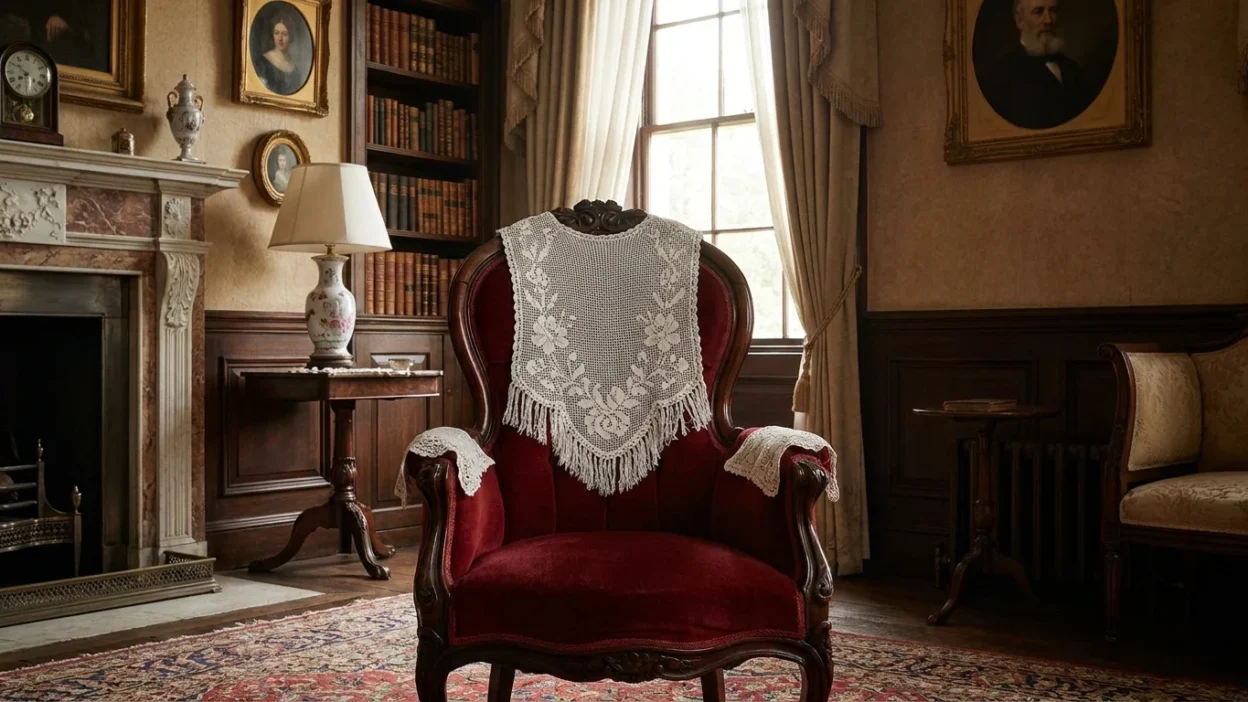
An antimacassar is a small piece of fabric traditionally placed over the back, headrest or arms of a chair or sofa. Its original purpose was practical: it protected upholstered furniture from hair oil, particularly the oily hair preparations that were widely used during the nineteenth century.
Today, antimacassars are less common in ordinary homes, but the word still appears in discussions about traditional interiors, antique furniture, Victorian decoration, upholstery and historical domestic life. Decorative antimacassars can also be found on vintage chairs, period furniture and heritage interiors.
Synonyms of synonyms of antimacassar
There is no large group of perfect one-word synonyms for antimacassar. The term refers to a particularly specific type of protective textile.
For this reason, the alternatives below include close synonyms, descriptive equivalents and related terms. They are grouped according to the aspect of an antimacassar they describe.
Terms for a protective chair or sofa covering
| Synonym | Pronunciation (IPA) | Part of Speech | Meaning | Example Sentence |
| Chair cover | /ˈtʃeə ˌkʌvə/ | Noun | A covering placed over a chair to protect or decorate it | A decorative chair cover protected the delicate upholstery. |
| Furniture protector | /ˈfɜːnɪtʃə prəˌtektə/ | Noun | A covering or material used to protect furniture from damage | The furniture protector prevented marks from reaching the fabric. |
| Upholstery protector | /ʌpˈhəʊlstəri prəˌtektə/ | Noun | Something used to protect upholstered furniture | The upholstery protector helped keep the chair clean. |
| Upholstery cover | /ʌpˈhəʊlstəri ˌkʌvə/ | Noun | Fabric or material covering upholstered furniture | She placed an upholstery cover over the old armchair. |
| Protective covering | /prəˈtektɪv ˈkʌvərɪŋ/ | Noun | A material used to prevent something from becoming damaged or dirty | The protective covering kept the fabric free from stains. |
| Chair protector | /ˈtʃeə prəˌtektə/ | Noun | A covering designed to protect a chair | The chair protector was easy to remove and wash. |
| Sofa protector | /ˈsəʊfə prəˌtektə/ | Noun | A covering designed to protect a sofa | They bought a sofa protector for their newly upholstered furniture. |
| Furniture cover | /ˈfɜːnɪtʃə ˌkʌvə/ | Noun | A cover placed over furniture for protection or storage | A furniture cover protected the sofa from dust. |
| Upholstery guard | /ʌpˈhəʊlstəri ɡɑːd/ | Noun | Something that protects upholstered material from damage | The upholstery guard was particularly useful on the antique chair. |
| Fabric protector | /ˈfæbrɪk prəˌtektə/ | Noun | A covering or treatment intended to protect fabric | The fabric protector reduced the risk of stains on the chair. |
Terms describing the position or form of an antimacassar
| Synonym | Pronunciation (IPA) | Part of Speech | Meaning | Example Sentence |
| Headrest cover | /ˈhedrest ˌkʌvə/ | Noun | A covering placed over the headrest of a seat | The headrest cover protected the upholstery from contact with hair. |
| Backrest cover | /ˈbækrest ˌkʌvə/ | Noun | A cover placed over the backrest of a chair or seat | The backrest cover matched the room’s traditional decoration. |
| Chair-back cover | /ˈtʃeə bæk ˌkʌvə/ | Noun | A covering designed specifically for the back of a chair | A lace chair-back cover gave the room a period appearance. |
| Armrest cover | /ˈɑːmrest ˌkʌvə/ | Noun | A protective cover placed over a chair or sofa armrest | The armrest cover prevented the fabric from becoming worn. |
| Seat cover | /ˈsiːt ˌkʌvə/ | Noun | A covering placed over a seat | The seat cover was removed before the antique chair was displayed. |
| Slipcover | /ˈslɪpˌkʌvə/ | Noun | A removable fabric cover fitted over furniture | The removable slipcover was washed regularly. |
| Decorative cover | /ˈdekərətɪv ˌkʌvə/ | Noun | A cover intended partly or mainly for decoration | The decorative cover complemented the Victorian furniture. |
| Protective cloth | /prəˈtektɪv klɒθ/ | Noun | A piece of fabric used to protect an object or surface | A protective cloth was placed over the chair before the room was redecorated. |
| Furniture drape | /ˈfɜːnɪtʃə dreɪp/ | Noun | A piece of fabric loosely covering furniture | A furniture drape protected the chair during renovation work. |
| Upholstery shield | /ʌpˈhəʊlstəri ʃiːld/ | Noun | A covering or barrier that protects upholstery | The upholstery shield helped preserve the delicate material. |
These terms are not all dictionary-perfect replacements for antimacassar. Some are broader than the original word, while others describe only a particular part of the object.
That distinction is important when choosing an alternative.
What Does synonyms of antimacassar Mean?
The phrase synonyms of antimacassar refers to words and descriptive expressions that have the same or a closely related meaning as antimacassar.
An antimacassar is traditionally a piece of decorative fabric placed over part of a chair, sofa or other upholstered seat to protect the upholstery.
The most important feature is its protective function.
Historically, hair oils and pomades could easily leave greasy marks on upholstered furniture. An antimacassar provided a removable layer between a person’s hair and the furniture.
The object was therefore both practical and decorative.
A typical antimacassar might be made from:
- lace
- crochet
- embroidered fabric
- cotton
- linen
- wool
- decorative textile
- other washable materials
Many historical examples were designed to complement the furniture rather than simply look like protective equipment.
What does the word antimacassar mean?
The unusual name comes from Macassar oil, a type of hair oil that became fashionable in the nineteenth century.
The prefix anti- means “against” or “opposed to”. In this case, the term refers to something designed to protect furniture against the effects of hair oil.
The word therefore has a very literal historical connection with furniture protection.
What does an antimacassar look like?
An antimacassar is usually a relatively small piece of fabric rather than a complete furniture cover.
It may sit across the upper section of a chair back, where a person’s head or hair would normally touch the upholstery. Some styles may also extend over the arms of chairs or sofas.
Traditional examples are often highly decorative.
Lace, crochet and embroidery were particularly suitable because an antimacassar could serve as a practical household item while also adding visual interest to the room.
Is an antimacassar the same as a chair cover?
Not necessarily.
A chair cover is a broad term for almost any covering placed over a chair.
An antimacassar is much more specific. It traditionally protects particular areas of upholstered furniture from contact with hair and hair products.
Therefore, an antimacassar can be described as a type of chair or furniture protector, but not every chair cover is an antimacassar.
Most Common Synonyms of synonyms of antimacassar
Because antimacassar describes such a specialised object, everyday speakers often use a more general descriptive phrase instead.
Chair cover
Chair cover is probably one of the simplest alternatives when the exact historical term is not important.
It immediately tells the reader that the object is a covering for a chair.
However, it does not explain why the cover is being used.
For example:
“A lace chair cover was placed over the back of the armchair.”
This sentence could describe an antimacassar, but it could also refer to another decorative chair covering.
Furniture protector
Furniture protector focuses on the function rather than the shape of the object.
It is useful when discussing the practical purpose of an antimacassar.
For example:
“The furniture protector helped preserve the antique upholstery.”
This expression is broader because furniture protectors can include covers, pads and other protective materials.
Upholstery protector
Upholstery protector is more precise than furniture protector because it identifies the material being protected.
Upholstery refers to the fabric, padding and other materials used to cover furniture.
Therefore:
“The upholstery protector prevented the fabric from becoming marked.”
This can be a useful modern description of the protective role traditionally performed by an antimacassar.
Headrest cover
A headrest cover can be a close descriptive alternative when the antimacassar is positioned specifically where the head rests.
This term is particularly useful when explaining the object to someone unfamiliar with historical furniture.
However, a headrest cover can also refer to modern car seats, office chairs and other furniture.
Backrest cover
Backrest cover describes the location of the covering.
It is suitable when the textile sits over the back of a chair or seat.
Like headrest cover, however, it does not carry the historical association with hair oil that makes antimacassar distinctive.
Upholstery cover
An upholstery cover is a broad term for material placed over upholstered furniture.
It can describe a full cover or a smaller protective piece.
This makes it useful in modern contexts where the historical word may be unfamiliar.
Slipcover
A slipcover is a removable fabric covering fitted over a piece of furniture.
It is related to an antimacassar but usually covers much more of the furniture.
For example, a slipcover may completely cover an armchair or sofa, whereas a traditional antimacassar may cover only the upper back or another specific area.
Decorative cover
This term is useful when the visual role is more important than the protective purpose.
Many historical antimacassars were decorative as well as practical, so decorative cover can describe one aspect of them.
However, it is much broader than antimacassar.
Difference Between synonyms of antimacassar and Its Synonyms
The most important point to remember is that antimacassar has no large collection of exact synonyms.
Most alternatives are descriptive expressions.
Understanding their differences will help you avoid using a word that changes the meaning.
Antimacassar vs chair cover
An antimacassar is a specialised type of protective textile associated with upholstered seating.
A chair cover may cover the entire chair or only part of it.
Therefore, chair cover is broader.
Antimacassar vs furniture protector
A furniture protector can refer to many different products.
It might be:
- a sofa cover
- a chair pad
- a protective sheet
- a waterproof covering
- a removable textile
- a temporary dust cover
An antimacassar is more specific in shape, placement and historical function.
Antimacassar vs upholstery protector
These terms are close in function.
An upholstery protector is anything designed to protect upholstered material.
An antimacassar is a particular traditional example of such protection.
The difference is therefore mainly one of specificity.
Antimacassar vs headrest cover
A headrest cover focuses on the part of the seat being protected.
An antimacassar traditionally sits where the head and hair come into contact with furniture, so the descriptions can overlap.
However, modern headrest covers may be designed for completely different purposes.
Antimacassar vs backrest cover
A backrest cover may be used on modern furniture, car seats, office chairs or other seating.
An antimacassar has a much more specific historical and decorative identity.
Antimacassar vs armrest cover
Some traditional furniture protection extended to the arms of chairs and sofas.
An armrest cover, however, specifically protects the armrest.
It should not normally be treated as a complete synonym for antimacassar.
Antimacassar vs slipcover
A slipcover normally covers a substantial portion of furniture.
An antimacassar is usually much smaller and strategically placed.
This is an important distinction when describing antique or historical interiors.
Antimacassar vs protective cloth
A protective cloth is a very broad expression.
It could refer to fabric used to protect a table, painting, floor, machine or piece of furniture.
It describes the function without identifying the object.
Common Mistakes When Using synonyms of antimacassar
Mistake 1: Assuming all chair covers are antimacassars
Not every chair cover is an antimacassar.
The traditional object is specifically associated with protecting upholstered furniture, especially from contact with hair and hair oil.
A full chair cover serves a much broader purpose.
Mistake 2: Treating “slipcover” as an exact synonym
A slipcover can be related to an antimacassar, but the two objects are generally different in size and function.
A slipcover commonly covers most or all of a piece of furniture.
An antimacassar is usually a smaller protective textile.
Mistake 3: Forgetting the historical meaning
Modern furniture protectors may be designed for pets, children, spills, dust or general wear.
The traditional antimacassar had a particularly distinctive historical purpose: protecting upholstery from hair and hair products.
Ignoring this background can remove the most interesting part of the word’s meaning.
Mistake 4: Using “seat cover” for every antimacassar
A seat cover usually protects the part of a chair or sofa where someone sits.
An antimacassar traditionally protects areas such as the upper back or arms.
Therefore, seat cover can describe the wrong part of the furniture.
Mistake 5: Confusing decoration with function
Antimacassars were often decorative, but their decorative appearance was not their only purpose.
They were designed to protect furniture.
Calling one simply a decorative cloth leaves out an important part of its meaning.
Mistake 6: Using obscure vocabulary when a descriptive phrase is clearer
Because antimacassar is itself an uncommon word, replacing it with another unusual term may make the sentence harder to understand.
For general readers, phrases such as chair protector, upholstery protector or decorative chair cover may be clearer.
Tips for Using synonyms of antimacassar Correctly
Use “antimacassar” when historical precision matters
If you are writing about Victorian interiors, antique furniture, historical homes or nineteenth-century domestic life, antimacassar is often the most accurate term.
It immediately provides historical context.
For example:
“The Victorian parlour contained a velvet sofa decorated with embroidered antimacassars.”
This is much more precise than simply saying sofa covers.
Use descriptive terms for modern audiences
If your readers may not know the word, a descriptive phrase can improve accessibility.
You might write:
“An antimacassar, or decorative upholstery protector, covered the upper part of the chair.”
This introduces the specialised word while making its meaning immediately clear.
Choose the synonym according to the function
If the main idea is protection, use:
- furniture protector
- upholstery protector
- chair protector
- protective covering
If the location matters, use:
- headrest cover
- backrest cover
- chair-back cover
- armrest cover
If the visual role matters, use:
- decorative cover
- decorative cloth
- embroidered covering
Consider the size of the covering
This is especially important when distinguishing an antimacassar from a slipcover.
If the material covers most of the furniture, slipcover or furniture cover may be more suitable.
If it covers a small, specific area of an upholstered chair or sofa, antimacassar may be the more precise term.
Think about your audience
A specialist reader interested in antiques may understand antimacassar immediately.
A general reader may find chair protector or decorative upholstery cover easier to understand.
Good writing does not simply choose the most technically accurate word. It also considers whether the reader will understand it.
Avoid forcing an exact synonym
Because there is no perfect replacement for antimacassar in every situation, it is perfectly acceptable to use the original word.
If you are worried that readers may not recognise it, explain it briefly rather than replacing it with an inaccurate synonym.
For example:
“The chair was decorated with an antimacassar, a small protective cloth traditionally used to shield upholstery from hair oil.”
This provides both precision and clarity.
Why Is the Word Antimacassar Interesting?
The word is particularly interesting because it preserves a small piece of social and domestic history.
Macassar oil became associated with fashionable men’s hairstyles during the nineteenth century. As people used oily hair preparations, upholstered furniture was more likely to develop greasy marks.
The antimacassar was a practical response to this problem.
It also reflects the importance of washable household textiles during the period. Rather than repeatedly cleaning or replacing expensive upholstery, households could use removable cloth coverings in areas likely to become dirty.
Over time, these protective pieces became decorative objects in their own right.
Lace, crochet and embroidery allowed people to combine practicality with ornamentation.
This is why antimacassars are now strongly associated with traditional interiors and period furniture.
Why Are Antimacassars Less Common Today?
Changes in furniture materials, hair products, cleaning methods and interior design have reduced the need for traditional antimacassars.
Modern upholstery is often designed to withstand everyday use, and many fabrics can be cleaned more easily than delicate historical materials.
Hair products have also changed significantly.
Instead of heavy oils that could easily leave marks, modern styling products are often formulated differently and used in smaller quantities.
Interior design has changed as well. Contemporary furniture tends to favour simpler, cleaner lines, making highly decorative chair-back cloths less common.
Nevertheless, the concept has not completely disappeared.
Modern furniture protectors, washable covers and removable upholstery guards perform some of the same practical functions.
Antimacassars in Interior Design
Antimacassars remain relevant when discussing historical and decorative interiors.
They can help create the appearance of a Victorian, Edwardian or traditional sitting room.
A carefully chosen embroidered or crocheted antimacassar can add texture and visual detail to an antique armchair.
They are particularly suitable for:
- period homes
- antique furniture collections
- museums
- heritage properties
- historical displays
- traditional interiors
- theatrical productions
- vintage-inspired rooms
Their value is therefore not only practical.
For collectors and interior designers, an antimacassar can also be an authentic decorative detail that reflects the period in which the furniture was used.
Summary
The word antimacassar refers to a traditional protective piece of fabric placed over part of an upholstered chair or sofa. Historically, its main purpose was to protect furniture from hair oil and other marks, particularly during the nineteenth century.
Because the word describes such a specific object, there are few genuine one-word synonyms. Instead, useful descriptive alternatives include chair cover, furniture protector, upholstery protector, chair protector, headrest cover, backrest cover, upholstery cover, furniture cover and protective cloth.
Understanding these distinctions helps you use synonyms of antimacassar accurately while keeping your writing natural, informative and easy to understand.
FAQs
1. What is the closest synonym for antimacassar?
There is no exact everyday synonym for antimacassar. Chair protector, upholstery protector and chair-back cover are among the closest descriptive alternatives.
2. What is an antimacassar used for?
An antimacassar is traditionally used to protect upholstered furniture from marks caused by contact with hair and hair products. It may also serve a decorative purpose.
3. Is a chair cover the same as an antimacassar?
Not exactly. A chair cover is a broad term that can describe many types of coverings. An antimacassar is a more specialised protective textile traditionally placed over particular parts of upholstered furniture.
4. Why is it called an antimacassar?
The name refers to Macassar oil, a nineteenth-century hair oil. An antimacassar was designed to protect furniture from the oily marks that such hair products could leave behind.
5. Is an antimacassar still used today?
They are much less common than they were historically, but antimacassars can still be found in antique furniture, traditional interiors, museums, heritage settings and vintage-inspired decoration.
6. What is the difference between an antimacassar and a slipcover?
An antimacassar is usually a relatively small protective cloth covering a particular area of an upholstered chair or sofa. A slipcover normally fits over a much larger portion, often most or all, of the furniture.