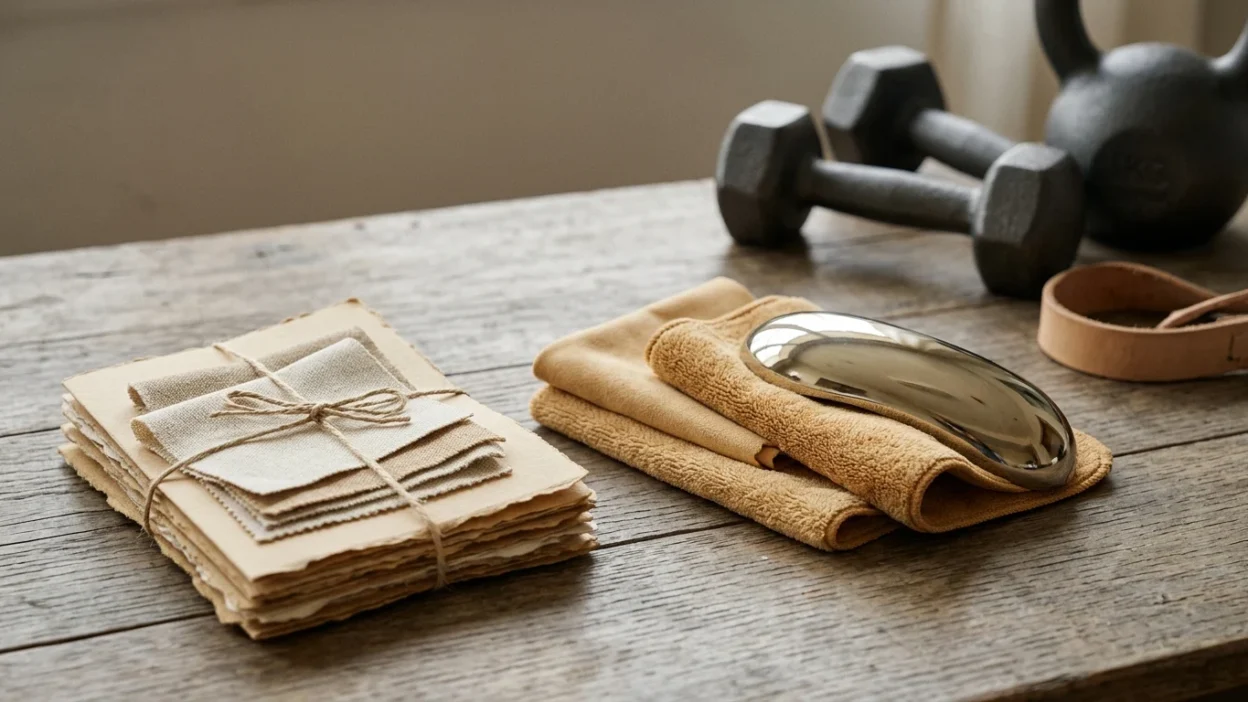
The word buff has several meanings in English, making it an interesting word to explore when improving your vocabulary. Depending on the context, it can describe someone who is physically strong, a person who knows a great deal about a particular subject, a pale yellowish-brown colour, or the act of polishing a surface until it becomes smooth and shiny.
Whether you are writing an article, improving your vocabulary, preparing an assignment or simply looking for a more precise expression, understanding these alternatives will help you communicate clearly and naturally.
Synonyms of Buff
The best synonym for buff depends on its grammatical role and intended meaning. When it describes a person with a strong interest in a subject, words such as enthusiast, aficionado and fan are suitable.
When it describes a physically strong person, muscular, well-built and strong may fit. When it refers to a colour, beige, tan and sandy are useful alternatives. As a verb, polish and burnish can express the action of making a surface shine.
The table below groups the alternatives by meaning to help you choose the right word for each situation.
Buff meaning a person who is enthusiastic or knowledgeable
| Synonym | Pronunciation (IPA) | Part of Speech | Meaning | Example Sentence |
| Enthusiast | /ɪnˈθjuːziæst/ | Noun | Someone who has a strong interest in an activity or subject | She is a photography enthusiast who enjoys taking landscape pictures. |
| Aficionado | /əˌfɪʃiəˈnɑːdəʊ/ | Noun | A person who has considerable knowledge of or enthusiasm for a particular subject | He is a jazz aficionado who attends live concerts regularly. |
| Fan | /fæn/ | Noun | Someone who likes or supports a person, activity or subject | My brother is a fan of classic detective novels. |
| Expert | /ˈekspɜːt/ | Noun | Someone with extensive knowledge or skill in a particular area | The museum invited an expert in medieval history to give a talk. |
| Connoisseur | /ˌkɒnəˈsɜː/ | Noun | Someone with refined knowledge and judgement in a particular field | As a coffee connoisseur, she could identify subtle differences between blends. |
| Devotee | /ˌdevəˈtiː/ | Noun | A person who is deeply committed to or enthusiastic about something | He is a devotee of traditional British cinema. |
Buff meaning physically strong or muscular
| Synonym | Pronunciation (IPA) | Part of Speech | Meaning | Example Sentence |
| Muscular | /ˈmʌskjələ/ | Adjective | Having well-developed muscles | The muscular athlete trained for the competition every morning. |
| Well-built | /ˌwel ˈbɪlt/ | Adjective | Having a strong, solid or muscular physique | The well-built swimmer trained several times a week. |
| Strong | /strɒŋ/ | Adjective | Having considerable physical power | She is strong enough to lift the heavy equipment safely. |
| Athletic | /æθˈletɪk/ | Adjective | Having a fit, active physique associated with sport | His athletic build helped him perform well on the court. |
| Fit | /fɪt/ | Adjective | In good physical condition and able to exercise effectively | Regular cycling has helped him stay fit and energetic. |
Buff meaning a pale yellowish-brown colour
| Synonym | Pronunciation (IPA) | Part of Speech | Meaning | Example Sentence |
| Beige | /beɪʒ/ | Noun or adjective | A pale, neutral brownish colour | She chose beige curtains for the living room. |
| Tan | /tæn/ | Noun or adjective | A light brown colour resembling tanned skin or leather | The shop displayed a tan leather handbag. |
| Sandy | /ˈsændi/ | Adjective | Having a pale yellowish-brown colour like sand | The artist painted the beach in soft sandy shades. |
| Fawn | /fɔːn/ | Noun or adjective | A pale brown colour with a warm, slightly yellow tone | The fawn-coloured coat matched her brown boots. |
| Khaki | /ˈkɑːki/ | Noun or adjective | A dull, earthy colour ranging from yellowish-brown to greenish-brown | He wore khaki trousers for the countryside walk. |
Buff meaning to polish or make a surface shine
| Synonym | Pronunciation (IPA) | Part of Speech | Meaning | Example Sentence |
| Polish | /ˈpɒlɪʃ/ | Verb | To rub or treat a surface to make it smooth or shiny | She used a soft cloth to polish the wooden table. |
| Shine | /ʃaɪn/ | Verb | To make something bright or glossy | He shined his shoes before the interview. |
| Burnish | /ˈbɜːnɪʃ/ | Verb | To polish a surface by rubbing it, often to produce a smooth finish | The craftsperson burnished the metal until it gleamed. |
| Gloss | /ɡlɒs/ | Verb | To make a surface smooth and shiny | The carpenter glossed the finished wooden panels. |
| Smooth | /smuːð/ | Verb | To make a surface even by removing roughness | She smoothed the rough surface before applying the finish. |
The verb alternatives also differ slightly. Polish is a general term for improving a surface’s appearance, while burnish often suggests a more specific polishing technique. Choosing the most accurate word makes your writing more informative.
What Does Buff Mean?
The word buff has several established meanings in modern English. Its interpretation depends on the surrounding words and the situation in which it appears.
1. A person who is enthusiastic about a subject
In informal English, a buff is someone who has a strong interest in a particular subject and often knows a great deal about it.
For example:
- She is a film buff who watches classic films at the weekend.
- My uncle is a railway buff who collects old photographs of trains.
- He is a history buff with a particular interest in ancient Rome.
In these examples, buff does not necessarily mean that the person is a professional or qualified expert. It mainly highlights enthusiasm, interest and, often, considerable knowledge.
This meaning commonly appears in combinations such as history buff, film buff, car buff, computer buff and sports buff.
2. A person who is muscular
In informal speech, buff can describe someone who has a muscular, well-developed physique.
For example:
- He became noticeably more buff after months of strength training.
- The actor looked buff in the action film.
- She wanted to become stronger and more athletic through regular exercise.
In this context, the word is casual and often associated with fitness, bodybuilding and physical appearance.
However, buff does not always mean the same thing as fit. A person may have prominent muscles without necessarily having excellent cardiovascular fitness, flexibility or endurance. Likewise, someone can be very fit without having a heavily muscular physique.
3. A pale yellowish-brown colour
Buff is also the name of a light, earthy colour that resembles the colour of certain types of leather, paper or natural materials.
For example:
- The envelope was made from buff-coloured paper.
- The historic building had a warm buff stone exterior.
- She selected buff fabric for the upholstery.
In design, clothing and interior decoration, the word can describe a neutral shade that sits between beige, cream and light brown. The exact colour varies according to the material and context.
Words such as beige, tan, fawn and sandy may be useful alternatives, although each can suggest a slightly different shade.
4. To polish or shine a surface
As a verb, to buff means to rub a surface, often with a cloth, pad or polishing tool, to improve its smoothness or shine.
For example:
- He buffed the car after washing it.
- She buffed the leather shoes with a soft brush.
- The technician buffed the surface to remove minor marks.
In this sense, buff is closely related to polish. It is frequently used in car care, shoe care, furniture restoration and other activities involving the treatment of surfaces.
5. A further meaning in specialist contexts
In some contexts, particularly gaming, buff is used to describe an improvement to a character, ability or item. A game developer might buff a character by increasing its strength or making one of its abilities more effective.
For example:
- The latest update buffed the character’s defensive ability.
- Players asked the developers to buff an underpowered weapon.
In this context, possible alternatives include strengthen, improve, enhance and boost. These words are not always exact replacements because buff has a specific meaning in gaming communities.
Understanding these different uses is essential when searching for synonyms. The word that works for a film buff may be entirely unsuitable when describing a colour or polishing a surface.
Most Common Synonyms of Buff
Some synonyms of buff are more widely useful than others. The following alternatives are especially common and easy to apply in everyday communication.
1. Enthusiast
Enthusiast is one of the best alternatives when buff refers to someone who is passionate about a subject.
For example, a person who enjoys studying historical events in their spare time can be called a history enthusiast.
The word is suitable for both informal and formal writing. It is slightly more neutral than buff and can describe a wide range of interests, from gardening to astronomy.
Best used when: You want to emphasise strong interest or enjoyment.
2. Aficionado
Aficionado describes someone with considerable enthusiasm or knowledge about a particular activity or subject.
For example, “She is a classical music aficionado” suggests that she takes a keen interest in classical music and may have a good understanding of its composers, performers and styles.
This word is more formal or sophisticated than buff. It is particularly suitable for writing about music, food, art, wine and other subjects where appreciation and knowledge are important.
Best used when: You want to convey informed enthusiasm.
3. Fan
Fan is a simple and familiar alternative. It usually describes someone who likes a person, activity, team or subject.
For example, “He is a fan of science fiction” is a natural alternative to “He is a science fiction buff”.
However, a fan does not necessarily possess extensive knowledge. Someone can enjoy a subject without studying it in depth.
Best used when: You want an accessible, everyday expression.
4. Expert
Expert is appropriate when the person has advanced knowledge, experience or skill.
For example, a history buff may read historical books for pleasure, whereas a history expert may conduct research, teach the subject or work professionally in the field.
The distinction matters because enthusiasm does not automatically establish expertise.
Best used when: The person’s knowledge or professional ability is the main point.
5. Muscular
When buff describes someone’s physique, muscular is a direct and widely understood alternative.
For example, “The muscular athlete lifted the weight with control” focuses on developed muscles.
Unlike buff, muscular is suitable for neutral descriptive writing, including sports reports, character descriptions and fitness articles.
Best used when: You want to describe visible muscle development.
Difference Between Buff and Its Synonyms
The word buff has several meanings, so no single synonym works in every situation. Understanding the differences will help you avoid awkward substitutions and make your writing more precise.
Buff vs enthusiast
Both buff and enthusiast can describe someone who takes a keen interest in a subject.
The main difference is tone. Buff is more informal and is commonly used in familiar combinations such as film buff or history buff. Enthusiast is more neutral and works well in professional and educational writing.
Compare:
- “He is a film buff.” This sounds natural and conversational.
- “He is a film enthusiast.” This is slightly more neutral and may suit a formal profile.
Both expressions are correct, but the second may fit better in a professional biography.
Buff vs aficionado
An aficionado is generally associated with informed enthusiasm and appreciation. A buff may simply be someone who is keenly interested in a topic.
For example, a car buff might enjoy reading about classic vehicles, while a classic-car aficionado might also have detailed knowledge of their design, history and engineering.
The distinction is not absolute, but aficionado often conveys a more specialised interest.
Buff vs expert
An expert has recognised knowledge or skill, whereas a buff is usually defined by enthusiasm.
Someone may be a railway buff because they collect train photographs and enjoy visiting railway museums. A railway expert might work in railway engineering, history or transport planning.
Do not use expert merely because someone enjoys a subject. The word makes a stronger claim about competence.
Buff vs muscular
When describing a person, buff is informal and commonly suggests a visibly muscular physique.
Muscular is more neutral and descriptive. It can be used in formal writing without the casual tone associated with buff.
For example:
- “He looks buff after months at the gym.”
- “The muscular athlete prepared for the competition.”
The first sentence sounds conversational, while the second is suitable for sports or fitness writing.
Buff vs fit
Fit refers to physical condition, which can include stamina, strength, mobility and endurance. Buff usually highlights a muscular appearance.
A long-distance runner may be extremely fit without having a heavily muscular physique. A bodybuilder may look buff but still need to train specifically for endurance.
Choose fit when overall physical condition matters and muscular when muscle development is the focus.
Buff vs strong
Strong means having physical power, emotional resilience or another form of strength.
A person can be strong without looking muscular. Likewise, someone who looks muscular may not be exceptionally strong in every activity.
For example, “She is strong enough to carry the equipment” focuses on ability, whereas “She has a muscular build” describes appearance.
Buff vs beige
Both buff and beige can describe light, neutral colours. However, buff often has a warm yellowish-brown quality, while beige can be more neutral, greyish or cream-like.
Colour names are not perfectly standardised across fabrics, paints and digital displays. If an exact shade matters, a colour sample or reference image is more reliable than the name alone.
Buff vs tan
Tan generally suggests a brown shade associated with leather or tanned skin. Buff is often paler and more yellowish.
The terms can overlap, especially in fashion and interior design. The best choice depends on the particular shade and the convention used by the manufacturer or designer.
Buff vs polish
Both words can describe making a surface shiny, but polish is the broader term.
You might polish furniture, shoes, jewellery or metal. Buff often suggests rubbing the surface with a cloth, polishing pad or machine to improve its finish.
For example, you may apply polish to a shoe and then buff it with a cloth.
Buff vs burnish
Burnish is more specialised than buff. It commonly refers to creating a smooth or glossy finish through rubbing or pressure.
In ordinary conversation, polish will usually be clearer. In technical writing about crafts, metalwork or finishing processes, burnish may be more precise.
Buff in gaming vs strengthen
In gaming, to buff a character or ability means to improve its effectiveness, often by adjusting its statistics or performance.
Strengthen and enhance can communicate a similar general idea, but they may not carry the same specific gaming meaning.
For example, “The update buffed the character’s defence” is natural gaming language. “The update strengthened the character’s defence” is more accessible to a general audience.
Common Mistakes When Using Buff
Because buff has several meanings, it is easy to choose a synonym that changes the intended message. The following mistakes are worth avoiding.
1. Assuming buff always means muscular
Although buff commonly describes a muscular person, it can also refer to an enthusiast, a colour or a polishing action.
For example, “She is a history buff” means that she is keenly interested in history, not that she has a muscular physique.
How to avoid it: Look at the words surrounding buff. A phrase such as car buff usually refers to an enthusiast, while buff-coloured paper refers to a colour.
2. Confusing enthusiasm with expertise
A person who is passionate about a subject is not necessarily a qualified professional.
Calling someone an expert can imply a level of knowledge or competence that the word buff does not require.
How to avoid it: Use enthusiast or aficionado when describing strong personal interest. Reserve expert for someone whose knowledge or skill justifies that description.
3. Treating buff, beige and tan as identical colours
These colour names overlap, but they do not always describe the same shade.
Buff generally suggests a pale yellowish-brown, beige is a broader neutral colour and tan often implies a warmer or deeper brown.
How to avoid it: Choose the closest colour term based on the actual appearance. For design work, check a sample rather than relying entirely on the label.
4. Using muscular and fit as exact equivalents
Muscular describes developed muscles, while fit describes good physical condition.
Someone who has strong cardiovascular endurance may be fit without being visibly muscular. Similarly, a muscular appearance alone does not prove that someone has excellent endurance.
How to avoid it: Decide whether you are describing physique, strength, stamina or general fitness.
5. Choosing an overly technical word
Words such as burnish may be accurate in specialist settings but unnecessary in everyday conversation.
For instance, “Polish the table” is usually clearer than “Burnish the table” if the reader does not need to understand a particular finishing technique.
How to avoid it: Consider your audience. Use technical vocabulary when precision matters, but choose familiar language when it communicates the same idea.
Tips for Using Buff Correctly
Understanding synonyms is not just about memorising alternative words. It is about choosing expressions that convey the intended meaning clearly.
1. Identify which meaning applies
Start by deciding how buff is being used.
If it describes an enthusiastic person, consider enthusiast, fan or aficionado. If it describes a physique, consider muscular, well-built or fit. If it refers to a colour, look at beige, tan or fawn. If it describes polishing, consider polish, shine or burnish.
This is the most important step because the meanings are quite different.
2. Think about formality
Some alternatives work better in casual conversation, while others suit formal writing.
Fan and buff are informal and familiar. Enthusiast is suitable in a wide range of contexts, while aficionado often sounds more sophisticated. Expert is appropriate when knowledge or professional skill is genuinely relevant.
For surface finishing, polish is accessible to most readers, while burnish may be more suitable for a technical explanation.
3. Choose the most precise word
Avoid selecting a synonym simply because it sounds impressive.
If you want to say that a person has well-developed muscles, muscular is more precise than powerful. If you want to describe general physical condition, fit may be better. If you want to highlight someone’s knowledge of a subject, enthusiast or expert may work, depending on their actual level of expertise.
Precision makes writing easier to understand.
4. Learn common word combinations
Many words appear naturally alongside particular nouns. Learning these combinations can improve your fluency.
Useful examples include:
- History buff
- Film buff
- Car enthusiast
- Music aficionado
- Muscular build
- Athletic physique
- Beige fabric
- Tan leather
- Polish a surface
- Buff a car
- Burnish metal
Remembering these phrases can help you select vocabulary naturally instead of translating individual words mechanically.
5. Use context to distinguish meanings
A sentence often makes the intended meaning clear.
Consider the phrase “a buff finish”. This may refer to a colour or to a surface that has been treated, depending on the surrounding description. Similarly, “a computer buff” clearly refers to someone interested in computers.
If the meaning could be misunderstood, rewrite the sentence to make it clearer. For example, use “buff-coloured fabric” rather than simply “buff fabric” if colour is the main point.
Summary
The word buff has several meanings, so the best synonym depends on the context.
When it describes someone with a strong interest in a subject, enthusiast, aficionado, fan and devotee are useful alternatives. When it refers to a muscular physique, muscular, well-built, strong and fit may be appropriate.
For the colour meaning, beige, tan, sandy, fawn and khaki offer related shades. When buff is used as a verb meaning to polish a surface, polish, shine and burnish are valuable alternatives.
The main lesson is to identify the intended meaning before choosing a replacement. Consider the sentence, audience and level of formality, then select the word that communicates your message most accurately. With practice, you can use these synonyms to make your English clearer, more varied and more precise.
FAQs
1. What are the best synonyms of buff?
The best synonyms depend on the meaning. For a person who loves a subject, use enthusiast, aficionado or fan. For a muscular person, use muscular or well-built. For the colour, consider beige or tan. For polishing, use polish or burnish.
2. What does buff mean when describing a person?
When describing a person’s interests, buff means someone who is very enthusiastic about a subject, such as a film buff or history buff. In informal descriptions of appearance, buff can also mean muscular or physically well-built.
3. Is enthusiast a synonym for buff?
Yes. Enthusiast is a suitable synonym when buff refers to someone who has a strong interest in a subject or activity. It is generally more neutral and can be used in both formal and informal writing.
4. What is another word for a fitness buff?
Depending on the intended meaning, alternatives include fitness enthusiast, gym enthusiast, fitness fan and exercise enthusiast. If you mean someone with developed muscles, muscular or well-built may be more accurate.
5. What colour is buff?
Buff is a pale yellowish-brown colour often associated with natural leather, paper or stone. Related colour names include beige, tan, fawn and sandy, although their precise shades differ.