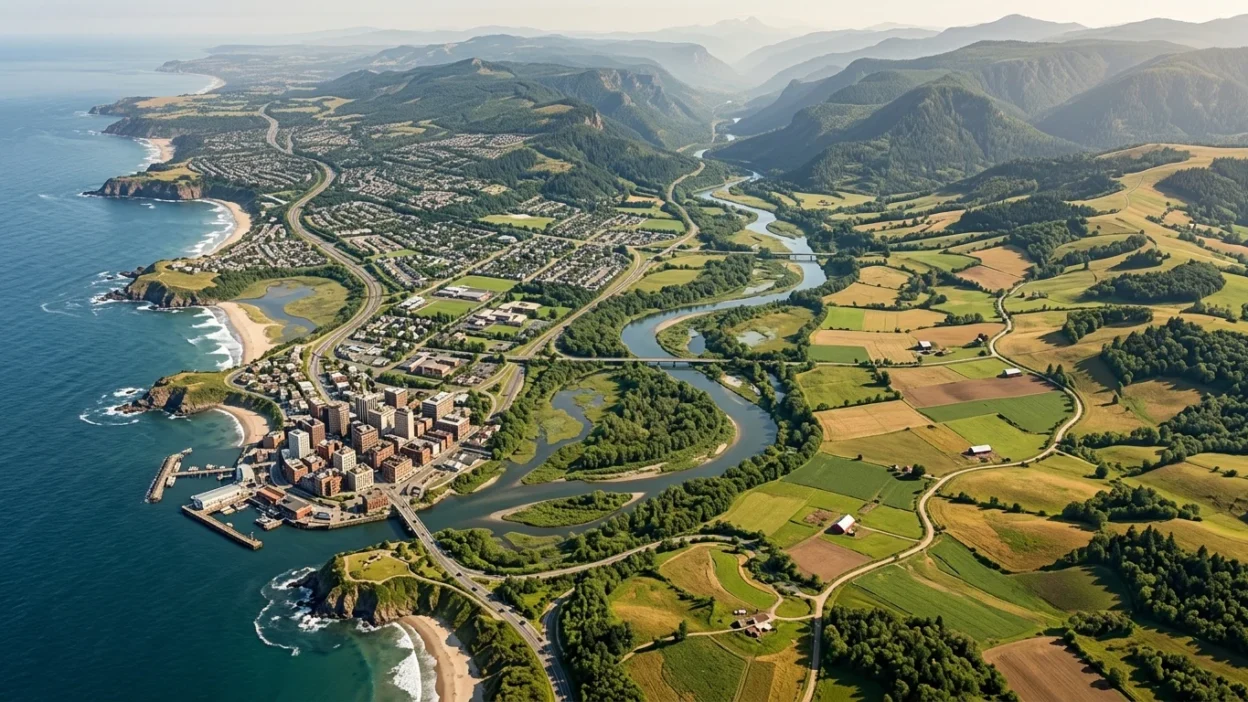
The word region is commonly used to describe a particular area of land, part of a country, or section of the world. It can also refer to a specific part of the body, a geographical zone, an area with shared characteristics, or a particular field of activity.
Because the word has several meanings, choosing the right synonym depends on the context.
For example, area is a general alternative that works in many situations, while territory often refers to land under a particular authority. District usually describes an officially recognised part of a town, city, or country. Meanwhile, zone often refers to an area defined by a particular purpose, condition, or feature.
Synonyms of Region
The noun region has several related meanings. It can refer to a geographical location, an administrative division, an area with particular characteristics, or a specific part of something.
The following alternatives are grouped according to their most common uses. Some are close synonyms, while others are suitable only in particular contexts.
Synonyms Related to Geographical Areas
| Synonym | Pronunciation (IPA) | Part of Speech | Meaning | Example Sentence |
| Area | /ˈeəriə/ | Noun | A particular part of a place or surface | The area around the lake attracts many visitors. |
| Zone | /zəʊn/ | Noun | An area distinguished by specific features, conditions, or rules | This zone receives heavy rainfall during the monsoon season. |
| District | /ˈdɪstrɪkt/ | Noun | An area defined for administrative, political, or organisational purposes | She works in the commercial district of the city. |
| Territory | /ˈterɪtəri/ | Noun | An area of land associated with a country, authority, or group | The explorers travelled through unfamiliar territory. |
| Locality | /ləʊˈkæləti/ | Noun | A particular place or neighbourhood | The locality is known for its historic buildings. |
| Province | /ˈprɒvɪns/ | Noun | A major administrative division of a country | The province has several important agricultural centres. |
| Sector | /ˈsektə/ | Noun | A distinct part of an area, organisation, or system | The northern sector of the city is expanding rapidly. |
| Tract | /trækt/ | Noun | An extended area of land or a defined stretch of a larger area | A large tract of forest surrounds the village. |
Synonyms Related to Natural and Cultural Regions
| Synonym | Pronunciation (IPA) | Part of Speech | Meaning | Example Sentence |
| District | /ˈdɪstrɪkt/ | Noun | An area recognised by its location, activities, or identity | The district is famous for its traditional markets. |
| Zone | /zəʊn/ | Noun | A geographical area with a particular climate, purpose, or characteristic | Many rare plants grow in this climatic zone. |
| Belt | /belt/ | Noun | An area characterised by a particular natural feature or activity | The region forms part of the country’s agricultural belt. |
| Basin | /ˈbeɪsən/ | Noun | An area of land drained by a river system or surrounded by higher ground | The river basin supports several farming communities. |
| Highland | /ˈhaɪlənd/ | Noun | An area of land at a relatively high elevation | The highlands are known for their cool climate. |
| Lowland | /ˈləʊlənd/ | Noun | An area of relatively low-lying land | The lowlands are suitable for growing several crops. |
| Frontier | /ˈfrʌntɪə/ | Noun | A border or a region near the edge of settled or controlled territory | The frontier region has a long history of trade. |
Synonyms Related to Parts of a Body or Other Things
| Synonym | Pronunciation (IPA) | Part of Speech | Meaning | Example Sentence |
| Part | /pɑːt/ | Noun | A section or component of something larger | The affected part of the skin became red. |
| Section | /ˈsekʃən/ | Noun | A distinct portion of a larger whole | The surgeon examined a particular section of the tissue. |
| Area | /ˈeəriə/ | Noun | A specific part of a surface, body, or subject | The patient reported discomfort in the lower abdominal area. |
| Locality | /ləʊˈkæləti/ | Noun | A specific location or place | The researchers recorded the locality where each species was found. |
| Domain | /dəˈmeɪn/ | Noun | A field, sphere, or area of activity or knowledge | Environmental protection is an important domain of public policy. |
Note: Some words in these groups overlap because they have several meanings. Area, zone, district, and locality are particularly flexible, but they are not interchangeable in every sentence. Choose the alternative that matches the intended meaning of region.
What Does Synonyms of Region Mean?
The phrase synonyms of region refers to words that have a meaning similar to region and can sometimes be used in its place. The most suitable alternative depends on whether the word refers to a geographical location, an administrative division, a natural environment, or a part of something.
A region is generally a defined or identifiable area within a larger geographical space, physical structure, or field of activity.
For example:
- The coastal region attracts tourists.
- The northern region experiences colder winters.
- The doctor examined the affected region of the body.
- The company plans to expand into a new business region.
Although the word appears in all four sentences, its precise meaning changes slightly.
Region as a Geographical Area
In geography, a region is an area identified by physical features, climate, culture, population, or other characteristics.
For example:
The mountainous region receives heavy snowfall during winter.
You could also write:
The mountainous area receives heavy snowfall during winter.
Here, area is a natural alternative because both words refer to a particular part of the landscape.
However, highland might be more appropriate if the main point is that the land is elevated.
Region as an Administrative Division
A region can also refer to a recognised division used for government, planning, or administration.
For example:
The government introduced new transport policies across the region.
Depending on the country’s administrative system, alternatives might include district, province, or territory.
These terms have more specific meanings, so it is important to understand how the area is officially organised before replacing one with another.
Region as a Part of the Body
In medicine and anatomy, region refers to a particular area of the body.
For example:
The patient reported pain in the upper abdominal region.
In a less formal context, area or part may be used:
The patient reported pain in the upper abdominal area.
However, medical writing often uses region because it can identify a defined anatomical location.
Region as a Field of Activity
The word can also describe an abstract area of work, knowledge, or experience.
For example:
This question belongs to the region of scientific research.
In modern English, field, domain, or sphere would usually sound more natural in this context.
For instance:
This question belongs to the field of scientific research.
Understanding the context is therefore essential when choosing synonyms.
Most Common Synonyms of Region
Several alternatives are particularly useful in everyday English. The following explanations show when to use them and how their meanings differ from region.
1. Area
Area is one of the most common and flexible alternatives to region. It can describe a physical location, a part of a surface, a neighbourhood, or a subject of activity.
Example:
The area surrounding the railway station is busy throughout the day.
Use area when you want a general term that does not require a precise administrative or geographical classification.
2. Zone
A zone is an area defined by particular conditions, rules, purposes, or characteristics.
Example:
The city has introduced a low-emission zone to reduce air pollution.
The word is especially useful when the area has a clearly identified function or feature.
Common expressions include climate zone, industrial zone, time zone, and safety zone.
3. District
A district is an area often recognised for administrative, commercial, residential, or local purposes.
Example:
The historic district contains several buildings from the nineteenth century.
It is especially appropriate when discussing towns, cities, local government, or officially recognised divisions.
4. Territory
Territory refers to an area of land associated with a particular country, authority, group, or animal.
Example:
The expedition crossed a remote territory that had rarely been visited by outsiders.
Unlike area, the word can suggest ownership, jurisdiction, control, or boundaries.
It is also used in expressions such as animal territory and territorial waters.
5. Locality
A locality is a particular place or neighbourhood, often considered in relation to its immediate surroundings.
Example:
The locality has become popular because of its parks and public transport.
The word is common in formal, geographical, and research contexts.
It is useful when referring to a specific place without describing its formal administrative status.
6. Province
A province is a major administrative division in certain countries.
Example:
The province has introduced new regulations for agricultural development.
This is not a universal substitute for region. A province usually has an established administrative meaning, whereas a region may be informal or based on geographical characteristics.
7. Sector
A sector refers to a distinct part of an area, organisation, economy, or system.
Example:
The eastern sector of the city has experienced rapid development.
It is also commonly used in business and economics, as in the private sector and the agricultural sector.
Use it when the focus is on a defined division or component.
8. Tract
A tract is an extended area of land or a distinct stretch of something.
Example:
The reserve protects a large tract of woodland.
The word is more formal than area and is particularly useful in descriptions of land, forests, or property.
9. Belt
A belt is an area characterised by a particular natural feature, climate, crop, industry, or activity.
Example:
The town lies within a major wheat-growing belt.
It often appears in geographical descriptions, such as green belt, industrial belt, and cotton belt.
10. Basin
A basin is an area of land that is drained by a river system or lies within a natural depression.
Example:
The river basin provides water for farms and nearby settlements.
This term is useful in physical geography, hydrology, and environmental studies. It should not replace region unless the geographical characteristics fit.
Difference Between Synonyms of Region and Its Synonyms
Although several words can replace region, their meanings are not identical. Choosing carefully helps prevent ambiguity and makes writing more accurate.
Region vs Area
Both words can describe a part of a larger geographical space.
However, area is more general and can refer to almost any part of a place, surface, or subject.
Region often suggests a larger or more recognisable geographical area with shared characteristics.
Compare:
- The area around the school is quiet.
- The northern region is known for its mountains.
The first sentence describes the immediate surroundings of a school. The second refers to a broader geographical division.
Region vs Zone
A zone is often defined by a particular feature, purpose, or rule.
For example, a flood zone is an area identified by flood risk, while a climatic region is an area with shared climatic characteristics.
The terms overlap, but zone often highlights a classification or function.
Region vs District
A district is often an official administrative or local division.
A region may be official, but it can also be defined informally by culture, geography, climate, or economic activity.
For example, a commercial district is usually associated with business activity, whereas a coastal region is identified by its relationship with the sea.
Region vs Territory
Territory often emphasises land, boundaries, control, or jurisdiction.
Region usually focuses on an area and its characteristics rather than who controls it.
For example:
The region is known for its diverse wildlife.
The territory is protected by national law.
The first highlights geographical characteristics. The second may suggest legal authority or control.
Region vs Province
A province is generally a specific type of administrative division.
A region is a broader term that may refer to administrative areas, natural landscapes, cultural groupings, or informal geographical areas.
Not every region is a province, and not every country uses provinces as its principal administrative divisions.
Region vs Locality
A locality usually refers to a particular place or neighbourhood.
A region may cover a much larger area.
For example, a village might be a locality within a mountainous region.
Region vs Sector
A sector refers to a distinct part of a larger system or area.
It can describe a geographical division, but it is also common in economics, business, and organisational structures.
For example, the northern sector of a city is geographical, whereas the health sector refers to a field of economic or public activity.
Region vs Basin
A basin has a specific physical-geographical meaning. It may be a depression in the land or an area drained by a river system.
A region does not necessarily have either feature.
Therefore, basin should be used only when the relevant landform or drainage system is being described.
Region vs Domain
Domain usually refers to an abstract field of activity, knowledge, or influence.
For example, the domain of biology means the field of biology, not a physical geographical region.
If the original sentence describes a subject or area of expertise, field or domain may be more natural than region.
Common Mistakes When Using Synonyms of Region
1. Assuming Every Synonym Is Interchangeable
The most common mistake is treating all related words as exact replacements.
For example, province, district, zone, and basin have specific meanings. They cannot replace region in every sentence.
Always check whether the alternative accurately describes the place or concept.
2. Confusing an Administrative Region with a Natural Region
An administrative region is defined for government, planning, or organisational purposes.
A natural region is identified by physical characteristics such as climate, landforms, or vegetation.
For example, a province may contain several different natural regions.
Do not assume that political boundaries always match geographical boundaries.
3. Using “Territory” When Ownership Is Irrelevant
Territory can suggest control, jurisdiction, or ownership.
If you are simply describing a landscape, area or region may be more appropriate.
4. Using “Zone” Without a Defining Feature
A zone is usually identified by a characteristic, purpose, condition, or set of rules.
For example, industrial zone and temperature zone are clear expressions.
If no particular classification is intended, area may sound more natural.
5. Confusing “District” with “Province”
A district and a province are not necessarily the same administrative level.
Their legal meanings vary between countries, so it is important to understand the relevant administrative system.
6. Using “Basin” as a General Geographical Synonym
A basin refers to a particular type of landform or drainage area.
It should not be used as a general substitute for every region.
7. Ignoring the Figurative Meaning of Region
The word can sometimes refer to an abstract area of thought or activity, but alternatives such as field, domain, or sphere are often more natural.
For example:
This issue belongs to the field of economics.
This is usually more idiomatic than saying that it belongs to a region of economics.
8. Choosing a Complicated Word When a Simple One Works
Using locality, tract, or territory does not automatically make a sentence more professional.
If area communicates your meaning clearly, there may be no reason to choose a more specialised word.
Tips for Using Synonyms of Region Correctly
1. Identify the Type of Region
Before selecting a synonym, determine what the word refers to.
Is it a geographical landscape, an administrative division, a neighbourhood, a part of the body, or an abstract field of activity?
This simple step helps narrow your choices.
2. Use “Area” for General Descriptions
When you do not need to specify the area’s formal status or defining features, area is usually a safe and natural choice.
Example:
The area around the river is popular with walkers.
3. Use “Zone” for Specific Conditions or Purposes
Choose zone when the area is defined by a feature, rule, or function.
Examples include industrial zone, restricted zone, climate zone, and safety zone.
4. Use “District” for Local or Administrative Divisions
When discussing local government, business centres, or recognised urban divisions, district may be more precise than region.
Example:
The district has several schools and public parks.
5. Use “Territory” When Boundaries or Control Matter
If ownership, jurisdiction, or control is central to the sentence, territory may be suitable.
Example:
The protected territory is managed by the national authorities.
6. Use Physical Geography Terms Accurately
Words such as basin, highland, lowland, and belt refer to particular geographical features or patterns.
Use them when those features are relevant, not merely to avoid repeating region.
7. Use “Field” or “Domain” for Abstract Subjects
When discussing a subject area, discipline, or sphere of expertise, field and domain are often more natural than region.
Example:
Artificial intelligence is a rapidly developing field.
8. Consider the Audience
For general readers, simple alternatives such as area and part are usually easy to understand.
For academic or technical writing, terms such as district, basin, territory, and locality may provide greater precision when used correctly.
9. Avoid Repetition Naturally
If you have used region several times in a paragraph, you can vary your language where appropriate.
For example:
The coastal region attracts thousands of visitors. This area is known for its beaches, while the nearby district contains several historic towns.
Here, area and district reduce repetition while preserving the intended meanings.
10. Prioritise Accuracy Over Variety
A synonym should make the sentence clearer, not merely different.
If region is the most accurate word, keep it. Use an alternative only when it fits the context and expresses the intended meaning.
Summary
The word region refers to a particular area within a larger geographical space, a defined part of the body, or an area of activity or knowledge. Its meaning depends on the context, which is why several alternatives can sometimes be used.
However, these alternatives are not all exact synonyms. Area is general-purpose, zone often refers to a defined function or condition, district commonly describes an administrative or local division, and territory may emphasise boundaries or control.
For physical geography, terms such as basin, highland, lowland, and belt are useful when their specific meanings apply. For abstract subjects, field or domain may be more natural than region.
FAQs
1. What is the most common synonym of region?
Area is one of the most common synonyms of region. It is a flexible word that can describe a geographical location, part of a surface, or section of a larger place.
2. What are five synonyms of region?
Five common alternatives are area, zone, district, territory, and locality. Each has a slightly different meaning, so the best choice depends on the context.
3. Is area the same as region?
Not exactly. Both words can refer to a geographical space, but area is more general. Region often refers to a larger or more identifiable geographical division with shared characteristics.
4. What is another word for a geographical region?
Depending on the context, you can use area, zone, district, territory, locality, or province. For natural landscapes, words such as basin, highland, and lowland may be appropriate.
5. What is the difference between a region and a territory?
A region is an identifiable area of land or a part of something larger. A territory often emphasises land associated with a particular authority, group, country, or boundary.