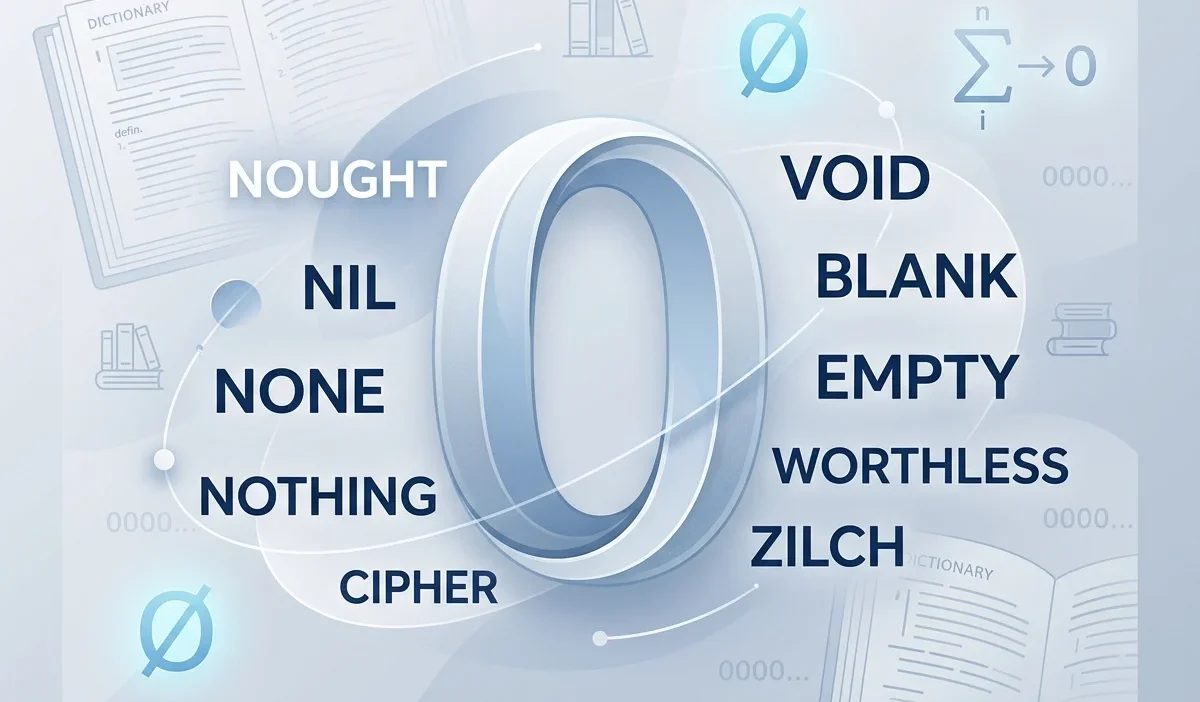
The English language is rich in vocabulary, offering multiple words that express similar ideas while carrying subtle differences in meaning and usage. One such word is zero, a simple yet remarkably versatile term that appears in mathematics, science, technology, finance, education, sports, business, and everyday communication.
Although most people immediately associate zero with the numeral 0, its meaning extends far beyond numbers. It can represent the complete absence of something, a starting point, a lack of value, or even an indication that something does not exist at all.
Because zero is used so frequently, relying on it repeatedly in speech or writing can make your language sound repetitive. Learning the synonyms of zero allows you to express the same idea more naturally while selecting the most appropriate word for a particular context.
For example, a football commentator is far more likely to use nil than zero, while a mathematician may choose nought in British English. Likewise, a lawyer might describe an agreement as void, whereas someone speaking casually may simply say they earned zilch.
Understanding these distinctions is particularly important for students, writers, teachers, bloggers, professionals, and English learners. Using the correct synonym improves clarity, strengthens vocabulary, and helps readers understand exactly what you mean.
The word zero has a fascinating history. It originated from the Arabic word ṣifr, meaning “empty” or “nothing.” This word travelled into medieval Latin before becoming the Italian zefiro, which eventually evolved into the English word zero.
The development of zero as both a mathematical concept and a linguistic term revolutionised science, engineering, accounting, and computing. Without the idea of zero, modern mathematics and digital technology would not exist in the forms we know today.
Synonyms of Zero
Although many people think of zero simply as the number 0, the word has several different meanings. Consequently, its synonyms can be grouped into categories based on their usage. Some replace the number itself, others express the absence of something, while a few indicate that something has little or no value.
The following table includes some of the most commonly used synonyms of zero in British English.
| Synonym | Pronunciation (IPA) | Part of Speech | Meaning | Example Sentence |
| Nought | /nɔːt/ | Noun | The number zero, especially in British English | The match ended three-nought. |
| Nil | /nɪl/ | Noun | Zero used in sports scores | England won two-nil. |
| Nothing | /ˈnʌθɪŋ/ | Pronoun/Noun | Complete absence of anything | There was nothing left to say. |
| None | /nʌn/ | Pronoun | Not any amount or quantity | None of the students failed the test. |
| Cipher | /ˈsaɪfə/ | Noun | The numeral zero; also used historically | The final digit is a cipher. |
| O (Oh) | /əʊ/ | Noun | Spoken form of zero | Dial zero for assistance. |
| Goose Egg | /ɡuːs ɛɡ/ | Noun | Informal expression for a score of zero | The away team finished with a goose egg. |
| Love | /lʌv/ | Noun | Zero in tennis scoring | The first game started at love-all. |
| Void | /vɔɪd/ | Noun | Complete emptiness or absence | His departure left a void in the team. |
| Blank | /blæŋk/ | Noun/Adjective | Empty or containing no information | Leave the final answer blank. |
| Empty | /ˈempti/ | Adjective | Containing nothing | The bottle was completely empty. |
| Nothingness | /ˈnʌθɪŋnəs/ | Noun | A state of complete absence | The abandoned building seemed filled with nothingness. |
| Nullity | /ˈnʌlɪti/ | Noun | Something legally invalid or without effect | The agreement became a nullity. |
| Worthless | /ˈwɜːθləs/ | Adjective | Having no value | The damaged vouchers became worthless. |
| Nil Value | /nɪl ˈvæljuː/ | Noun Phrase | Having no financial value | The broken machinery had nil value. |
| Non-existent | /ˌnɒn ɪɡˈzɪstənt/ | Adjective | Not existing at all | Customer demand was virtually non-existent. |
| Absent | /ˈæbsənt/ | Adjective | Not present | Evidence was absent from the report. |
| Zilch | /zɪltʃ/ | Noun | Informal word meaning absolutely nothing | I earned zilch during the holidays. |
Why Are There So Many Synonyms?
English has developed over centuries by borrowing vocabulary from Latin, French, Germanic languages, Arabic, Greek, and many others. As a result, multiple words often describe similar concepts while serving different purposes.
For instance:
- Nought is deeply rooted in British English and remains common in schools and sports commentary.
- Nil is almost exclusively associated with sporting events such as football and hockey.
- Void frequently appears in legal, philosophical, and technical writing.
- Blank usually refers to empty spaces on forms or documents.
- Nothing and none are among the most common alternatives in everyday conversation.
- Zilch is an informal expression commonly heard in casual speech.
Recognising these distinctions allows you to write naturally instead of replacing words mechanically.
Synonyms Based on Different Meanings
To understand these alternatives better, it is useful to divide them into groups according to their meanings.
1. Synonyms Referring to the Number 0
These words directly represent the numeral zero.
- Zero
- Nought
- Nil
- Cipher
- O (Oh)
- Goose Egg
- Love (in tennis)
These are generally interchangeable only in specific contexts. For example, love cannot replace zero outside tennis, and nil is rarely used outside sports.
2. Synonyms Meaning “Nothing”
These describe the absence of something.
- Nothing
- None
- Void
- Nothingness
- Empty
- Blank
- Absent
These words are useful when discussing missing objects, information, people, or evidence rather than numerical values.
3. Synonyms Meaning “No Value”
Some words suggest that something has little or no worth.
Examples include:
- Worthless
- Nil value
- Nullity
- Non-existent
Although these words may imply zero in a figurative sense, they should not replace the numeral 0.
Choosing the Right Synonym
One of the biggest mistakes English learners make is assuming every synonym can replace zero in every sentence. Consider the following examples.
Correct:
- The final score was two-nil.
- The answer is zero.
- The room was empty.
- The contract became void.
- I earned zilch this month.
Incorrect:
- The answer is void.
- The room was nil.
- The contract became nought.
These examples show that context is essential when choosing a synonym.
What Does Zero Mean?
The word zero may appear straightforward, but it has several distinct meanings depending on how it is used. Understanding these meanings is essential before learning when each synonym is appropriate.
Zero as a Number
The primary meaning of zero is the number 0, representing no quantity. It is one of the ten digits used in the decimal number system and serves as the foundation of modern mathematics.
Unlike other numbers, zero has unique mathematical properties. Adding zero to any number leaves that number unchanged, while multiplying any number by zero always produces zero. It also separates positive numbers from negative numbers on the number line.
Examples include:
- Zero plus eight equals eight.
- The thermometer showed zero degrees Celsius.
- She scored zero marks because she did not attempt the exam.
- The account balance is exactly zero.
Without zero, modern calculations, accounting systems, engineering, and computer programming would be impossible.
Zero as the Absence of Something
In everyday English, zero frequently means that something is completely absent. This usage is especially common in business, journalism, healthcare, education, and scientific writing.
Examples:
- The laboratory found zero traces of contamination.
- There were zero customer complaints this month.
- The investigation produced zero evidence of fraud.
- We received zero applications before the deadline.
In these examples, zero emphasises that none of the expected items existed.
Zero as a Starting Point
Many systems use zero as their point of origin or reference. Rather than representing “nothing,” it simply marks where measurement begins.
Examples include:
- Zero degrees on a thermometer.
- Zero kilometres at the beginning of a road.
- Zero altitude at sea level.
- Zero pressure before the machine starts.
- Zero emissions in environmentally friendly technologies.
This meaning is particularly common in engineering, geography, science, and technology.
Zero as a Symbol of Failure or Lack
People often use zero figuratively to indicate a complete lack of success, effort, interest, or importance.
Examples:
- She has zero interest in politics.
- His explanation carried zero credibility.
- The proposal received zero support.
- Their chances of winning were close to zero.
Here, zero expresses complete absence rather than a numerical quantity.
Zero in Computing
In computing, zero plays an even more significant role. Computers operate using the binary number system, where every piece of data is represented by combinations of 0 and 1. In this context, zero often represents an “off” state, while one represents an “on” state.
Because of this binary system, zero forms the foundation of modern digital communication, software development, artificial intelligence, and electronic devices.
Zero in Everyday Language
Beyond mathematics and science, people regularly use zero in everyday expressions, such as:
- Zero tolerance
- Zero balance
- Zero gravity
- Zero waste
- Zero risk (or very little risk)
- Zero visibility
These expressions demonstrate how the word has evolved into a versatile term used across countless fields.
Most Common Synonyms of Zero
Now that you understand the different meanings of zero, it is time to explore its most frequently used synonyms in greater detail. Although many of these words can convey a similar idea, each has its own history, preferred context, and level of formality. Choosing the correct synonym makes your writing clearer, more engaging, and grammatically accurate.
Below are the most common synonyms of zero, together with detailed explanations, practical examples, and guidance on when to use them.
1. Nought
Nought is one of the closest synonyms of zero in British English. It is commonly used in schools, mathematics, and sports commentary, although it is much less common in American English.
The word comes from Old English and literally means “nothing”. Today, it most often refers to the number 0.
When to Use Nought
Use nought when discussing:
- Mathematics
- Numbers
- Telephone numbers
- British sports scores
Examples
- The answer to the equation is nought.
- Chelsea won three-nought.
- Write a nought after the decimal point.
- The first digit should be nought.
Usage Tip
If your audience is primarily British, nought sounds perfectly natural. However, international readers are generally more familiar with zero.
2. Nil
Nil is another well-known synonym, but unlike nought, it has a much narrower range of use. It is almost exclusively associated with sporting events.
Football, rugby, hockey, cricket, and several other sports regularly use nil instead of zero when reporting scores.
Examples
- Liverpool won two-nil.
- The first half ended nil-nil.
- England secured a one-nil victory.
- Neither side managed to score, so the match finished nil-nil.
Usage Tip
Avoid using nil outside sporting contexts.
Incorrect:
There were nil customers yesterday.
Correct:
There were zero customers yesterday.
3. Nothing
The word nothing refers to the complete absence of anything. Unlike zero, it is not limited to numerical values.
It is among the most frequently used words in everyday English.
Examples
- There was nothing inside the box.
- Nothing has changed since yesterday.
- We found nothing unusual during the inspection.
- She said nothing throughout the meeting.
Common Uses
Nothing often appears in phrases such as:
- Nothing at all
- Nothing else
- Nothing more
- Nothing important
- Nothing unusual
Usage Tip
Although nothing and zero both indicate absence, nothing is usually broader and more conversational.
4. None
None means “not any” and is commonly used to indicate the complete absence of people, objects, or quantities.
Unlike nothing, none often replaces a noun already mentioned.
Examples
- None of the students failed.
- None of the applications met the criteria.
- None of the answers were correct.
- None of the money has been spent.
Difference Between None and Nothing
Compare the following:
- There is nothing in the cupboard.
- None of the food has been eaten.
Both express absence, but they function differently in grammar.
5. Cipher
The word cipher has two main meanings.
First, it refers to the number zero.
Second, it can refer to a coded message or secret writing.
Historically, cipher was much more common than it is today.
Examples
- Add a cipher to the end of the number.
- The final digit is a cipher.
- Medieval mathematicians often used the term cipher instead of zero.
Usage Tip
Today, cipher sounds formal and somewhat old-fashioned when used to mean zero.
6. O (Oh)
In spoken English, many people pronounce the number 0 as “oh.”
This pronunciation is especially common when reading:
- Telephone numbers
- Flight numbers
- Room numbers
- Identification numbers
Examples
- Dial zero for reception.
- The code begins with oh-five.
- My extension number ends in zero.
Usage Tip
Although people often say “oh”, formal writing should use zero rather than the letter O.
7. Goose Egg
Goose egg is an informal expression meaning a score of zero.
The phrase comes from the similarity between the shape of the numeral 0 and an egg.
Examples
- The visitors finished with a goose egg.
- Our team kept the opposition on a goose egg.
- He scored a goose egg in the first round.
Usage Tip
This expression is mainly used in North American English and should be avoided in formal writing.
8. Love
In tennis, the word love represents the score of zero.
Although its exact origin is debated, one popular explanation links it to the French word l’œuf (“the egg”), referring to the shape of the number zero.
Examples
- The first game started at love-all.
- She won the opening set six-love.
- The score quickly became forty-love.
Usage Tip
Outside tennis, love should never replace zero.
9. Void
The word void refers to complete emptiness, absence, or legal invalidity.
It is commonly used in:
- Law
- Philosophy
- Science
- Literature
Examples
- The contract became void.
- His departure left a void in the organisation.
- The spacecraft drifted through the endless void of space.
Usage Tip
Void usually describes emptiness rather than the numerical value of zero.
10. Blank
Blank refers to an empty space waiting to be filled.
It frequently appears in education, office work, and digital technology.
Examples
- Leave the answer blank.
- The screen suddenly went blank.
- Please complete every blank on the application form.
Usage Tip
Do not use blank when referring to numbers.
Incorrect:
My bank balance is blank.
Correct:
My bank balance is zero.
11. Empty
The adjective empty describes something containing nothing.
Unlike zero, it usually refers to physical objects or locations.
Examples
- The cupboard was empty.
- The hall remained empty after the event.
- The bottle is completely empty.
- The parking area was almost empty.
Usage Tip
Use empty for containers, rooms, buildings, and spaces rather than numerical quantities.
12. Worthless
Worthless means having no financial, practical, or emotional value.
It does not literally mean zero, but it often implies that something has effectively lost all worth.
Examples
- The counterfeit note proved worthless.
- The expired voucher became worthless.
- Without evidence, the claim was worthless.
Usage Tip
Avoid replacing numerical zero with worthless.
13. Nothingness
Nothingness refers to complete emptiness or non-existence.
It is more common in philosophy, literature, and creative writing than in everyday conversation.
Examples
- The desert stretched into endless nothingness.
- He stared into the darkness and saw nothingness.
- Philosophers have debated the meaning of nothingness for centuries.
14. Nullity
Nullity is a formal legal term describing something that has no legal force or validity.
Examples
- The agreement became a nullity.
- The court declared the marriage a nullity.
- The document was treated as a legal nullity.
15. Non-existent
The adjective non-existent means something does not exist at all.
Examples
- Customer demand was virtually non-existent.
- Security was almost non-existent.
- Communication between the departments was non-existent.
Although it is not a direct synonym for the numeral zero, it often communicates the same idea of complete absence.
16. Absent
Absent describes something that is not present where it is expected to be.
Examples
- Evidence was absent from the report.
- Common sense appeared absent during the discussion.
- Several important details were absent from the proposal.
17. Zilch
Zilch is a highly informal word meaning absolutely nothing.
It is popular in casual conversation but rarely appears in professional writing.
Examples
- I earned zilch this month.
- He knows zilch about finance.
- We received zilch in return.
Usage Tip
Replace zilch with zero or nothing in academic or business writing.
Difference Between Zero and Its Synonyms
Although many dictionaries list these words as synonyms, they are not completely interchangeable. Understanding their differences will help you choose the most accurate word in every situation.
Zero vs Nought
Both words represent the number 0, but nought is mainly used in British English.
| Zero | Nought |
| International usage | Mainly British English |
| Common in mathematics | Common in mathematics and British sports |
| Used worldwide | Less common outside the UK |
Examples:
- The answer is zero.
- The answer is nought.
Both are correct, but audience matters.
Zero vs Nil
The difference is straightforward.
Zero is used generally, whereas nil is mainly reserved for sports.
Correct:
- The balance is zero.
- Manchester United won two-nil.
Incorrect:
- The balance is nil.
Zero vs Nothing
Although both indicate absence, zero usually refers to measurable quantities.
Examples:
- Zero customers visited today.
- There is nothing in the office.
The first sentence refers to a numerical count, while the second simply states that the office contains no items.
Zero vs None
None replaces “not any.”
Examples:
- None of the reports were complete.
- Zero reports were submitted.
Both are grammatically correct, but their sentence structures differ.
Zero vs Blank
Blank refers to empty spaces.
Examples:
- Leave the form blank.
- The answer is zero.
A blank page is not necessarily the same as the number zero.
Zero vs Empty
Empty usually describes physical objects.
Examples:
- The cupboard is empty.
- The account balance is zero.
One refers to physical contents; the other refers to numerical value.
Zero vs Void
A void often suggests emptiness or legal invalidity rather than numerical absence.
Examples:
- The contract is void.
- The score is zero.
Replacing one with the other would change the meaning completely.
Zero vs Worthless
Worthless refers to value.
Examples:
- The shares became worthless.
- The company made zero profit.
Profit is measured numerically, whereas worth concerns value.
Zero vs Zilch
Both can express nothing, but their tone differs considerably.
Zero works in every type of writing.
Zilch belongs almost entirely to casual speech.
Examples:
Formal:
- We received zero complaints.
Informal:
- We got zilch.
Zero vs Cipher
Cipher is formal, historical, and uncommon in everyday English.
Modern writers almost always prefer zero, unless discussing historical mathematics or cryptography.
Common Mistakes When Using Zero
Although the word zero appears straightforward, many English learners—and even native speakers—sometimes misuse it or choose the wrong synonym. Most of these mistakes occur because people assume that every synonym can replace zero in every sentence. In reality, each synonym has its own specific meaning, level of formality, and preferred context.
Learning these common mistakes will help you write and speak more naturally while avoiding confusion.
1. Using Nil Outside Sports
One of the most common mistakes is using nil in ordinary conversation or professional writing.
Incorrect:
- There were nil customers yesterday.
- The company made nil sales last month.
Although these sentences are understandable, they sound unnatural in standard English.
Correct:
- There were zero customers yesterday.
- The company made zero sales last month.
Why?
The word nil is traditionally used for sports scores, particularly in football, rugby, and hockey.
Correct examples include:
- Liverpool won three-nil.
- The match finished nil-nil.
Outside these contexts, zero is usually the better choice.
2. Confusing None with Zero
Many learners use none and zero interchangeably.
Although they both express absence, they serve different grammatical functions.
Incorrect:
- None degrees Celsius.
- None kilometres remain.
Correct:
- Zero degrees Celsius.
- Zero kilometres remain.
None functions as a pronoun, while zero functions as a numeral.
Examples:
- None of the books were returned.
- Zero books were returned.
Both sentences are correct, but they have different grammatical structures.
3. Using Blank Instead of Zero
The adjective blank describes an empty space, not a numerical value.
Incorrect:
- My account balance is blank.
- The thermometer reads blank.
Correct:
- My account balance is zero.
- The thermometer reads zero.
Use blank only when something is intentionally left empty.
Examples:
- Leave the final question blank.
- The screen remained blank after restarting.
4. Using Void as a Numerical Synonym
Many people misunderstand the word void because it can also imply “nothing.”
However, void usually refers to emptiness or legal invalidity rather than numerical quantity.
Incorrect:
- The answer is void.
Correct:
- The answer is zero.
Correct use of void includes:
- The contract is void.
- His resignation left a void in the department.
5. Using Worthless When Referring to Numbers
Although worthless suggests that something has no value, it does not replace numerical zero.
Incorrect:
- The speed dropped to worthless kilometres per hour.
- The temperature became worthless.
Correct:
- The speed dropped to zero kilometres per hour.
- The temperature reached zero degrees.
Use worthless only when discussing value or usefulness.
6. Overusing the Word Zero
Another common mistake is repeating zero too frequently throughout a piece of writing.
For example:
The company had zero complaints, zero accidents, zero losses, and zero delays.
Although grammatically correct, repeating the same word several times can reduce readability.
A more natural version is:
The company had zero complaints, no accidents, no financial losses, and experienced no delays.
Varying vocabulary improves both readability and SEO performance.
7. Using Informal Synonyms in Professional Writing
Words such as zilch and goose egg sound natural in conversation but are generally unsuitable for academic or business writing.
Informal:
- We earned zilch from the campaign.
Professional:
- The campaign generated zero revenue.
Similarly,
Informal:
- The team finished with a goose egg.
Professional:
- The team failed to score.
Always consider your audience before choosing an informal synonym.
8. Forgetting Regional Differences
British English and American English sometimes favour different words.
For example:
| British English | American English |
| Nought | Zero |
| Nil (sports) | Zero |
| Zero | Zero |
If you are writing for an international audience, zero is usually the safest option because it is universally recognised.
Tips for Using Zero Correctly
Choosing the right synonym is not simply about replacing one word with another. It requires an understanding of context, audience, and tone. The following tips will help you use zero and its synonyms naturally and accurately.
Understand the Context First
Before choosing a synonym, ask yourself what zero means in the sentence.
Is it:
- A number?
- A sports score?
- An absence of something?
- A lack of value?
- A legal term?
Identifying the meaning first will guide your choice.
Choose the Appropriate Level of Formality
Different situations require different vocabulary.
Formal Writing
Suitable choices include:
- Zero
- None
- Void
- Nil value
- Non-existent
Informal Conversation
Suitable choices include:
- Zilch
- Nothing
- Goose egg
Using overly casual words in professional documents may reduce credibility.
Use Sports Terminology Correctly
Remember that certain synonyms belong almost exclusively to sports.
Football:
- One-nil
- Nil-nil
- Three-nil
Tennis:
- Love-all
- Forty-love
- Six-love
Avoid mixing these expressions with ordinary numerical situations.
Avoid Mechanical Substitution
Do not replace zero with another synonym simply to avoid repetition.
Always ask:
“Does this word preserve the original meaning?”
For example:
Correct:
- The screen is blank.
- The score is zero.
Incorrect:
- The score is blank.
Although both involve absence, the meanings are different.
Read High-Quality British English Sources
One of the best ways to master these words is by observing how they are used naturally.
Reading newspapers, books, educational websites, and academic articles helps you understand:
- Formal usage
- Informal usage
- British vocabulary
- Professional writing style
The more examples you encounter, the easier these distinctions become.
Practise Writing Sentences
Vocabulary improves through regular practice.
Choose five synonyms and create original sentences.
For example:
- None of the passengers were injured.
- The final score was two-nil.
- The cupboard is empty.
- We earned zilch.
- The contract became void.
Writing your own examples reinforces learning far better than memorisation alone.
Think About Your Audience
A blog aimed at students may comfortably use words such as nought and nil.
A scientific report should generally prefer zero.
A legal document may require void or nullity.
Matching vocabulary to your audience makes your writing more professional.
Expand Your Vocabulary Gradually
Instead of memorising every synonym at once, learn them in groups.
Week One:
- Zero
- None
- Nothing
Week Two:
- Nought
- Nil
- Blank
Week Three:
- Void
- Worthless
- Empty
This gradual approach makes long-term retention much easier.
Summary
The word zero is much more than simply the number 0. It represents absence, starting points, measurement, value, and even philosophical ideas. Because of its broad range of meanings, English includes numerous synonyms that are suitable for different situations.
Among the most common alternatives are nought, nil, none, nothing, cipher, void, blank, empty, worthless, nullity, nothingness, non-existent, absent, goose egg, love, and zilch. Although these words share similarities, they are not always interchangeable.
For example, nil belongs mainly to sports, love is unique to tennis, blank refers to empty spaces, void is common in legal writing, and zilch is an informal expression used in everyday conversation. Meanwhile, zero remains the most versatile and universally accepted option in almost every type of writing.
Ultimately, the best synonym is the one that fits the context. Rather than replacing zero automatically, consider what the sentence is trying to express. Doing so will strengthen both your writing style and your command of the English language.
FAQ
1. What is the most common synonym for zero?
The most common synonyms of zero include nought, nil, none, nothing, and cipher. The best choice depends on the context in which the word is being used.
2. Is nought the same as zero?
Yes. In British English, nought is a direct synonym for the number zero. It is especially common in mathematics, education, and sports commentary.
3. Why is nil used in football?
The word nil has long been the traditional term for a score of zero in British sports. It remains standard in football, rugby, hockey, and several other sporting events.
4. Can zilch be used in formal writing?
No. Zilch is an informal expression meaning “nothing at all.” It is suitable for casual conversations but should generally be avoided in academic, legal, or business writing.
5. What is the difference between zero and nothing?
Zero usually refers to a measurable numerical quantity, whereas nothing refers to the complete absence of anything. Although similar, they are used in different grammatical contexts.
6. Is void another word for zero?
Not exactly. Void usually refers to emptiness or legal invalidity rather than the numeral 0. It should only replace zero when the meaning relates to absence rather than numbers.
7. Which synonym should I use in business writing?
Professional writing generally favours zero, none, nil value, void, and non-existent, depending on the sentence.
8. Why should I learn synonyms of zero?
Learning synonyms improves vocabulary, reduces repetition, enhances writing quality, strengthens communication skills, and helps you choose the most accurate word for every situation.