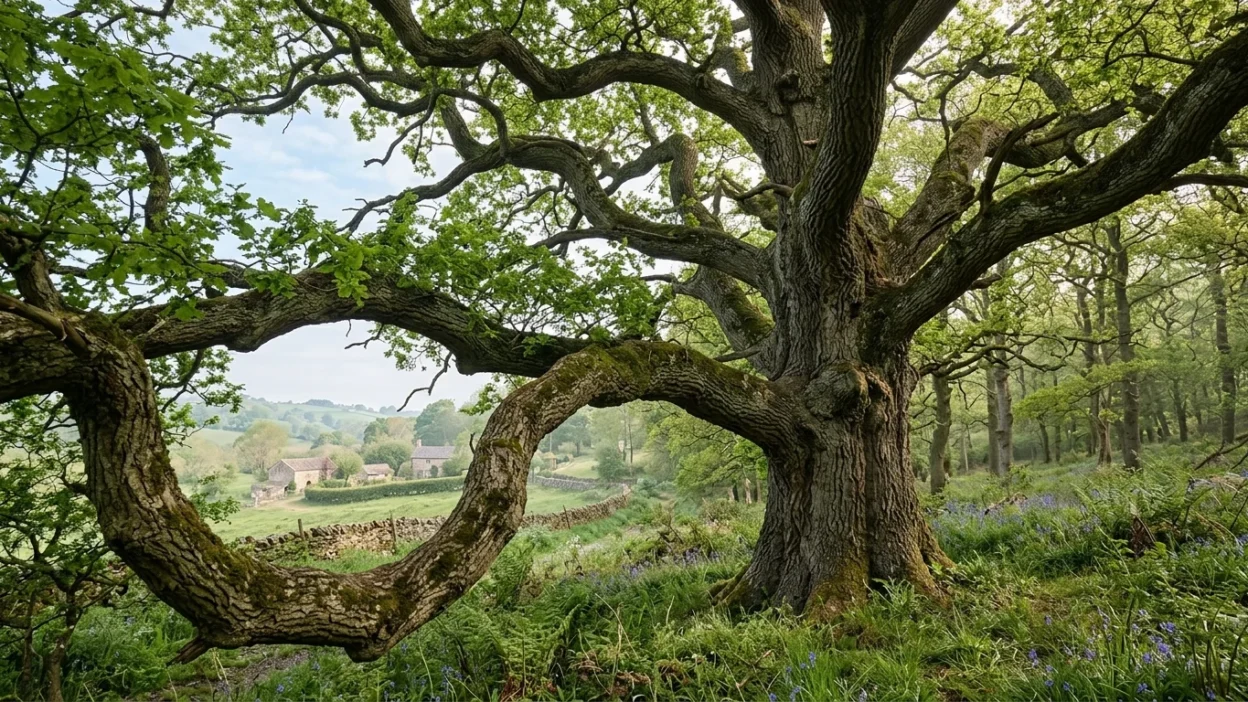
The word bough refers to a large branch of a tree, particularly one that grows directly from the trunk or forms a substantial part of the tree’s framework. It is a familiar word, but it has a distinctly literary and descriptive quality.
You are more likely to encounter it in poetry, fiction, nature writing, songs, and elegant descriptions of woodland scenes than in technical gardening instructions.
Finding suitable synonyms for bough depends on what you are trying to describe. Branch is the closest everyday alternative, but it is broader because a branch can be large or small.
Words such as limb, bough, and tree limb can describe substantial woody growth, while terms such as twig, sprig, and shoot refer to smaller or younger growth and therefore are not exact substitutes.
Some related words describe a branch’s position or function rather than the branch itself. Fork, for example, can refer to the point where a branch divides, while crotch can describe the angle or junction between branches.
Synonyms of Synonyms for Bough
There are several close alternatives to bough, although they do not all have exactly the same meaning. The strongest direct alternatives are branch, limb, and tree limb. Other terms describe smaller branches, young growth, or particular parts of a branching structure.
| Synonym | Pronunciation (IPA) | Part of Speech | Meaning | Example Sentence |
| Branch | /brɑːntʃ/ | Noun | A woody part growing from the trunk or another branch | A heavy branch stretched across the garden. |
| Limb | /lɪm/ | Noun | A large main branch of a tree | A broken limb fell during the storm. |
| Tree limb | /triː lɪm/ | Noun | A large or substantial branch of a tree | The arborist inspected the damaged tree limb. |
| Large branch | /lɑːdʒ brɑːntʃ/ | Noun | A substantial woody growth from a tree | A large branch shaded the bench below. |
| Arm | /ɑːm/ | Noun | A projecting branch resembling an arm | One long arm of the oak reached over the wall. |
| Twig | /twɪɡ/ | Noun | A very small, thin branch | A bird carried a twig to its nest. |
| Sprig | /sprɪɡ/ | Noun | A small shoot or branch, often with leaves or flowers | She placed a sprig of blossom in the vase. |
| Shoot | /ʃuːt/ | Noun | A new young growth emerging from a plant or tree | Fresh shoots appeared after the rain. |
| Bole branch | /bəʊl brɑːntʃ/ | Noun | A branch growing from the main trunk or bole | Several bole branches formed the tree’s main structure. |
| Ramification | /ˌræmɪfɪˈkeɪʃən/ | Noun | A branching structure or one of its divisions | The intricate ramification of the tree was striking. |
| Offshoot | /ˈɒfʃuːt/ | Noun | A smaller growth or branch developing from a larger structure | A new offshoot emerged from the older branch. |
| Fork | /fɔːk/ | Noun | A point or structure where a branch divides | The owl settled at the fork of two branches. |
| Branchlet | /ˈbrɑːntʃlət/ | Noun | A small branch | Tiny branchlets filled the outer canopy. |
| Twiglet | /ˈtwɪɡlət/ | Noun | A very small twig or branch | The nest was woven around several twiglets. |
| Spray | /spreɪ/ | Noun | A small group of branches, leaves, or flowers | A spray of blossom hung from the tree. |
| Shoots | /ʃuːts/ | Noun | Young, new stems or branches growing from a plant | Green shoots appeared along the old branch. |
| Crotch | /krɒtʃ/ | Noun | The angle or junction where branches divide | The tree had a narrow crotch between its main limbs. |
| Canopy | /ˈkænəpi/ | Noun | The upper layer formed by a tree’s branches and leaves | Sunlight filtered through the woodland canopy. |
| Crown | /kraʊn/ | Noun | The upper branching and leafy part of a tree | The tree had a broad, spreading crown. |
| Boughing | /ˈbaʊɪŋ/ | Noun | The arrangement or formation of branches | The boughing of the old oak created an unusual silhouette. |
Direct Synonyms and Close Alternatives
The closest everyday replacement for bough is branch.
A limb is also very close, particularly when referring to a large, strong branch. In fact, tree limb is often used when the writer wants to emphasise the size or substantial nature of the branch.
The word arm can also be used metaphorically for a branch that extends from the trunk. It is especially effective in descriptive and literary writing.
Smaller or Younger Branches
Not every branch-related word can replace bough.
A twig is much smaller and thinner. A branchlet is similarly a small branch. A sprig often refers to a small shoot bearing leaves, flowers, or other growth, while a shoot usually suggests fresh or young growth.
These words are useful when precise size or age matters.
Words for Branching Structures
Some terms in the table describe how a tree branches rather than identifying one large branch.
A fork is a point where one branch divides into two or more directions. A crotch describes the angle or junction created by branches. Ramification refers to the overall branching arrangement or process.
Similarly, the crown and canopy are larger parts of the tree’s structure. They should not be used as direct replacements for a single bough.
What Does Synonyms for Bough Mean?
The phrase synonyms for bough refers to words and expressions that can replace, explain, or closely describe the word bough depending on the context.
A bough is a large branch of a tree. The word traditionally suggests a substantial woody branch, often one that forms part of the tree’s main framework.
For example:
The children sat beneath the broad bough of the old oak.
Here, bough creates a slightly more literary image than branch.
The word is especially common in descriptions of mature trees. A sentence such as The heavy boughs bent towards the ground immediately creates an image of large, sturdy branches extending from a tree.
Bough vs Branch
The most important distinction is between bough and branch.
Branch is a general word. It can refer to almost any woody division growing from a tree’s trunk or another branch.
Bough generally suggests a larger branch and often carries a more poetic or literary tone.
For example:
The bird landed on a branch.
This is completely neutral.
The bird landed on an ancient bough.
This sounds more descriptive and literary, while also suggesting a substantial branch.
Bough in Literature
The word bough has a long history in English literature and poetry.
It is particularly useful when a writer wants to create an image of an old, spreading tree. Expressions involving boughs can evoke shade, shelter, age, nature, seasons, birds, fruit, and woodland landscapes.
Because of this association, replacing bough with branch may preserve the basic meaning but remove some of the literary atmosphere.
Bough in Everyday English
In everyday conversation, branch is generally more common.
If someone says:
Be careful of that low branch.
the sentence sounds completely natural.
Saying:
Be careful of that low bough.
is understandable, but it sounds more literary or deliberate.
Therefore, the best synonym is not necessarily the one that is closest in dictionary meaning. Register and context matter too.
Most Common Synonyms of Synonyms for Bough
Branch
Branch is the most useful general alternative to bough.
It works in everyday conversation, technical descriptions, gardening, journalism, nature writing, and fiction.
For example:
The branch broke under the weight of the snow.
Because branch can refer to woody growth of many sizes, it is broader than bough.
Limb
Limb usually suggests a large, substantial branch.
It is especially common when discussing tree maintenance, storms, damage, cutting, or safety.
For example:
The storm damaged a large limb.
In this context, limb sounds natural because the word emphasises the branch’s size and structural importance.
Tree Limb
Tree limb is simply a more explicit form of limb.
It is useful when clarity is important, particularly in practical or professional writing.
For example:
The council arranged for the dangerous tree limb to be removed.
This sounds more precise than simply saying limb when the surrounding context does not already make the subject clear.
Arm
Arm is a metaphorical term for a branch that extends outward from the trunk.
It is particularly effective in creative writing.
For example:
The ancient tree stretched one crooked arm towards the river.
This creates a visual comparison between a tree branch and a human arm.
Twig
Twig refers to a much smaller branch.
It is therefore not a true synonym for bough, but it can be useful when writing about the different levels of a tree’s branching system.
For example:
The sparrow balanced on a slender twig.
The contrast is clear: a bough is large and substantial, while a twig is small and delicate.
Sprig
A sprig is usually a small shoot or branch, particularly one carrying leaves, flowers, or other growth.
For example:
She tucked a sprig of blossom behind the vase.
The word often has a decorative or botanical quality.
Shoot
A shoot usually refers to a new growth emerging from a plant.
It can become a branch as it develops, but a young shoot should not normally be called a bough.
For example:
New shoots appeared on the tree after the spring rain.
This word is especially useful when the focus is on growth and development.
Branchlet
A branchlet is a small branch.
It is more precise than twig in some botanical contexts and can be useful when describing the smaller divisions of a tree’s structure.
For example:
Fine branchlets filled the outer edges of the canopy.
Crown
The crown is the upper portion of a tree, including its branches, stems, and foliage.
It is therefore much broader than a bough.
For example:
The crown of the oak spread widely above the woodland floor.
Using crown instead of bough would change the meaning from one branch to the tree’s entire upper structure.
Canopy
A tree’s canopy is the layer or covering formed by its leaves and branches.
It is commonly used in descriptions of forests, parks, gardens, and urban trees.
For example:
The dense canopy kept the woodland floor cool.
Again, this is not an exact synonym for bough, but it is an important related term.
Difference Between Synonyms for Bough and Its Synonyms
The differences between branch-related words are mainly based on size, age, position, structure, and tone.
| Word | Main Meaning | Typical Use |
| Bough | Large branch of a tree | Literary, descriptive |
| Branch | Woody division of a tree | General and everyday |
| Limb | Large tree branch | Practical, arboricultural |
| Tree limb | Large branch | Clear, practical |
| Arm | Branch extending like an arm | Figurative, literary |
| Twig | Small, thin branch | Everyday, descriptive |
| Sprig | Small shoot or branch | Botanical, decorative |
| Shoot | Young new growth | Botanical, gardening |
| Branchlet | Small branch | Botanical |
| Fork | Point where branches divide | Structural |
| Crotch | Junction between branches | Arboricultural, technical |
| Crown | Upper branching part of a tree | Arboriculture, nature writing |
| Canopy | Layer of branches and foliage | Forestry, ecology |
| Offshoot | Smaller growth from a larger structure | General, botanical |
| Ramification | Branching arrangement | Formal, technical |
Bough vs Limb
These are the closest alternatives when you specifically mean a large branch.
Bough tends to sound more literary.
Limb is more practical and is common when discussing tree safety, pruning, storm damage, or structural problems.
Compare:
The poet sat beneath the bough.
with:
The arborist inspected the damaged limb.
Both describe a large branch, but their tones are very different.
Bough vs Twig
The difference is mainly size.
A bough is substantial.
A twig is small and thin.
Calling a tiny twig a bough would give the reader the wrong impression of its size.
Bough vs Shoot
A shoot focuses on new growth.
A bough normally suggests an established and substantial branch.
Therefore, shoot is more appropriate when discussing a tree’s growth and development.
Bough vs Crown
A bough is an individual large branch.
A crown is the whole upper branching and leafy structure.
These words therefore operate at different levels.
Bough vs Canopy
A canopy is the covering created by branches and foliage.
A bough is one physical component that may contribute to that canopy.
For example:
The bough stretched across the path beneath the canopy.
Both words can appear naturally in the same sentence because they describe different things.
Common Mistakes When Using Synonyms for Bough
Treating Every Branch-Related Word as an Exact Synonym
This is the most common mistake.
Words such as twig, shoot, crown, and canopy are related to boughs but do not mean the same thing.
Always consider the size and structure of the object you are describing.
Using Twig for a Large Branch
A twig is small and thin.
If you are describing a substantial branch supporting a nest, fruit, or heavy foliage, bough, branch, or limb is likely to be more appropriate.
Using Canopy for One Branch
A canopy refers to a larger covering formed by leaves and branches.
For example:
The canopy blocked the sunlight.
This does not mean one branch blocked the sunlight. It describes the combined upper structure of the tree or trees.
Confusing Crown with Canopy
The terms overlap, but they are not identical.
The crown generally refers to the upper portion of an individual tree, including its branches and foliage.
The canopy often refers to the leafy covering produced by one or more trees, particularly in forestry or ecological contexts.
Using Bough in Highly Technical Writing
Although bough is perfectly valid English, it can sound literary.
In arboricultural or technical writing, branch and limb are often more appropriate.
For example:
The arborist removed the damaged limb.
sounds more professional than:
The arborist removed the damaged bough.
Assuming Bough Always Means Any Branch
A bough generally suggests a large branch.
If the object is a very thin young growth, twig, shoot, or branchlet is more precise.
Tips for Using Synonyms for Bough Correctly
Choose Branch for General Writing
If you are unsure which word to use, branch is usually the safest choice.
It is broad, familiar, and suitable for almost every context.
Choose Bough for Literary Descriptions
Use bough when you want an image to feel poetic, natural, traditional, or atmospheric.
For example:
Moonlight filtered through the ancient boughs.
The word helps create a more evocative scene.
Choose Limb for Large or Damaged Branches
Limb works particularly well when the branch is substantial.
It is also common in writing about storms, pruning, tree surgery, and structural safety.
Use Twig for Small Growth
When a branch is tiny, use twig.
This gives readers a clearer sense of scale.
Use Shoot for New Growth
If the emphasis is on a tree producing fresh growth, shoot is usually more accurate.
For example:
Young shoots emerged from the base of the tree.
Use Arm as a Metaphor
Arm can make creative descriptions more vivid.
For example:
The oak extended a long arm over the garden wall.
This creates a person-like image without changing the underlying idea of a branch.
Consider the Intended Audience
For children, general readers, or casual conversation, branch is usually the easiest word.
For poetry and creative writing, bough can be more expressive.
For professional tree care, branch and limb are generally clearer.
For botanical descriptions, terms such as shoot, branchlet, and sprig may provide greater precision.
Avoid Forced Synonyms
There is no need to replace bough every time it appears.
Repeating a precise word is often better than using an inaccurate alternative.
If you are describing a large branch, bough may simply be the best word for the sentence.
Summary
The word bough refers to a large branch of a tree and is especially associated with literary, poetic, and descriptive English.
The closest everyday synonym is branch, while limb and tree limb are useful when emphasising a large or substantial branch. Arm can work as a metaphorical alternative in creative writing.
Choosing the right alternative depends on size, age, context, and tone. Use branch for general communication, bough for literary descriptions, limb for substantial branches, and twig or shoot when describing smaller or younger growth.
The most important rule is simple: choose the word that accurately describes the part of the tree you mean while matching the tone of your writing.
FAQs
What is the closest synonym for bough?
Branch is the closest and most widely useful synonym for bough. However, bough usually suggests a larger branch and often has a more literary or poetic tone.
Is limb a synonym for bough?
Yes, limb can be a close synonym when referring to a large branch of a tree. The word limb is particularly common in practical contexts involving tree maintenance, damage, pruning, and safety.
What is the difference between a bough and a branch?
A branch is a general term for a woody division growing from a tree’s trunk or another branch. A bough usually suggests a larger, more substantial branch and often sounds more literary.
Is twig another word for bough?
No. A twig is much smaller and thinner than a bough. It is a related tree term but should not normally be used as a direct synonym for a large branch.
What is a poetic synonym for bough?
Arm can work as a poetic or metaphorical alternative when a tree branch is described as extending like a human arm. Bough itself is already a distinctly literary word compared with the everyday term branch.
What is the difference between bough and canopy?
A bough is a large individual branch. A canopy is the upper covering formed by the combined branches and foliage of a tree or group of trees. They describe different parts of a tree’s structure.
What is a small branch called?
A small branch can be called a branchlet, twig, or sprig, depending on its size and characteristics. A shoot usually refers specifically to young or newly developing growth.
Is bough commonly used in British English?
Yes. Bough is a standard English word and is well understood in British English, although branch is much more common in everyday speech. Bough is particularly frequent in literature, poetry, nature writing, and descriptive prose.