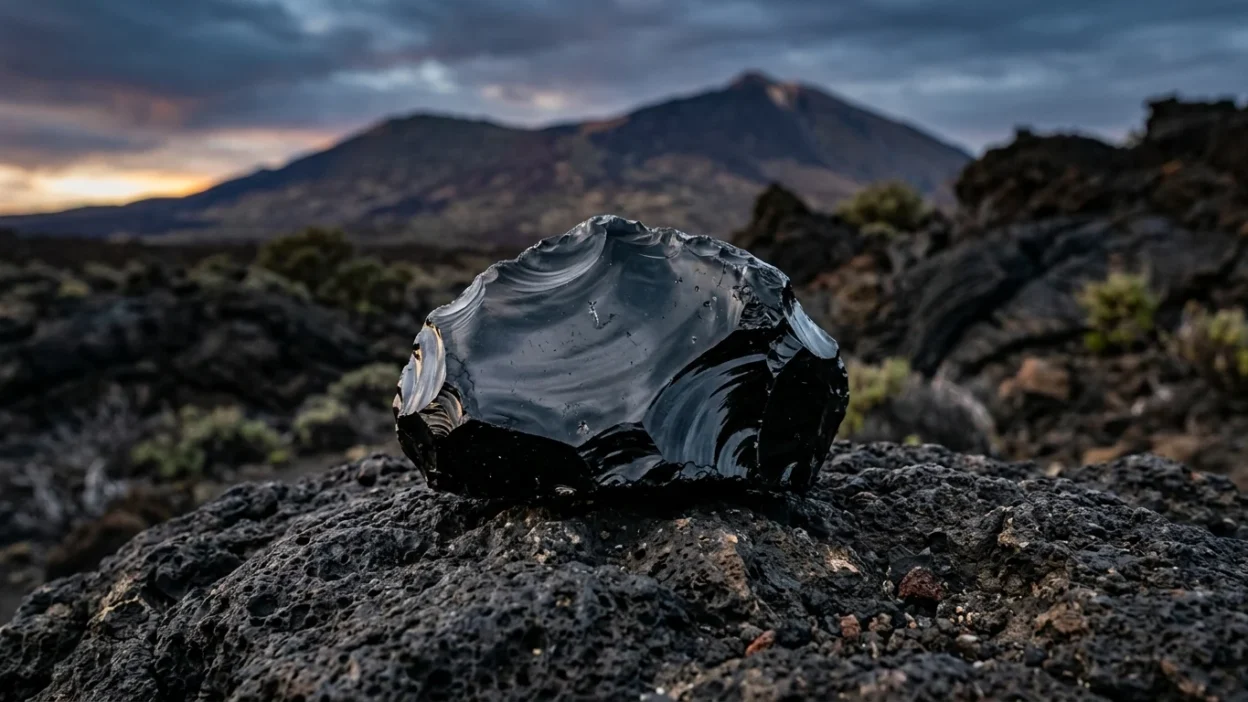
Finding synonyms for obsidian is slightly different from finding alternatives for an ordinary descriptive word. Obsidian is a specific geological material: a naturally occurring volcanic glass formed when lava cools so quickly that crystals have little or no time to develop.
Because it refers to a particular substance, there are very few words that can replace obsidian exactly.
Instead, writers may encounter broader geological descriptions, related types of volcanic glass, traditional names, and terms that describe obsidian’s appearance or formation. Words such as volcanic glass, natural glass, and volcanic rock can sometimes help explain what obsidian is, although they are not always exact substitutes.
Understanding this distinction is important. For example, volcanic glass is a broader category that includes obsidian and other glassy volcanic materials. Pitchstone, perlite, and tachylyte are related volcanic glasses, but each has its own characteristics.
Meanwhile, names such as snowflake obsidian and Apache tear refer to particular forms or varieties of obsidian rather than synonyms for the material as a whole.
Synonyms of Synonyms for Obsidian
Strictly speaking, obsidian has no large set of perfect synonyms. The table below therefore includes the closest descriptive alternatives, broader terms, related volcanic-glass materials, and recognised varieties or forms.
| Synonym | Pronunciation (IPA) | Part of Speech | Meaning | Example Sentence |
| Volcanic glass | /vɒlˈkænɪk ɡlɑːs/ | Noun | Natural glass formed from rapidly cooled volcanic material | Obsidian is a type of volcanic glass. |
| Natural glass | /ˈnætʃərəl ɡlɑːs/ | Noun | Glass occurring naturally rather than being manufactured | Obsidian is a well-known example of natural glass. |
| Volcanic rock | /vɒlˈkænɪk rɒk/ | Noun | Rock formed from volcanic activity | Obsidian is a volcanic rock with a glassy structure. |
| Igneous glass | /ˈɪɡniəs ɡlɑːs/ | Noun | Glassy material produced through the cooling of molten rock | The sample was identified as an igneous glass. |
| Vitreous volcanic rock | /ˈvɪtriəs vɒlˈkænɪk rɒk/ | Noun | A volcanic rock with a glass-like texture | The dark vitreous volcanic rock had a smooth fracture. |
| Volcanic vitreous material | /vɒlˈkænɪk ˈvɪtriəs məˈtɪəriəl/ | Noun | Glass-like material created by volcanic processes | The artefact was made from volcanic vitreous material. |
| Glassy volcanic rock | /ˈɡlɑːsi vɒlˈkænɪk rɒk/ | Noun | Volcanic rock with a predominantly glassy texture | The glassy volcanic rock reflected the light. |
| Pitchstone | /ˈpɪtʃstəʊn/ | Noun | A dark, glassy volcanic rock containing more water than typical obsidian | Pitchstone can resemble obsidian but has a different composition and texture. |
| Perlite | /ˈpɜːlaɪt/ | Noun | A hydrated volcanic glass often showing distinctive cracking | Perlite develops a characteristic structure when heated. |
| Tachylyte | /ˈtækɪlaɪt/ | Noun | A dark volcanic glass, usually associated with basaltic lava | Tachylyte is another naturally occurring volcanic glass. |
| Pumice | /ˈpʌmɪs/ | Noun | A highly vesicular volcanic material formed from gas-rich lava | Unlike obsidian, pumice contains many visible cavities. |
| Vitrophyre | /ˈvɪtrəfaɪə/ | Noun | A rock containing a glassy volcanic groundmass around crystals | The specimen had a vitrophyric texture. |
| Snowflake obsidian | /ˈsnəʊfleɪk əbˈsɪdiən/ | Noun | Obsidian containing pale crystal patterns that resemble snowflakes | The polished snowflake obsidian had striking pale markings. |
| Apache tear | /əˈpætʃi tɪə/ | Noun | A rounded, translucent form of black obsidian | She found a small Apache tear in a mineral collection. |
| Rainbow obsidian | /ˈreɪnbəʊ əbˈsɪdiən/ | Noun | Obsidian displaying colourful optical effects when viewed under suitable light | The rainbow obsidian showed subtle bands of colour. |
| Mahogany obsidian | /məˈhɒɡəni əbˈsɪdiən/ | Noun | Obsidian with reddish-brown or mahogany-coloured patterns | The bracelet was made from mahogany obsidian. |
| Black volcanic glass | /blæk vɒlˈkænɪk ɡlɑːs/ | Noun | A descriptive phrase for dark volcanic glass such as common obsidian | The archaeologist examined a piece of black volcanic glass. |
| Vitreous rock | /ˈvɪtriəs rɒk/ | Noun | Rock characterised by a glass-like texture | The vitreous rock broke with a curved fracture. |
| Glassy lava | /ˈɡlɑːsi ˈlɑːvə/ | Noun | Lava that has cooled into a glass-like material | Rapid cooling can produce glassy lava. |
| Natural volcanic glass | /ˈnætʃərəl vɒlˈkænɪk ɡlɑːs/ | Noun | Naturally occurring glass produced by volcanic activity | The museum display explained how natural volcanic glass forms. |
Important Note About These Terms
The words above should not all be treated as interchangeable dictionary synonyms for obsidian.
Volcanic glass, natural glass, and natural volcanic glass are useful descriptive alternatives because obsidian belongs to the category of naturally occurring volcanic glasses. However, these terms are broader than obsidian.
Pitchstone, perlite, and tachylyte are different types of volcanic glass or closely related glassy volcanic materials. They should not normally be used as direct replacements for obsidian.
Likewise, snowflake obsidian, rainbow obsidian, mahogany obsidian, and Apache tear identify particular forms, appearances, or varieties associated with obsidian.
This distinction makes the vocabulary more scientifically accurate.
What Does Synonyms for Obsidian Mean?
The phrase synonyms for obsidian refers to words and expressions that can either describe obsidian, explain its geological nature, or refer to closely related materials and varieties.
The word obsidian itself describes a naturally occurring volcanic glass. It usually forms when lava rich in silica cools rapidly, preventing the atoms within the molten material from arranging themselves into well-developed mineral crystals.
This rapid cooling is one of the most important features of obsidian.
Obsidian commonly has a smooth, glass-like appearance and can be black, brown, grey, or other colours. Some specimens also display distinctive optical effects or patterns. Its characteristic conchoidal fracture can produce extremely sharp edges, which made the material valuable for prehistoric tools and cutting implements.
Why Does Obsidian Have Few True Synonyms?
Many everyday words have several direct alternatives. For example, large can be replaced by big, huge, or enormous in appropriate contexts.
Obsidian is different because it is a specific scientific name.
A mineral or rock name generally identifies a particular material rather than a general quality. Replacing obsidian with another geological term may therefore change the meaning.
For example:
Obsidian → a particular type of natural volcanic glass.
Volcanic glass → a broader category that includes obsidian and other glassy volcanic materials.
Pitchstone → a distinct glassy volcanic rock with its own characteristics.
Pumice → a volcanic material that is very different in structure because it contains abundant vesicles.
This is why context matters when looking for alternatives.
Obsidian as Volcanic Glass
The phrase volcanic glass is probably the most useful descriptive alternative when explaining obsidian to a general reader.
For example:
Obsidian is a naturally occurring volcanic glass formed by rapid cooling.
This sentence is more informative than simply replacing the word obsidian with volcanic glass.
The broader phrase explains what type of material obsidian is without pretending that the two terms are identical.
Obsidian as a Glassy Volcanic Rock
The expression glassy volcanic rock can also be useful in educational writing.
It highlights two important characteristics: the material has a volcanic origin and a glass-like structure.
This description is particularly useful when introducing the subject to someone unfamiliar with geological terminology.
Most Common Synonyms of Synonyms for Obsidian
Because exact synonyms are limited, some related expressions are considerably more useful than others.
Volcanic Glass
Volcanic glass is the most useful broad descriptive term.
It explains obsidian’s essential nature without suggesting that every volcanic glass is obsidian.
A sentence such as:
Obsidian is a dark form of volcanic glass.
is simple and suitable for educational content.
The term is also useful when discussing the formation of obsidian alongside other glassy volcanic materials.
Natural Glass
Natural glass is a wider term. Natural glasses occur through geological processes rather than industrial manufacturing.
Obsidian is one of the best-known examples.
However, natural glass can include materials formed through processes other than volcanic lava cooling. For this reason, natural glass is broader than obsidian.
Glassy Volcanic Rock
This phrase provides a straightforward physical description.
It can be useful when writing for readers who may not be familiar with geological classification. The expression immediately communicates that the material is a volcanic rock with a glass-like structure.
Black Volcanic Glass
Black volcanic glass is a descriptive rather than scientific synonym.
Many examples of ordinary obsidian are black, making this expression understandable in general writing. Nevertheless, not all obsidian is necessarily black, and not every black volcanic glass specimen should automatically be called obsidian.
Therefore, it works best as a descriptive phrase rather than a strict replacement.
Pitchstone
Pitchstone is frequently mentioned alongside obsidian because both are glassy volcanic rocks.
However, they should not be confused.
Pitchstone generally has a higher water content and often has a resinous or pitch-like appearance. It can also contain a greater degree of microscopic or developing crystalline material.
Therefore, pitchstone is a related geological term, not a perfect synonym.
Perlite
Perlite is another naturally occurring volcanic glass.
It is commonly recognised by its distinctive structure and can expand dramatically when heated. This property has made it useful in horticultural and industrial applications.
Although perlite and obsidian are related as volcanic glasses, they are not interchangeable terms.
Tachylyte
Tachylyte is a dark volcanic glass generally associated with basaltic compositions.
It provides a useful example of why the phrase volcanic glass is broader than obsidian. Different volcanic glasses can form from different types of lava and possess different compositions.
Using tachylyte as a direct substitute for obsidian would therefore be inaccurate.
Snowflake Obsidian
Snowflake obsidian is not a synonym for obsidian itself. It is a recognisable variety or appearance of obsidian associated with pale, snowflake-like patterns.
The patterns are commonly associated with cristobalite crystals or crystalline inclusions within the glass.
The term is especially common in jewellery, decorative stone, mineral collecting, and lapidary contexts.
Apache Tear
An Apache tear is a small, rounded, commonly translucent form of black obsidian.
The expression is particularly associated with mineral collecting and jewellery. Because it refers to a particular form rather than the whole material, it should not replace obsidian in every context.
Rainbow Obsidian
Rainbow obsidian refers to obsidian that can display rainbow-like optical effects under appropriate lighting and viewing conditions.
It is useful when discussing decorative specimens, polished stones, collections, or lapidary work.
Again, the word obsidian remains the broader material name.
Difference Between Synonyms for Obsidian and Its Synonyms
The biggest challenge with synonyms for obsidian is understanding the difference between a genuine synonym and a related geological term.
Obsidian vs Volcanic Glass
These terms have a clear hierarchical relationship.
Obsidian is a specific naturally occurring volcanic glass.
Volcanic glass is a broader descriptive category.
Therefore, you can say:
Obsidian is a type of volcanic glass.
But it is not always accurate to say:
All volcanic glass is obsidian.
The second statement is too broad.
Obsidian vs Natural Glass
Natural glass includes glass-like materials created naturally through geological processes.
Obsidian belongs within this broader category.
Therefore, natural glass can explain what obsidian is, but it cannot always replace the specific name.
Obsidian vs Volcanic Rock
The phrase volcanic rock is much broader.
It can refer to many materials formed through volcanic activity, including basalt, rhyolite, pumice, and obsidian.
Consequently, calling every volcanic rock “obsidian” would be incorrect.
Obsidian vs Pitchstone
Both are glassy volcanic materials, but they are not the same term.
Pitchstone generally has a higher water content and may have a more resinous appearance. Obsidian is typically characterised by its glassy nature and rapid cooling.
Use pitchstone only when referring specifically to that material.
Obsidian vs Pumice
These materials can both form from volcanic activity, but their structures are very different.
Obsidian is dense and glassy, whereas pumice is highly porous and contains numerous gas bubbles or vesicles.
Therefore, pumice should never be treated as a direct synonym for obsidian.
Obsidian vs Perlite
Both can be described as volcanic glasses, but their characteristics differ.
Perlite is hydrated volcanic glass and is particularly notable for its expansion when heated.
Obsidian is generally recognised for its smooth glassy appearance, conchoidal fracture, and formation through rapid cooling.
Obsidian vs Timeless or Metaphorical Terms
In creative writing, obsidian may be described with phrases such as black glass, volcanic glass, dark stone, or glass-like rock.
These can be useful stylistically, but they are descriptive expressions rather than scientific synonyms.
For example:
The warrior carried a blade as dark as obsidian.
Here, replacing obsidian with volcanic glass could alter the imagery and make the sentence sound more technical.
Common Mistakes When Using Synonyms for Obsidian
Calling Every Volcanic Glass Obsidian
This is one of the most important mistakes to avoid.
Obsidian is a particular type of volcanic glass. Other volcanic glasses exist, so the broader category should not automatically be treated as the specific material.
Using Pitchstone as a Direct Replacement
Pitchstone is related to obsidian but has distinct characteristics.
If a geological description specifically identifies a specimen as pitchstone, replacing that term with obsidian may introduce a factual error.
Calling Pumice Obsidian
Both materials are volcanic, but their structures are very different.
Pumice is highly vesicular, meaning it contains abundant cavities created by escaping gases. Obsidian is predominantly glassy and generally much denser.
Assuming Obsidian Is Always Black
Black is the classic colour associated with obsidian, but specimens can occur in other shades and patterns.
Brown, grey, reddish, greenish, and patterned varieties are known, depending on composition and inclusions.
Consequently, black volcanic glass is a useful description in some contexts but not a complete definition.
Treating Variety Names as General Synonyms
Terms such as snowflake obsidian, rainbow obsidian, and mahogany obsidian describe particular appearances or varieties.
They should not normally be used as replacements for the general word obsidian.
Using “Glass” Without Geological Context
Obsidian looks like glass, but it is naturally formed geological material.
Calling it simply “glass” may cause readers to assume that it is manufactured glass.
The expression volcanic glass is much more precise.
Tips for Using Synonyms for Obsidian Correctly
Use the Specific Name When Accuracy Matters
If you are writing about geology, archaeology, mineral collecting, or ancient technology, use obsidian when you mean the specific material.
This prevents confusion with related volcanic materials.
Use Volcanic Glass for Explanation
When introducing the material to a general audience, volcanic glass is particularly useful.
For example:
Obsidian is a naturally occurring volcanic glass that forms when lava cools rapidly.
This gives readers both the specific name and the broader description.
Choose Descriptive Phrases for Creative Writing
In fiction, poetry, product descriptions, or visual writing, phrases such as black volcanic glass or glassy volcanic rock can create a vivid image.
For example:
The polished black volcanic glass caught the afternoon light.
This can sound more descriptive than repeatedly using the word obsidian.
Use Geological Terms Carefully
Terms such as pitchstone, perlite, and tachylyte are best used when the distinction between volcanic-glass materials matters.
They add precision rather than serving as casual substitutes.
Match the Variety to the Context
If you are specifically discussing a patterned specimen, a term such as snowflake obsidian or rainbow obsidian may be appropriate.
If you are referring to the material in general, simply use obsidian.
Avoid Repetition Without Sacrificing Accuracy
In a long article, repeating obsidian in every sentence can become stylistically dull. Instead of forcing inaccurate synonyms, vary the wording naturally.
You can alternate between:
- obsidian
- volcanic glass
- natural volcanic glass
- glassy volcanic rock
- the dark volcanic material
- the glass-like stone
The best choice depends on the sentence and how technically precise it needs to be.
Summary
There are not many exact synonyms for obsidian because obsidian is the specific name of a naturally occurring volcanic glass rather than a general descriptive adjective.
The closest broad descriptive term is volcanic glass, while natural glass, natural volcanic glass, and glassy volcanic rock can also help explain its geological nature. However, these expressions are broader or more descriptive rather than perfect dictionary synonyms.
Names such as snowflake obsidian, rainbow obsidian, mahogany obsidian, and Apache tear refer to particular varieties, appearances, or forms of obsidian.
FAQs
What is the closest synonym for obsidian?
Volcanic glass is the closest broad descriptive alternative to obsidian. Obsidian is a naturally occurring volcanic glass, but the two terms are not completely interchangeable because volcanic glass is a broader category.
Is volcanic glass another name for obsidian?
Not exactly. Volcanic glass is a broader geological term that includes obsidian and other naturally occurring glassy volcanic materials. It can be used to explain what obsidian is, but it is not a perfect synonym.
What is another word for black obsidian?
A descriptive phrase such as black volcanic glass can be used in suitable contexts. However, black volcanic glass is broader than black obsidian, so obsidian remains the more precise term when the material has been identified.
Is pitchstone a synonym for obsidian?
No. Pitchstone is a related glassy volcanic rock with different characteristics, including generally higher water content. It may resemble obsidian, but the two terms should not be treated as exact synonyms.
Is pumice another name for obsidian?
No. Both are volcanic materials, but their structures are very different. Obsidian is a dense, glassy material, while pumice is highly porous and contains many cavities formed by volcanic gases.
What are the different types or varieties of obsidian?
Commonly recognised names include snowflake obsidian, rainbow obsidian, mahogany obsidian, and Apache tears. These terms describe particular varieties, patterns, forms, or appearances rather than being general synonyms for obsidian.
Why does obsidian have so few synonyms?
Obsidian is a specific geological name. Scientific material names generally do not have numerous exact synonyms in the same way that common descriptive words do. Most alternatives therefore describe its composition, appearance, geological origin, or related materials.
What is obsidian made from?
Obsidian forms from volcanic lava that cools rapidly before significant crystallisation can occur. It is predominantly glassy rather than being made up of large visible mineral crystals. Its composition is commonly rich in silica, although the exact composition can vary.