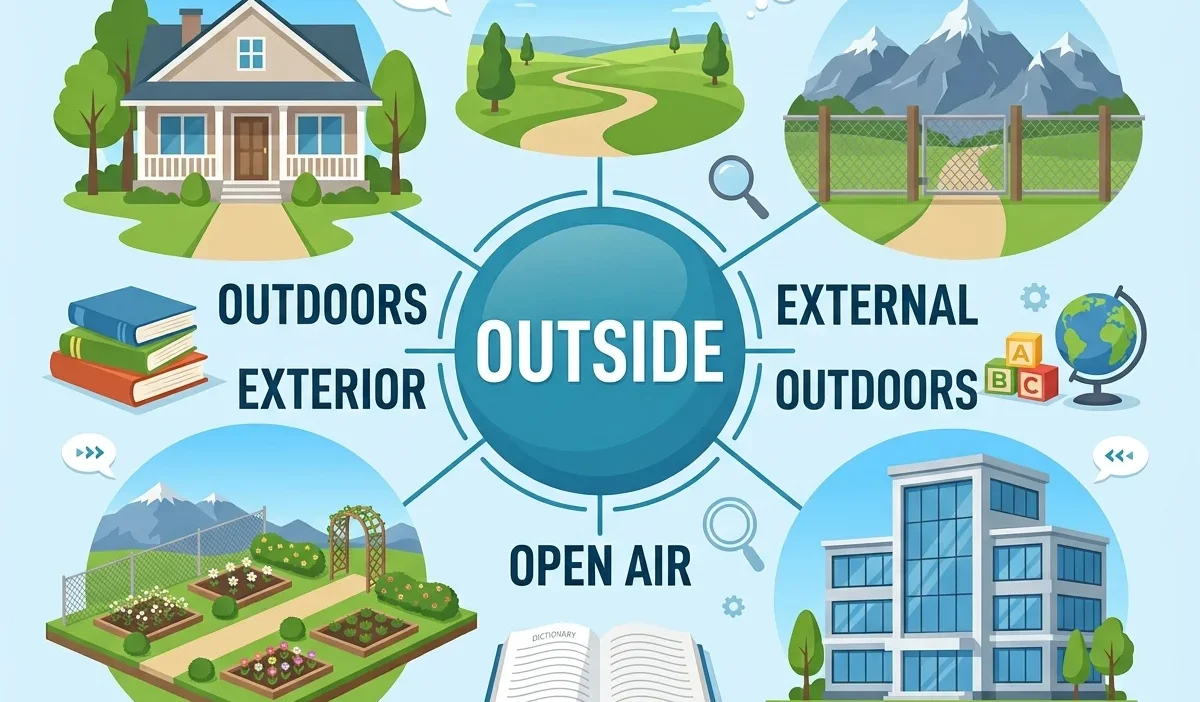
The English language offers a rich variety of words that allow us to express ideas more precisely. One such commonly used word is outside. Although it appears simple, outside has several meanings depending on the context. It can refer to a physical location beyond the boundaries of something, describe an external surface, or even refer to someone or something that is not part of a particular group or organisation.
Learning synonyms for outside helps improve your vocabulary, writing style, and communication skills. Whether you are writing an academic essay, a business report, a blog post, or simply improving your spoken English, knowing suitable alternatives can make your language more engaging and accurate.
However, not every synonym can replace outside in every sentence. Some words are better suited for describing physical locations, while others express the idea of being external, foreign, or independent. Understanding these differences helps you choose the most appropriate word for each situation.
Synonyms of Outside
The word outside has more than one meaning. Therefore, its synonyms can be grouped according to context.
Located Beyond or Not Inside
| Synonym | Pronunciation (IPA) | Part of Speech | Meaning | Example Sentence |
| Exterior | /ɪkˈstɪəriə(r)/ | Noun/Adjective | The outer part of something | The exterior of the building was recently renovated. |
| External | /ɪkˈstɜːnl/ | Adjective | Existing on or relating to the outside | External walls require regular maintenance. |
| Outdoors | /ˌaʊtˈdɔːz/ | Adverb/Noun | In the open air | The children enjoyed playing outdoors all afternoon. |
| Beyond | /bɪˈjɒnd/ | Preposition/Adverb | On the farther side of | The village lies beyond the river. |
| Outer | /ˈaʊtə(r)/ | Adjective | Situated farther from the centre | The castle has an outer wall. |
| Open-air | /ˌəʊpən ˈeə(r)/ | Adjective | Taking place outside | We attended an open-air concert. |
| Outdoorsy | /ˌaʊtˈdɔːzi/ | Adjective | Enjoying outdoor activities | She has an outdoorsy personality. |
External Surface or Appearance
| Synonym | Pronunciation (IPA) | Part of Speech | Meaning | Example Sentence |
| Surface | /ˈsɜːfɪs/ | Noun | The outer layer of something | The surface of the lake was calm. |
| Covering | /ˈkʌvərɪŋ/ | Noun | Outer protective layer | The covering protected the furniture from dust. |
| Shell | /ʃel/ | Noun | Hard outer covering | The shell of the egg cracked easily. |
| Skin | /skɪn/ | Noun | Outer layer | The fruit has a thick skin. |
Not Belonging to a Group
| Synonym | Pronunciation (IPA) | Part of Speech | Meaning | Example Sentence |
| Independent | /ˌɪndɪˈpendənt/ | Adjective | Not connected to an organisation | She works as an independent consultant. |
| Foreign | /ˈfɒrən/ | Adjective | From another country or organisation | Foreign investors showed interest in the project. |
| Alien | /ˈeɪliən/ | Adjective | Strange or belonging elsewhere | The idea seemed completely alien to them. |
| Unconnected | /ˌʌnkəˈnektɪd/ | Adjective | Having no connection | The two incidents were unconnected. |
| Separate | /ˈsepərət/ | Adjective | Existing independently | They kept their finances separate. |
Beyond Normal Limits
| Synonym | Pronunciation (IPA) | Part of Speech | Meaning | Example Sentence |
| Beyond | /bɪˈjɒnd/ | Preposition | Exceeding limits | The task was beyond my experience. |
| Exceeding | /ɪkˈsiːdɪŋ/ | Adjective | Going past a limit | The company reported exceeding expectations. |
| Outside the scope | /ˌaʊtˈsaɪd ðə skəʊp/ | Phrase | Not included | The issue is outside the scope of this report. |
What Does Outside Mean?
The word outside is one of the most flexible words in English because it functions as several parts of speech, including a noun, adjective, adverb, and preposition. Its meaning changes depending on the context.
1. Outside as a Preposition
When used as a preposition, outside means not inside a place or building.
Examples:
- Please wait outside the office.
- The children are playing outside the house.
- The bicycle is parked outside the gate.
2. Outside as an Adverb
As an adverb, outside refers to being in the open air or beyond an enclosed space.
Examples:
- Let’s eat outside today.
- It is raining heavily outside.
- She looked outside before leaving.
3. Outside as an Adjective
As an adjective, outside describes something located on the exterior.
Examples:
- The outside wall needs painting.
- Please clean the outside windows.
- The outside temperature has dropped sharply.
4. Outside as a Noun
As a noun, outside refers to the exterior or outer side of something.
Examples:
- The outside of the house looks impressive.
- Judge a person by more than just the outside.
- The outside of the package was damaged.
Literal Meaning of Outside
The most common meaning refers to a location beyond an enclosed area.
Examples:
- Outside the classroom
- Outside the hospital
- Outside the city
- Outside the country
Figurative Meaning of Outside
Outside can also describe something that does not belong to a particular group, organisation, or category.
Examples:
- Outside influence
- Outside opinion
- Outside assistance
- Outside investment
Common Expressions Using Outside
English speakers frequently use the word outside in everyday expressions.
Outside World
Refers to life beyond a particular place or environment.
Example:
After spending months in hospital, he was eager to return to the outside world.
Outside Chance
Means a very small possibility.
Example:
We have an outside chance of winning the competition.
Outside Interests
Activities that someone enjoys apart from work or study.
Example:
Employers often appreciate candidates with outside interests.
Outside Help
Assistance provided by someone who is not part of the organisation or group.
Example:
The company hired outside help to complete the project.
Outside Influence
Influence coming from an external source.
Example:
Parents were concerned about outside influences affecting their children.
Most Common Synonyms of Outside
Although English contains many alternatives, some synonyms are used far more frequently than others. Below are the most common ones, along with their typical contexts.
1. Exterior
Meaning: The outer part or appearance of a building or object.
Example:
- The exterior of the museum was beautifully restored.
Best used for: Buildings, vehicles, products, architecture, and design.
2. External
Meaning: Existing on or connected with the outside.
Example:
- External factors affected the company’s profits.
Best used for: Academic, scientific, medical, and business writing.
3. Outdoors
Meaning: In the open air rather than inside a building.
Example:
- We spent the afternoon outdoors enjoying the sunshine.
Best used for: Nature, travel, sports, leisure activities, and lifestyle writing.
4. Beyond
Meaning: On the farther side of something or exceeding a limit.
Example:
- The mountains lie beyond the valley.
- His achievements went beyond everyone’s expectations.
Best used for: Both physical distance and abstract ideas.
5. Outer
Meaning: Situated on the outside or farther from the centre.
Example:
- The astronauts repaired the outer panel of the spacecraft.
Best used for: Scientific, geographical, and technical contexts.
6. Independent
Meaning: Not controlled by or connected with another organisation.
Example:
- She works as an independent financial adviser.
Best used for: Business, employment, education, and politics.
7. Foreign
Meaning: Coming from another country or external source.
Example:
- Foreign companies invested heavily in the region.
Best used for: International affairs, economics, trade, and travel.
8. Separate
Meaning: Existing independently or apart from something else.
Example:
- They decided to keep their professional and personal lives separate.
Best used for: Everyday conversation, legal writing, and formal documents.
Why Learning Synonyms for Outside Matters
Expanding your vocabulary with suitable alternatives to outside offers several advantages:
- Improves the clarity and precision of your writing.
- Helps avoid repetitive language.
- Enhances academic and professional communication.
- Makes blog posts and articles more engaging.
- Supports better performance in English language examinations.
- Strengthens SEO writing by naturally varying vocabulary without keyword stuffing.
Difference Between Outside and Its Synonyms
Although many words can replace outside, they are not always interchangeable. Each synonym carries its own nuance and is suitable for particular situations. Choosing the correct word improves both clarity and style.
Outside vs Exterior
Both words refer to the outer part of something, but outside is more general, whereas exterior is more formal and is commonly used in architecture, construction, and design.
Examples
- The outside of the house needs painting. ✅ (Everyday English)
- The exterior of the house features natural stone. ✅ (Formal)
Best Use
- Outside: Everyday conversation
- Exterior: Formal descriptions, architecture, property listings
Outside vs External
External usually describes something connected to the outside or originating from outside, especially in business, science, medicine, and education. It is less commonly used to describe physical locations.
Examples
- External funding helped the charity expand.
- External hard drives provide additional storage.
Not natural:
- The children are playing external. ❌
Correct:
- The children are playing outside. ✅
Outside vs Outdoors
Although these words are closely related, they have different grammatical functions.
- Outside often indicates a specific place.
- Outdoors refers to the open air in general.
Examples
- Please wait outside the office.
- We spent the entire afternoon outdoors.
Outside vs Beyond
Beyond means farther than a place, limit, expectation, or ability.
Examples
- The village is beyond the forest.
- Her achievements were beyond expectations.
Unlike outside, beyond often expresses abstract ideas.
Outside vs Outer
Outer functions mainly as an adjective describing something nearer the edge.
Examples
- Outer layer
- Outer wall
- Outer circle
It cannot replace outside in many situations.
Incorrect:
- Meet me outer the building. ❌
Correct:
- Meet me outside the building. ✅
Outside vs Separate
Separate emphasises independence or division rather than location.
Examples
- They have separate offices.
- Keep personal and business accounts separate.
Outside vs Independent
Independent refers to freedom from control or influence rather than physical position.
Examples
- An independent journalist
- Independent research
Outside vs Foreign
Foreign refers to another country or external origin.
Examples
- Foreign investment
- Foreign language
- Foreign policy
It cannot replace outside when referring to physical locations.
Comparison Table
| Word | Main Meaning | Common Context |
| Outside | Not inside | Everyday English |
| Exterior | Outer appearance | Architecture, design |
| External | Connected with the outside | Business, medicine, science |
| Outdoors | In the open air | Nature, travel |
| Beyond | Farther than or exceeding | Distance, limits, ideas |
| Outer | Near the edge | Science, geography |
| Separate | Independent or divided | General English |
| Independent | Not controlled | Business, politics |
| Foreign | From another country | International contexts |
Common Mistakes When Using Outside
Even advanced English learners occasionally misuse outside and its synonyms. Understanding these common mistakes will help you write and speak more naturally.
1. Using “Exterior” in Everyday Conversation
Incorrect:
I’m waiting at the exterior of your house.
Correct:
I’m waiting outside your house.
“Exterior” sounds overly formal in casual conversation.
2. Confusing “Outside” with “Outdoors”
Incorrect:
We love playing outsides.
Correct:
We love playing outdoors.
or
We love playing outside.
3. Using “External” for Physical Locations
Incorrect:
The children are external.
Correct:
The children are outside.
4. Confusing “Beyond” with “Outside”
Incorrect:
She is beyond the classroom.
If you simply mean she is not inside the classroom, write:
She is outside the classroom.
Use beyond only if she is farther away.
5. Mixing “Outer” and “Outside”
Incorrect:
The dog is outer the gate.
Correct:
The dog is outside the gate.
6. Overusing One Word
Many writers repeat outside too often.
Example:
Outside the house, there was an outside garden with outside seating outside the entrance.
Improved:
Beyond the house stood a beautiful garden with open-air seating near the entrance.
Using appropriate synonyms makes writing more engaging.
7. Choosing the Wrong Formality
Academic writing often benefits from external, exterior, or independent, while everyday conversation usually sounds more natural with outside.
Tips for Using Synonyms for Outside Correctly
Improving your vocabulary is not simply about learning more words—it is about knowing when and how to use them.
Understand the Context
Always identify whether outside refers to:
- Physical location
- External appearance
- Independence
- Distance
- Limits
Different meanings require different synonyms.
Consider Your Audience
For academic or professional writing, choose formal alternatives such as:
- External
- Exterior
- Independent
For blogs or conversations, words like outside and outdoors usually sound more natural.
Learn Through Reading
Reading newspapers, novels, academic articles, and magazines helps you understand how native speakers naturally use synonyms.
Pay attention to:
- Newspapers
- Business reports
- Fiction
- Travel blogs
Avoid Forced Synonyms
Do not replace outside simply for the sake of variety.
For example:
Correct:
Please wait outside.
Not:
Please wait at the exterior.
Natural language is always better than unnecessary complexity.
Build Vocabulary with Example Sentences
Instead of memorising single words, learn complete sentences.
Example:
- The children are playing outdoors.
- The building’s exterior was renovated.
- External influences shaped the decision.
- The village lies beyond the hills.
This approach improves long-term retention.
Use a Good Dictionary
A quality learner’s dictionary explains:
- Meaning
- Pronunciation
- Grammar
- Common collocations
- Real-life examples
Understanding usage is more valuable than memorising definitions.
Practise Writing
Try replacing outside with suitable alternatives in your own writing.
Example:
Original:
We sat outside and enjoyed the weather.
Alternative:
We relaxed outdoors and enjoyed the pleasant weather.
Read Your Sentence Aloud
If the sentence sounds unnatural when spoken, another synonym is probably more suitable.
Natural writing almost always sounds natural when read aloud.
Summary
The word outside is one of the most versatile words in English. It can function as a noun, adjective, adverb, and preposition while expressing ideas related to location, appearance, independence, and limits.
Learning suitable synonyms for outside enriches your vocabulary, improves writing quality, and helps you communicate with greater precision. However, not every synonym carries the same meaning. Words such as exterior, external, outdoors, beyond, outer, independent, foreign, and separate each have specific uses and contexts.
FAQs
1. What is the best synonym for outside?
There isn’t one single best synonym. The right word depends on the sentence. Some common synonyms are exterior, external, outdoors, beyond, and outer.
2. Is outside a noun or an adjective?
Yes. The word outside can be used as a noun, adjective, adverb, or preposition, depending on how it is used in a sentence.
3. What is the difference between outside and outdoors?
Outside usually means a place that is not inside a building or area. Outdoors means being in the open air, such as in a park, garden, or countryside.
4. Can external always replace outside?
No. External is mostly used in formal writing, business, science, medicine, and education. It cannot replace outside in many everyday situations.
5. Which synonym is best for academic writing?
For academic or professional writing, words like external, exterior, independent, and separate are often better choices, depending on the meaning.
6. Why should I learn synonyms for outside?
Learning synonyms helps you improve your vocabulary, avoid repeating the same word, and make your writing and speaking clearer and more interesting.
7. Which synonym means something beyond a limit?
Beyond is the best synonym when you want to describe something that goes past a physical or abstract limit.