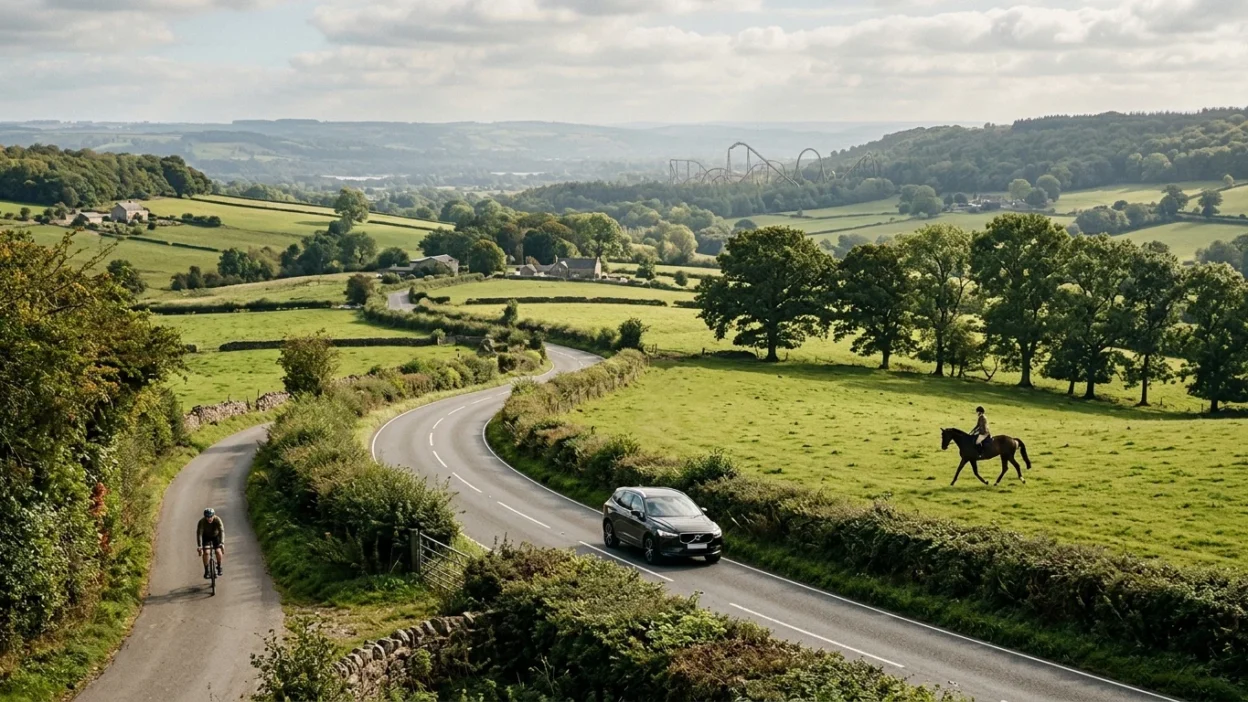
The word ride is one of those everyday English words that can have several meanings depending on the situation. It can describe travelling in a car, sitting on a horse, travelling by bicycle, enjoying an amusement attraction, or simply referring to a journey from one place to another.
Choosing the right alternative depends on the mode of transport, the purpose of the journey, the length of travel, and the tone of the sentence. In informal conversation, words such as trip, lift, and outing are common. In more formal writing, journey, passage, or excursion may sound more appropriate.
Synonyms of Synonyms for Ride
The word ride has several meanings, so its alternatives are best understood according to context. Some describe a journey, some refer to a particular method of transport, and others describe recreational travel or an amusement attraction.
Synonyms for Ride Meaning a Journey or Trip
| Synonym | Pronunciation (IPA) | Part of Speech | Meaning | Example Sentence |
| Journey | /ˈdʒɜːni/ | Noun | Travel from one place to another, usually referring to the experience or process of travelling | The journey to London took nearly four hours. |
| Trip | /trɪp/ | Noun | A journey to a particular place, often with a specific purpose | We took a short trip to the countryside. |
| Travel | /ˈtrævəl/ | Noun/Verb | The general activity or process of moving from one place to another | She enjoys travel during the summer holidays. |
| Excursion | /ɪkˈskɜːʃən/ | Noun | A short journey or outing, usually undertaken for pleasure or a particular purpose | The school organised an excursion to the museum. |
| Outing | /ˈaʊtɪŋ/ | Noun | A short trip away from home for pleasure or recreation | We had a pleasant family outing at the seaside. |
| Voyage | /ˈvɔɪɪdʒ/ | Noun | A long journey, especially by sea or through space | The ship began its voyage across the Atlantic. |
| Cruise | /kruːz/ | Noun/Verb | A journey, usually for pleasure, often by ship or vehicle | They went on a cruise around the Mediterranean. |
| Tour | /tʊə/ | Noun/Verb | A journey involving visits to several places, often for pleasure, work, or performance | The band began a European tour in May. |
| Passage | /ˈpæsɪdʒ/ | Noun | The act or process of travelling from one place to another | The passengers booked their passage to France. |
| Outing | /ˈaʊtɪŋ/ | Noun | A brief recreational journey or visit | The children enjoyed their afternoon outing. |
Some of these alternatives overlap, but they are not interchangeable in every sentence. Journey is especially useful when focusing on the process or experience of travelling. Trip normally refers to a particular journey, while travel has a broader meaning.
Synonyms for Ride Meaning Travel by a Particular Method
| Synonym | Pronunciation (IPA) | Part of Speech | Meaning | Example Sentence |
| Drive | /draɪv/ | Noun/Verb | Travel in a motor vehicle, especially when someone is controlling it | I drove to work this morning. |
| Cycle | /ˈsaɪkəl/ | Verb/Noun | Travel by bicycle | She cycles to the office every day. |
| Bike | /baɪk/ | Verb/Noun | Travel by bicycle or, in some contexts, motorcycle | We biked along the coast at sunrise. |
| Pedal | /ˈpedəl/ | Verb | Travel by bicycle while operating the pedals | He pedalled home after work. |
| Commute | /kəˈmjuːt/ | Verb/Noun | Travel regularly between home and work or study | She commutes by train every weekday. |
| Hitchhike | /ˈhɪtʃhaɪk/ | Verb | Travel by asking passing motorists for a free lift | They decided to hitchhike through the countryside. |
| Cruise | /kruːz/ | Verb | Travel smoothly or leisurely, often in a vehicle or boat | We cruised along the coastal road. |
| Go | /ɡəʊ/ | Verb | Move or travel from one place to another | We went to the village by bus. |
These words are useful when the original meaning of ride is connected to a particular form of transport. For example, ride a bicycle can become cycle or pedal, while ride in a car may become travel in a car or, if the person is driving, drive.
Synonyms for Ride Meaning an Amusement Attraction
When ride refers to an attraction at a fairground, theme park, or amusement park, the possible alternatives are more limited.
Words such as attraction, amusement, and fairground attraction can sometimes replace ride, although they describe the broader category rather than exactly the same thing.
For example, you might say, “The roller coaster is the park’s most popular attraction.” However, attraction does not necessarily mean that visitors sit inside or on the equipment and are moved around.
This distinction is important because ride is often the most natural word in everyday English for this particular meaning.
What Does Synonyms for Ride Mean?
The phrase synonyms for ride refers to alternative words or expressions that can be used instead of ride when the meaning remains appropriate.
The difficulty is that ride is a highly flexible word. It can function as both a verb and a noun, and its meaning changes considerably according to context.
As a verb, ride can mean travelling on or in something. For example:
- She rode her bicycle to school.
- He rode the bus into town.
- They rode horses across the field.
As a noun, ride can refer to a journey:
- The ride home was surprisingly quiet.
- It was a long ride to the airport.
- Can you give me a ride to the station?
It can also refer to an amusement attraction:
- The children went on a roller-coaster ride.
- That was the most exciting ride at the fair.
Because of these different meanings, there is no single synonym that works everywhere. The best replacement depends on what ride means in the sentence.
This is why learning synonyms by context is more useful than simply memorising a long list of similar words.
Most Common Synonyms of Ride
1. Journey
Journey is one of the closest general alternatives when ride refers to travelling from one location to another.
It is particularly common in British English. You can use it for short or long travel, although it often emphasises the process of getting somewhere.
For example:
The train journey from Manchester to London was comfortable.
Unlike ride, journey does not specifically suggest that the traveller is sitting on or inside a particular form of transport.
2. Trip
Trip is another highly useful alternative. It normally refers to a particular journey, especially one made for a purpose.
For example, instead of saying:
We went on a ride to the coast.
you might say:
We took a trip to the coast.
Trip is especially natural when talking about holidays, visits, business travel, or recreational journeys.
3. Travel
Travel has a broader meaning than ride. It refers to the general activity of moving between places rather than one specific journey.
For example:
She loves to travel around Europe.
You would not normally replace every occurrence of ride with travel, because the grammatical structure is different.
4. Drive
Drive is particularly useful when the person travelling is operating a car or another motor vehicle.
Compare:
I had a ride to Birmingham.
with:
I drove to Birmingham.
The first sentence does not tell us who was driving. The second clearly indicates that the speaker was operating the vehicle.
5. Cycle
Cycle is a precise alternative when ride refers to travelling by bicycle.
For example:
I ride my bike to work.
can become:
I cycle to work.
This is particularly natural in British English, where cycle is widely used as both a noun and verb.
6. Excursion
Excursion is a more formal word. It usually describes a short journey made for enjoyment, education, or a particular activity.
For example:
The students went on an excursion to a historic castle.
It would sound unnecessarily formal in some casual situations, so trip or outing may be more natural in everyday conversation.
7. Outing
Outing describes a short trip undertaken for pleasure or recreation.
For example:
We planned a family outing for Sunday.
It is especially useful when talking about families, friends, schools, clubs, or groups.
8. Cruise
Cruise usually suggests travelling leisurely, especially by ship, although it can also describe smooth travel in a vehicle.
For example:
They enjoyed a cruise around the Mediterranean.
In the right context, cruise can be a colourful and precise alternative to ride.
9. Tour
Tour refers to travelling around several places, often for pleasure, work, performance, or organised sightseeing.
For example:
We took a guided tour of Scotland.
It is different from ride because a tour generally involves visiting multiple locations or following an organised route.
10. Hitchhike
Hitchhike is a much more specific alternative. It means travelling by getting lifts from passing motorists, usually without paying for the transport.
For example:
They hitchhiked across the country during their summer holiday.
It should not be used as a general synonym for ride.
Difference Between Synonyms for Ride and Its Synonyms
Although many words can replace ride in particular situations, their meanings are rarely identical.
Understanding these differences helps you avoid sentences that sound unnatural or technically inaccurate.
Ride vs Journey
Ride can refer to travelling in or on a particular form of transport, while journey focuses more generally on travelling from one place to another.
The bus ride was comfortable.
The journey was comfortable.
Both sentences are correct, but bus ride specifically identifies the experience of travelling by bus.
Ride vs Trip
A trip usually refers to a particular journey, often with a purpose or destination.
A ride can simply describe the act or experience of travelling in or on something.
We took a trip to Edinburgh.
The ride to Edinburgh was relaxing.
The first focuses on the overall visit or journey. The second focuses on the travelling experience.
Ride vs Travel
Travel is much broader. It can describe travelling generally rather than one particular journey.
I love travelling.
I enjoyed the ride.
The two expressions do not have the same grammatical function or scope.
Ride vs Drive
Drive specifically suggests operating a vehicle.
Sarah rode in the car.
means Sarah was a passenger.
Sarah drove the car.
means Sarah was controlling the vehicle.
This is one of the most important distinctions to remember.
Ride vs Cycle
Cycle specifically means travelling by bicycle.
He rides his bicycle to work.
and:
He cycles to work.
are close in meaning.
However, cycle makes the method of transport immediately clear, while ride may require additional information.
Ride vs Excursion
An excursion is usually a planned or recreational short journey.
A ride can be spontaneous, practical, recreational, or simply part of everyday transport.
For example, going to work in a car is normally a ride or journey, not an excursion.
Ride vs Outing
An outing is usually a recreational trip away from home.
A ride can have any purpose.
Therefore, an outing is a type of trip, but not every ride is an outing.
Ride vs Voyage
A voyage generally refers to a long journey, especially by sea or through space.
You would say:
The ship began its voyage.
You would not normally use voyage for a short car journey to the shops.
Ride vs Cruise
A cruise generally suggests leisurely travel, especially on a ship.
A ride is much broader and can describe ordinary transport, cycling, horseback riding, or amusement attractions.
Ride vs Tour
A tour normally involves visiting several places or exploring an area.
A ride can take you directly from one destination to another without sightseeing or multiple stops.
Common Mistakes When Using Synonyms for Ride
Using “Drive” for Every Car Journey
One common mistake is assuming that drive always means ride in a car.
It does not.
If you are a passenger, you can ride in a car, but you do not necessarily drive it.
Correct:
I got a ride to work from my colleague.
Also correct:
My colleague drove me to work.
Incorrect in the intended passenger sense:
My colleague gave me a drive to work.
In British English, give me a lift is often much more natural.
Treating “Journey” and “Trip” as Identical
Although these words overlap, they often emphasise different things.
A journey focuses on the travel between places, whereas a trip often refers to the overall visit or purpose.
The journey took six hours.
We took a trip to Wales.
Both are natural, but their focus differs.
Using “Voyage” for Short Travel
Voyage sounds inappropriate for ordinary local journeys.
You would not normally say:
I took a voyage to the supermarket.
Instead, use:
I took a trip to the supermarket.
or simply:
I went to the supermarket.
Confusing “Cycle” with “Ride”
In British English, both expressions can describe bicycle travel.
I cycle to work.
I ride my bike to work.
However, cycle can function directly as the verb, while ride usually needs an object or appropriate construction when referring to the bicycle.
Using “Excursion” in Very Casual Situations
Excursion can sound formal or organised.
If you are talking casually about going out with friends, trip or outing may sound more natural.
Assuming Every Synonym Works in Every Sentence
This is perhaps the biggest mistake.
Words such as ride, journey, trip, drive, cycle, tour, and voyage overlap in meaning, but each carries its own implications.
Always consider what the original sentence actually means before replacing the word.
Tips for Using Synonyms for Ride Correctly
Consider the Type of Transport
Start by identifying how the person is travelling.
If it is a bicycle, cycle may be ideal. If it is a car and the person is controlling it, drive is more precise. If it is a ship, cruise or voyage may be appropriate depending on the context.
Consider Whether the Journey Is Recreational
If the journey is mainly for pleasure, words such as outing, excursion, tour, or cruise may work better than a general term such as ride.
Think About Formality
Everyday English often favours simple words such as:
- trip
- journey
- travel
- drive
- outing
More formal writing may use:
- excursion
- passage
- voyage
Choose the word that matches the tone of your writing.
Check Whether You Mean the Journey or the Activity
A ride can describe the experience of travelling, while travel can describe the broader activity.
Compare:
The ride was uncomfortable.
with:
Travel can be exhausting.
The first refers to a specific experience. The second discusses travel generally.
Look at the Grammar
Some synonyms work as nouns, some as verbs, and some can be both.
For example:
- journey — noun
- trip — noun
- travel — noun/verb
- drive — noun/verb
- cycle — noun/verb
- cruise — noun/verb
- tour — noun/verb
Replacing ride without checking the grammatical role can make a sentence incorrect.
Avoid Overly Formal Synonyms
Not every sophisticated-sounding synonym improves your writing.
If you are writing a casual message, trip may be better than excursion. If you are writing a travel article, however, excursion may provide useful variety.
Natural language is usually more effective than unnecessarily complicated vocabulary.
Use the Most Specific Word Available
Specific vocabulary often creates clearer writing.
Instead of:
We had a ride around the city.
you could write:
We cycled around the city.
if bicycles were involved.
Likewise:
We drove around the city.
is clearer when a car was used.
The more accurately your word reflects the situation, the stronger the sentence becomes.
Summary
The word ride has several meanings, which is why there is no single synonym that works in every situation. It can describe travelling in or on a vehicle, travelling by bicycle or horse, referring to a journey, or enjoying an amusement attraction.
The best synonym depends on what you want to emphasise. Use journey for the process of travelling, trip for a particular journey, drive when someone is operating a car, cycle for bicycle travel, and excursion or outing for recreational travel.
Rather than replacing ride simply to avoid repetition, choose an alternative that preserves the exact meaning of the original sentence. This approach makes your writing more precise, natural, and varied.
FAQs
What is the best synonym for ride?
The best synonym depends on the context. Journey, trip, travel, drive, and cycle are among the most useful alternatives, but each has a slightly different meaning.
What is another word for a ride in a car?
Depending on the situation, you can use journey, trip, or lift. In British English, lift is especially natural when someone gives you transport in their car.
For example:
Thanks for the lift home.
If you are the person operating the vehicle, drive may be more appropriate.
What is a synonym for ride a bicycle?
Cycle is one of the most natural alternatives in British English.
For example:
I ride my bicycle to work.
can become:
I cycle to work.
Pedal can also work when the action of using the bicycle is being emphasised.
Is “journey” a synonym for “ride”?
Yes, in some contexts. Both can refer to travelling from one place to another. However, ride often focuses on travelling in or on a particular form of transport, whereas journey focuses more generally on the travel between two places.
Is “trip” the same as “ride”?
Not exactly. A trip usually describes a particular journey or visit, while a ride can describe the experience of travelling in or on something.
For example, a trip may include several rides during the overall visit.
What is a formal synonym for ride?
Depending on the context, journey, excursion, or passage can sound more formal than ride. Voyage is also formal but is normally reserved for longer journeys, especially by sea or through space.
Can “travel” replace “ride”?
Sometimes, but not always. Travel is a broad term referring to the activity or process of moving between places. Ride can refer to a particular journey or the act of travelling in or on something.
Therefore, you should check the grammar and meaning of the sentence before making the substitution.
What is the difference between a ride and a journey?
A ride often refers to travelling in or on a specific form of transport, such as a car, bicycle, horse, or amusement attraction. A journey generally refers to travelling from one place to another.
For example, “The car ride was pleasant” focuses on the experience inside the car, while “The journey was pleasant” focuses more broadly on the travel itself.