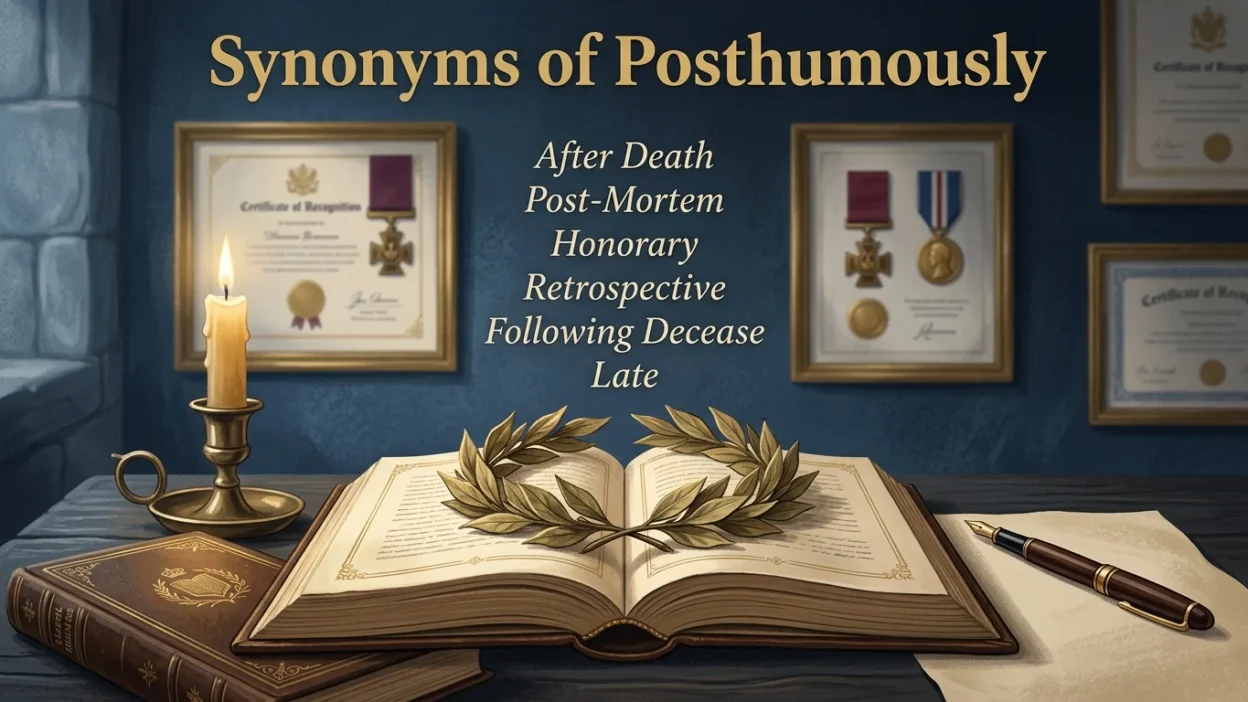
If you are searching for synonyms of posthumously, you are probably looking for alternative words or phrases that convey the idea of something happening after a person’s death. Whether you are writing an academic paper, a historical article, a news report, a biography, or a piece of creative writing, choosing the right synonym can improve clarity, avoid repetition, and make your writing more engaging.
Understanding the subtle differences between these alternatives is important because not every synonym can replace posthumously in every sentence. For example, phrases such as after death and following someone’s death are straightforward and suitable for general writing, whereas expressions like in memoriam or in remembrance carry a stronger emotional or commemorative tone.
Synonyms of Posthumously
The table below lists commonly used synonyms and equivalent expressions for posthumously. While not every term is a perfect one-word replacement, each conveys the idea of something occurring after a person’s death in the appropriate context.
| Synonym | Pronunciation (IPA) | Part of Speech | Meaning | Example Sentence |
| After death | /ˈɑːftə deθ/ | Adverbial phrase | Occurring after someone has died | The novel was published after death according to the author’s wishes. |
| Following death | /ˈfɒləʊɪŋ deθ/ | Adverbial phrase | Happening after a person’s death | The medal was awarded following death. |
| After one’s passing | /ˈɑːftə wʌnz ˈpɑːsɪŋ/ | Adverbial phrase | After someone has passed away | The scholarship was established after her passing. |
| After passing away | /ˈɑːftə ˈpɑːsɪŋ əˈweɪ/ | Adverbial phrase | Following someone’s death | His diaries were discovered after passing away. |
| In memoriam | /ɪn məˈmɔːriəm/ | Adverbial phrase | In memory of a deceased person | The concert was performed in memoriam. |
| In memory | /ɪn ˈmeməri/ | Adverbial phrase | As a tribute to someone who has died | A garden was created in memory of the scientist. |
| In remembrance | /ɪn rɪˈmembrəns/ | Adverbial phrase | To honour the memory of someone deceased | The ceremony was held in remembrance of the soldiers. |
| As a memorial | /æz ə məˈmɔːriəl/ | Adverbial phrase | Serving as a lasting tribute | The foundation was created as a memorial to its founder. |
| Subsequently after death | /ˈsʌbsɪkwəntli ˈɑːftə deθ/ | Adverbial phrase | Taking place later after death | Several manuscripts appeared subsequently after death. |
| Upon death | /əˈpɒn deθ/ | Adverbial phrase | At or immediately after someone’s death | Ownership transferred upon death. |
| Thereafter | /ˌðeərˈɑːftə/ | Adverb | After that event or point in time | She died in 1995, and thereafter her works gained worldwide recognition. |
| Subsequently | /ˈsʌbsɪkwəntli/ | Adverb | Happening later | The award was announced and subsequently presented after his death. |
| In tribute | /ɪn ˈtrɪbjuːt/ | Adverbial phrase | As an act of honour or respect | A concert was organised in tribute to the late musician. |
| Commemoratively | /kəˈmemərətɪvli/ | Adverb | In a commemorative manner | The stamp was issued commemoratively after the author’s death. |
| As a posthumous tribute | /æz ə ˈpɒstjʊməs ˈtrɪbjuːt/ | Phrase | Given to honour someone after death | The award served as a posthumous tribute to her achievements. |
| Following someone’s passing | /ˈfɒləʊɪŋ ˈsʌmwʌnz ˈpɑːsɪŋ/ | Adverbial phrase | After an individual’s death | Donations increased following his passing. |
Understanding These Synonyms
Although these expressions all relate to events occurring after a person’s death, they are not completely interchangeable.
For example, after death and following death are neutral expressions that work well in academic, legal, and historical writing. They simply describe when an event happened without adding emotional meaning.
Expressions such as in memory, in remembrance, and in tribute are different because they focus on honouring or commemorating the deceased rather than merely describing the timing of an event. These are commonly used in speeches, memorial services, charitable foundations, and commemorative ceremonies.
Origin of the Word
The word posthumously comes from the adjective posthumous, which originates from the Latin word postumus, meaning last or coming after. Over time, the term came to describe events occurring after a person’s death, particularly the publication of works or the granting of honours.
When Is “Posthumously” Used?
You will commonly encounter posthumously in situations involving:
- Literary works published after an author’s death.
- Awards presented after the recipient has died.
- Military honours granted after death.
- Academic degrees awarded after a student’s passing.
- Recognition of scientific or artistic achievements.
- Historical accounts describing events after someone’s death.
- Charitable organisations established to honour a deceased individual.
Examples in Context
Understanding how the word functions in real sentences makes it easier to use naturally.
Awards
The actor received an honorary award posthumously for his contribution to British cinema.
Books
Several unpublished manuscripts were released posthumously, attracting international attention.
Academic Recognition
The university awarded her degree posthumously after reviewing her outstanding academic record.
Historical Writing
The explorer became internationally famous posthumously, decades after his expeditions.
Why Learn Synonyms?
Using the same word repeatedly can make writing feel repetitive. Knowing suitable alternatives allows you to:
- Improve readability.
- Match the tone of your writing.
- Avoid unnecessary repetition.
- Write more naturally.
- Choose wording appropriate for formal, academic, historical, or creative contexts.
Rather than replacing posthumously with the same expression every time, you can select the alternative that best fits the context while preserving the intended meaning.
Most Common Synonyms of Posthumously
Although posthumously is the most precise word for describing something that happens after a person’s death, several alternative words and phrases can express a similar idea. The best choice depends on whether you are writing formally, academically, journalistically, or creatively.
1. After Death
After death is one of the clearest and simplest alternatives. It directly states that an event occurred once a person had died.
Example:
- The museum displayed the artist’s private collection after death.
- The charity expanded significantly after his death.
This phrase is suitable for:
- Academic writing
- Historical articles
- General English
- News reporting
It is easy to understand and works well for most audiences.
2. Following Death
Following death is a slightly more formal expression than after death. It is commonly found in official documents, biographies, research papers, and newspaper articles.
Example:
- Several awards were presented following her death.
- The investigation continued following the director’s death.
This expression sounds professional while remaining natural.
3. After Someone’s Passing
This phrase is softer and more respectful than after death. It avoids direct reference to death, making it appropriate for sensitive subjects.
Example:
- Donations increased dramatically after the founder’s passing.
- The memorial scholarship was established after her passing.
You will often see this expression in:
- Obituaries
- Memorial speeches
- Charity websites
- Personal biographies
4. In Memory
Unlike posthumously, in memory focuses on honouring a deceased person rather than simply describing the timing of an event.
Example:
- A new hospital wing was opened in memory of the surgeon.
- Hundreds attended the concert held in memory of the composer.
Use this phrase when discussing:
- Memorials
- Charities
- Public tributes
- Ceremonies
5. In Memoriam
In memoriam comes from Latin and literally means in memory of.
It is widely used in:
- Memorial plaques
- Funeral programmes
- Newspapers
- Award ceremonies
- Historical commemorations
Example:
- The orchestra performed a special concert in memoriam.
- The exhibition was organised in memoriam of the celebrated painter.
Because of its Latin origin, this phrase sounds formal and dignified.
6. In Remembrance
In remembrance emphasises respect and remembrance rather than the timing of an event.
Example:
- Candles were lit in remembrance of those who lost their lives.
- The annual service continues in remembrance of the victims.
It is particularly common during remembrance events and commemorative ceremonies.
7. Upon Death
This expression is primarily used in legal and financial contexts.
Examples include:
- Wills
- Inheritance documents
- Estate planning
- Insurance policies
Example:
- Ownership transfers upon death.
- Benefits become payable upon the policyholder’s death.
It is less common in everyday conversation.
8. Subsequently
The word subsequently simply means later. It only becomes similar to posthumously when the context already makes the person’s death clear.
Example:
- The scientist died in 1978. His discoveries were subsequently recognised worldwide.
Because it does not itself refer to death, readers need surrounding context.
9. Thereafter
Like subsequently, thereafter means after that point.
Example:
- She passed away in 2005. Thereafter, interest in her work increased significantly.
This word is more common in formal writing than everyday speech.
10. In Tribute
In tribute focuses on paying respect rather than indicating when something happened.
Example:
- A concert was organised in tribute to the late musician.
- The sculpture was unveiled in tribute to the war hero.
This expression is especially popular in journalism and public announcements.
Choosing the Best Synonym
Different situations call for different expressions.
| Situation | Best Choice |
| Academic writing | Following death |
| Historical articles | After death |
| Legal documents | Upon death |
| Obituaries | After someone’s passing |
| Memorial ceremonies | In memoriam |
| Charitable events | In memory |
| Awards and honours | Posthumously |
| Public tributes | In tribute |
Selecting the right alternative improves both clarity and tone.
Difference Between Posthumously and Its Synonyms
Many learners assume every synonym can replace posthumously, but that is not always true.
Some expressions describe when something happened, while others describe why it happened or how someone is remembered.
Understanding these differences helps you write accurately.
Posthumously vs After Death
These are the closest equivalents.
Posthumously
- More formal
- Single-word adverb
- Common in professional writing
After death
- Easier to understand
- More conversational
- Suitable for most readers
Examples
- She received the medal posthumously.
- She received the medal after her death.
Both are correct.
Posthumously vs Following Death
The meaning is almost identical.
The main difference is style.
Posthumously
- Concise
- Formal
- Often used with awards, honours and publications
Following death
- Slightly longer
- Often appears in reports and biographies
Example:
- His research was recognised posthumously.
- His research was recognised following his death.
Both communicate the same idea.
Posthumously vs In Memory
These expressions are not interchangeable.
Posthumously
Describes when something happened.
In memory
Explains why something exists.
Compare these examples:
✔ The professor received the award posthumously.
✔ A scholarship was created in memory of the professor.
Replacing one with the other would change the meaning.
Posthumously vs In Memoriam
In memoriam refers to remembrance.
Posthumously refers to timing.
Example:
The orchestra performed in memoriam.
The composer received a Grammy posthumously.
One honours the deceased.
The other describes when recognition occurred.
Posthumously vs Upon Death
These expressions belong to different contexts.
Posthumously
Used with:
- Awards
- Books
- Recognition
- Achievements
Upon death
Used with:
- Wills
- Estates
- Insurance
- Legal matters
Examples
Ownership transfers upon death.
The medal was awarded posthumously.
The meanings are different even though both involve death.
Posthumously vs Subsequently
Many learners confuse these words.
Subsequently simply means later.
It does not necessarily involve death.
Example:
She retired.
She subsequently moved abroad.
Death is not involved.
Only context can make subsequently similar to posthumously.
Which Word Should You Use?
Ask yourself these questions.
Is the sentence about timing?
Use:
- Posthumously
- After death
- Following death
Is the sentence about honouring someone?
Use:
- In memory
- In tribute
- In remembrance
- In memoriam
Is the sentence legal?
Use:
- Upon death
Choosing the right expression makes your writing more precise and more natural.
Why Context Matters
Many dictionaries list words as synonyms because they share a broad meaning.
However, experienced writers know that context is more important than dictionary definitions.
For example:
Correct
The singer received the award posthumously.
Less Natural
The singer received the award in remembrance.
The second sentence sounds awkward because awards are normally given posthumously, whereas ceremonies are held in remembrance.
The more accurately you match the synonym to the situation, the more professional your writing will appear.
Quick Comparison
| Expression | Best Used For |
| Posthumously | Awards, recognition, books |
| After death | General writing |
| Following death | Formal writing |
| Upon death | Legal documents |
| In memory | Memorials |
| In memoriam | Ceremonies |
| In tribute | Public honours |
| In remembrance | Commemorative events |
| Subsequently | General sequence of events |
| Thereafter | Historical and formal writing |
Common Mistakes When Using Posthumously
Although posthumously is a straightforward word, it is often misused. Understanding the most common mistakes will help you write more accurately and professionally.
1. Using Posthumously for Living People
The biggest mistake is using posthumously to describe something that happens to a living person.
Incorrect:
- The author received the award posthumously while attending the ceremony.
Correct:
- The author received the award during the ceremony.
Because posthumously always means after someone’s death, it cannot refer to anyone who is still alive.
2. Confusing Posthumously with In Memory
Many writers think these expressions mean exactly the same thing.
They do not.
Incorrect:
- The scholarship was awarded in memory.
Better:
- The scholarship was awarded posthumously.
If the scholarship itself exists to honour someone, then in memory of is appropriate.
If an award is given after a person’s death, posthumously is the correct choice.
3. Using It in the Wrong Context
Not everything that happens after death should be described as posthumously.
For example:
- Property ownership transfers upon death.
- Insurance payments are made upon death.
- Funeral arrangements take place after death.
In these situations, posthumously sounds unnatural because the focus is on legal or practical events rather than recognition or publication.
4. Overusing the Word
If you repeat posthumously several times in the same article, your writing becomes repetitive.
Instead, vary your language naturally.
For example:
- after death
- following death
- after their passing
- in memory
- in tribute
Using appropriate alternatives improves readability while maintaining accuracy.
5. Choosing a Synonym That Changes the Meaning
Not every listed synonym can replace posthumously.
Compare these examples.
Correct
- The medal was awarded posthumously.
Incorrect
- The medal was awarded in remembrance.
The second sentence sounds awkward because in remembrance describes an act of commemoration rather than the timing of the award.
Always consider whether the sentence refers to when something happened or why it happened.
6. Forgetting the Formal Tone
Posthumously is generally a formal word.
In casual conversation, people often prefer simpler expressions such as:
- after they died
- after his death
- after her passing
Using language that suits your audience makes your writing more natural.
7. Incorrect Sentence Placement
The position of posthumously can affect readability.
Natural
- The actor was honoured posthumously.
- The novel was published posthumously.
Less Natural
- Posthumously, the actor was honoured.
Although grammatically correct, the first style is more common in modern British English.
Tips for Using Posthumously Correctly
Using posthumously effectively is not difficult once you understand its meaning and purpose. The following tips will help you use the word confidently in different types of writing.
Understand the Meaning First
Remember that posthumously always refers to something that happens after a person’s death.
If the person is still alive, another word should be used.
Match the Context
This word commonly appears with:
- Awards
- Medals
- Degrees
- Publications
- Promotions
- Recognitions
- Honours
- Artistic works
These are the situations where posthumously sounds most natural.
Choose Simpler Alternatives for General Readers
While posthumously is widely understood, some audiences may find simpler phrases easier to read.
Examples include:
- after death
- after his passing
- following her death
These alternatives improve accessibility without changing the meaning.
Avoid Forced Synonyms
Some writers replace posthumously simply to avoid repetition.
However, replacing it with an unsuitable expression may confuse readers.
Always choose a synonym that matches the intended meaning.
Read the Sentence Aloud
Reading your writing aloud is an excellent way to identify awkward wording.
Ask yourself:
- Does the sentence sound natural?
- Is the meaning completely clear?
- Would another expression be easier to understand?
Small adjustments often make a big difference.
Consider Your Audience
Different readers expect different styles.
Academic writing
Formal vocabulary such as posthumously and following death is appropriate.
Journalism
Either posthumously or after death usually works well.
Creative writing
Expressions like after his passing or following her death often sound more natural.
Legal writing
Terms such as upon death are usually preferred.
Keep Your Writing Varied
If posthumously appears multiple times in one article, vary your wording where appropriate.
For example:
- The award was presented posthumously.
- The foundation was established after his death.
- The ceremony was held in memory of the scientist.
This keeps the writing engaging while maintaining accuracy.
Summary
Understanding the synonyms of posthumously helps you write with greater precision, variety, and confidence. While posthumously remains the most accurate term for describing events that occur after a person’s death, several alternative expressions can communicate a similar idea depending on the context.
Neutral phrases such as after death and following death are suitable for academic, historical, and journalistic writing. More respectful expressions such as after someone’s passing, in memory, in remembrance, and in memoriam are commonly used in memorials, tributes, and commemorative events. Meanwhile, upon death is primarily reserved for legal and financial contexts.
The key to choosing the right synonym is understanding the purpose of your sentence. If you are describing when something happened, posthumously or after death is usually the best choice. If you are emphasising honour or remembrance, expressions like in memory or in tribute are often more appropriate.
By selecting the most suitable synonym for each situation, you can create writing that is accurate, engaging, and natural while avoiding unnecessary repetition.
FAQs
1. What does posthumously mean?
Posthumously means after a person’s death. It is used to describe awards, publications, honours, promotions, or other events that happen after someone has died.
2. What is the closest synonym to posthumously?
The closest synonym is after death. Other common alternatives include following death, after someone’s passing, and upon death, depending on the context.
3. Can posthumously be used for books?
Yes. It is commonly used to describe books, diaries, letters, or other works published after an author’s death.
Example:
Her final novel was published posthumously.
4. Is posthumously a formal word?
Yes. Posthumously is generally considered a formal word and is widely used in journalism, academic writing, biographies, legal documents, and official announcements.
5. Can “in memory” replace posthumously?
Not always. Posthumously describes when something happened, while in memory explains that something was created to honour a person who has died.
6. Is “upon death” the same as posthumously?
No. Upon death is mainly used in legal and financial contexts, while posthumously usually refers to awards, recognition, publications, honours, or achievements that happen after someone’s death.
7. Why should I learn synonyms of posthumously?
Learning synonyms helps you avoid repeating the same word, improve readability, and choose the most suitable expression for academic, professional, historical, or creative writing.