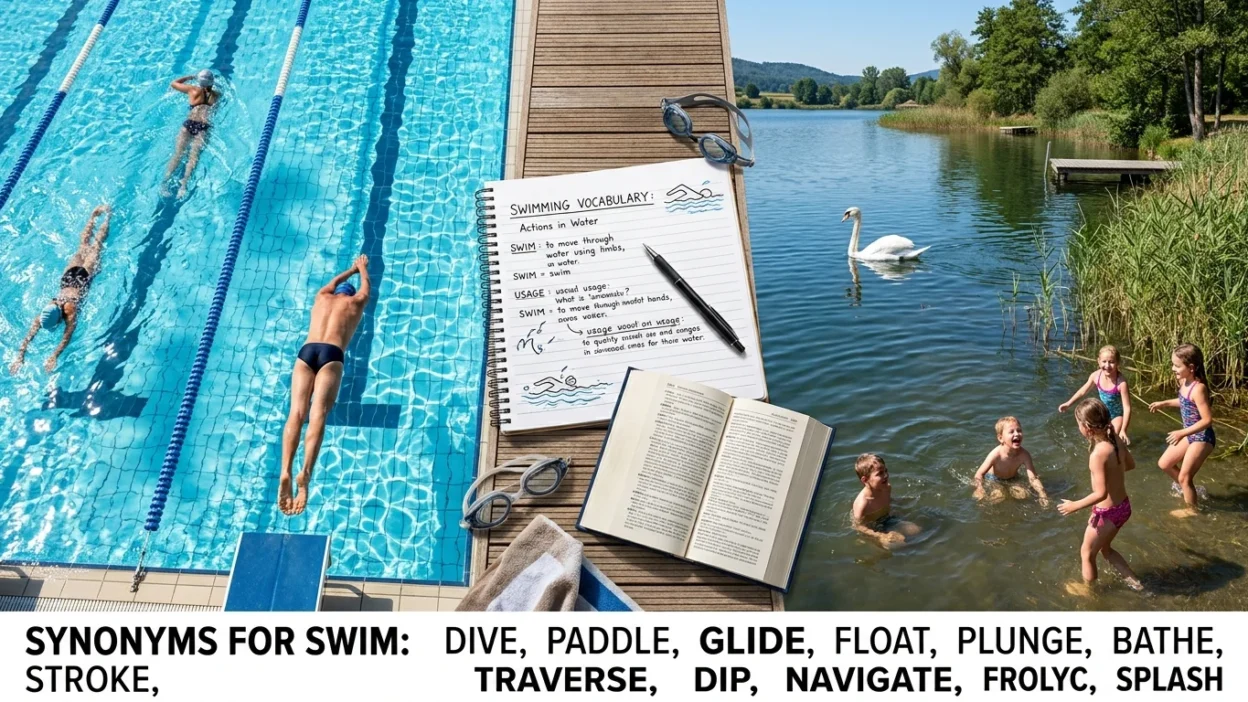
Swimming is one of the most common activities people describe in everyday English. Whether someone is enjoying a holiday at the beach, exercising in a pool, or watching fish move through the water, the verb “swim” is often the first word that comes to mind. However, English is a rich language with many alternative words that can express similar ideas in different contexts.
Learning synonyms for swim can make your writing more engaging, improve your speaking skills, and help you choose the most accurate word for a particular situation. Some alternatives describe graceful movement through water, while others suggest floating effortlessly, diving beneath the surface, or moving quickly across rivers, lakes, or oceans. Certain synonyms are also used figuratively to describe being overwhelmed by emotions, surrounded by large amounts of something, or moving through crowds.
Whether you are a student, writer, English learner, or simply someone looking to expand your vocabulary, understanding these alternatives will help you communicate more naturally and confidently.
Synonyms of Swim
The following table lists some of the most useful synonyms for swim. While many of these words are closely related, each carries its own shade of meaning and is appropriate in different situations.
| Synonym | Pronunciation (IPA) | Part of Speech | Meaning | Example Sentence |
| Paddle | /ˈpædəl/ | Verb | To move through shallow water using hands or feet | The children paddled happily near the shore. |
| Float | /fləʊt/ | Verb | To remain on the surface of water | She floated on her back while watching the clouds. |
| Glide | /ɡlaɪd/ | Verb | To move smoothly through water | The swan glided across the lake. |
| Dive | /daɪv/ | Verb | To jump or move beneath the water | He dived into the deep end of the pool. |
| Wade | /weɪd/ | Verb | To walk through shallow water | We waded across the stream. |
| Splash | /splæʃ/ | Verb | To move energetically in water | The children splashed in the paddling pool all afternoon. |
| Drift | /drɪft/ | Verb | To move slowly with the current | The boat drifted gently downstream. |
| Sail | /seɪl/ | Verb | To travel across water in a vessel | They sailed across the bay before sunset. |
| Cruise | /kruːz/ | Verb | To travel smoothly over water | The yacht cruised along the coastline. |
| Navigate | /ˈnævɪɡeɪt/ | Verb | To direct movement across water | The captain navigated the river carefully. |
| Immerse | /ɪˈmɜːs/ | Verb | To place or dip into water | She immersed herself in the cool lake. |
| Submerge | /səbˈmɜːdʒ/ | Verb | To go completely underwater | The submarine submerged within seconds. |
| Frolic | /ˈfrɒlɪk/ | Verb | To play energetically in water | The puppies frolicked in the shallow stream. |
| Bathe | /beɪð/ | Verb | To wash or spend time in water | Visitors bathed in the natural hot springs. |
| Tread water | /tred ˈwɔːtə/ | Verb phrase | To remain upright in deep water by moving arms and legs | She could tread water for several minutes without difficulty. |
What Does “Swim” Mean?
The word swim is primarily a verb that means to move through water using the arms, legs, fins, or other body movements. Humans swim for recreation, exercise, competition, and survival, while many animals swim naturally as their primary method of movement.
For example:
- She swims every morning before work.
- The dolphins swam alongside the boat.
- We learned to swim when we were six years old.
The word can also function as a noun.
For example:
- We went for a swim after lunch.
- A quick swim helped him relax.
Literal Meaning
In its literal sense, swim refers to travelling through water by using physical movement. This includes:
- Swimming in a pool
- Swimming across a river
- Swimming in the sea
- Fish swimming underwater
- Ducks swimming on a pond
This is the most common meaning used in everyday conversation.
Examples
- They swam across the lake before sunset.
- Penguins swim remarkably fast.
- I enjoy swimming in the sea during summer.
Figurative Meaning
Like many English verbs, swim also has several figurative meanings.
It may describe someone feeling overwhelmed.
Example:
My head was swimming after reading the complicated report.
It can also describe being surrounded by large quantities of something.
Example:
The market was swimming with tourists during the festival.
Another common expression refers to blurred vision.
Example:
His eyes began to swim after staring at the computer screen all day.
These figurative uses are common in both spoken and written British English.
Is Every Synonym Interchangeable?
No. Although many words relate to moving in or on water, they are not always interchangeable.
For example:
- Float suggests remaining on the surface without much effort.
- Dive focuses on moving beneath the water.
- Wade means walking through shallow water rather than swimming.
- Glide highlights smooth and graceful movement.
- Paddle usually refers to gentle movement in shallow water or using short strokes.
Choosing the correct synonym depends on the situation you want to describe.
Most Common Synonyms of Swim
Although swim is the most widely used word for moving through water, several synonyms can express the same general idea with different shades of meaning. Choosing the right word makes your writing more descriptive and helps readers picture the action more clearly.
Below are the most common synonyms of swim, along with explanations, examples, and guidance on when to use each one.
1. Paddle
Paddle means to move through water using gentle strokes with the hands or feet. It often refers to moving in shallow water or travelling slowly in a canoe or kayak.
When to use it
Use paddle when the movement is relaxed, slow, or takes place in shallow water.
Examples:
- The children paddled along the edge of the beach.
- We paddled our canoe across the quiet lake.
- She removed her shoes and paddled in the cool water.
Unlike swim, paddle usually suggests little effort and is often associated with leisure.
2. Float
To float means to stay on the surface of the water without sinking. Unlike swimming, floating does not necessarily involve moving from one place to another.
When to use it
Choose float when the emphasis is on remaining on the water’s surface.
Examples:
- He floated on his back for several minutes.
- The inflatable raft floated gently downstream.
- Leaves floated across the pond.
People can float without swimming, making this synonym suitable only in specific situations.
3. Glide
Glide describes smooth, graceful movement through water with very little visible effort.
It is commonly used for swans, dolphins, boats, and skilled swimmers.
Examples
- The swan glided elegantly across the lake.
- She glided through the water with perfect technique.
- The yacht glided into the harbour.
This word creates a sense of beauty and effortless motion.
4. Dive
To dive means to move quickly beneath the surface of the water, usually headfirst.
Examples
- He dived into the swimming pool.
- The seal dived after a fish.
- She loves diving in the Mediterranean during summer.
Although diving usually involves swimming afterwards, the two words describe different actions.
5. Wade
Wade means to walk through shallow water rather than swimming.
Examples
- We waded across the stream.
- Tourists waded into the sea before swimming.
- They carefully waded through the flooded path.
This word should not replace swim when someone is fully supported by the water.
6. Splash
Splash refers to energetic movement in water that sends droplets into the air.
Examples
- The children splashed happily in the pool.
- The dog splashed through the river.
- Everyone laughed as they splashed each other.
The focus is on playful movement rather than travelling through the water.
7. Drift
To drift means to move slowly with the current or wind.
Examples
- The boat drifted towards the shore.
- Seaweed drifted across the bay.
- We drifted peacefully down the river.
Unlike swimming, drifting often happens without active effort.
8. Bathe
Bathe usually means to wash or spend time in water.
In British English, it can also refer to swimming in natural water, although this usage is less common today.
Examples
- They bathed in the sea every afternoon.
- Visitors bathed in the warm spring.
- He bathed before dinner.
The intended meaning depends on the context.
9. Immerse
To immerse means to place something or someone completely into water.
It can also be used figuratively.
Examples
- She immersed herself in the lake.
- The photographer immersed the equipment carefully.
- He immersed himself in his studies.
This word focuses on entering the water rather than travelling through it.
10. Submerge
Submerge means to go completely underwater.
Examples
- The submarine submerged quickly.
- She submerged herself to cool down.
- The rock became submerged after heavy rain.
This synonym highlights complete coverage by water.
11. Tread Water
Tread water means to stay in one place in deep water by moving your arms and legs continuously.
Examples
- She could tread water for ten minutes.
- Lifeguards practise treading water regularly.
- He was tired but continued to tread water until help arrived.
This expression describes maintaining position rather than moving forward.
12. Cruise
Although cruise normally refers to travelling in a boat or ship, it sometimes describes smooth movement across water.
Examples
- The yacht cruised along the coastline.
- We cruised through the islands all weekend.
- The ferry cruised towards the harbour.
Unlike swim, this word is generally used for vessels rather than people.
Difference Between Swim and Its Synonyms
Many learners assume that words such as float, paddle, and dive can replace swim in every sentence. In reality, each word has its own specific meaning and should be used in the appropriate context.
The table below highlights the main differences.
| Word | Main Meaning | Can Replace “Swim”? |
| Swim | Move through water using the body | Yes |
| Paddle | Move gently through shallow water | Sometimes |
| Float | Stay on the water’s surface | No |
| Dive | Go beneath the water | No |
| Wade | Walk through shallow water | No |
| Glide | Move smoothly and gracefully | Sometimes |
| Splash | Play energetically in water | Rarely |
| Drift | Move with the current | No |
| Bathe | Wash or spend time in water | Sometimes |
| Immerse | Put completely into water | No |
| Submerge | Go fully underwater | No |
| Tread water | Stay upright in deep water | No |
Comparing Common Examples
Consider these sentences:
Correct:
- She swims every morning before work.
- She glides through the water with ease.
- She floated on her back for a few minutes.
- She dived into the pool confidently.
These sentences describe different actions even though they all involve water.
Now compare these examples:
❌ She floated across the English Channel.
✔ She swam across the English Channel.
Floating alone would not normally allow someone to travel such a long distance intentionally.
Another example:
❌ The children waded around the deep end of the pool.
✔ The children swam around the deep end of the pool.
Since the water is too deep to walk through, swam is the correct choice.
Choosing the Right Synonym
When selecting an alternative to swim, think about these questions:
- Is the person moving or staying still?
- Are they above or below the water?
- Is the water shallow or deep?
- Is the movement graceful, playful, or forceful?
- Is the subject a person, an animal, or a boat?
Answering these questions will help you choose the most accurate word for the situation.
Common Mistakes When Using “Swim”
Even though swim is a simple and familiar verb, learners often make mistakes when choosing between swim and its synonyms. Understanding these common errors will help you communicate more accurately in both spoken and written English.
1. Using Every Synonym as a Direct Replacement
One of the biggest mistakes is assuming that every synonym has exactly the same meaning as swim.
Incorrect:
- She floated across the river.
Correct:
- She swam across the river.
Why?
Floating means staying on the surface of the water, while swimming involves actively moving through it.
2. Confusing “Dive” with “Swim”
A dive is the action of entering or moving beneath the water, whereas swim refers to travelling through the water.
Incorrect:
- We dived for an hour.
Correct:
- We swam for an hour.
- We dived into the pool before swimming.
3. Mixing Up “Wade” and “Swim”
People wade through shallow water because they can still touch the bottom. Once they begin moving through deeper water using their arms and legs, they are swimming.
Incorrect:
- We waded across the deep lake.
Correct:
- We swam across the deep lake.
4. Overusing the Same Word
Using swim repeatedly can make your writing sound repetitive.
Instead of writing:
The fish swam around the pond. The ducks swam nearby. The children swam after them.
You could write:
The fish glided around the pond. The ducks paddled nearby, while the children swam after them.
Using appropriate synonyms creates smoother, more engaging writing.
5. Forgetting Figurative Meanings
The word swim also has figurative uses.
Examples include:
- My head was swimming after the long meeting.
- The streets were swimming with tourists.
- His eyes began to swim from exhaustion.
Understanding these expressions will improve your comprehension of books, newspapers, and everyday conversations.
Tips for Using “Swim” Correctly
Choosing the right synonym depends on the situation you are describing. These practical tips can help you use swim and its alternatives naturally.
Consider the Type of Movement
Ask yourself how the subject is moving.
- Swim – active movement through water
- Float – staying on the surface
- Glide – smooth movement
- Dive – entering beneath the water
- Wade – walking through shallow water
Selecting the correct word makes your description more precise.
Think About the Context
Some synonyms work best in specific situations.
For example:
- Birds and swans often glide.
- Children usually splash.
- Canoes paddle across rivers.
- Boats cruise along the coast.
- Submarines submerge beneath the sea.
Matching the word to the context improves clarity.
Avoid Unnecessary Repetition
If you’re writing a story, article, or essay, replacing repeated uses of swim with suitable alternatives can make your work more engaging.
Instead of:
The dolphin swam towards the boat. It swam around the boat before it swam away.
You could write:
The dolphin glided towards the boat, circled it gracefully, and then swam away into deeper water.
Learn Common Expressions
English contains many idioms featuring swim.
Some popular examples include:
- Swim against the tide
- Swim with the current
- Sink or swim
- In the swim (meaning involved or fashionable)
- Make someone’s head swim
These expressions are common in British English and add variety to both speech and writing.
Read and Listen Regularly
One of the best ways to master synonyms is through regular exposure to English.
Reading novels, newspapers, magazines, and online articles will help you notice how native speakers choose different words depending on the context.
Films, documentaries, podcasts, and audiobooks also provide excellent examples of natural vocabulary.
Summary
The verb swim is one of the most commonly used words for describing movement through water, but English offers many alternatives that add variety and precision to your language.
Words such as paddle, glide, float, dive, wade, splash, and submerge each describe a different type of movement or action. Although they are related to swimming, they cannot always replace swim directly. Understanding these differences helps you choose the most accurate word for every situation.
Whether you are improving your vocabulary, preparing for an English examination, writing professionally, or simply aiming to sound more natural, learning these synonyms will strengthen your communication skills and make your writing more engaging.
FAQs
- What is the best synonym for “swim”?
The best synonym depends on the context. Paddle, glide, float, and dive are common alternatives, but each has a different meaning. - Is “float” the same as “swim”?
No. Float means staying on the surface of the water, while swim means actively moving through the water. - Can “wade” replace “swim”?
Only in shallow water. Wade means walking through water rather than moving by swimming. - What is a formal alternative to “swim”?
Words such as glide, immerse, navigate, and submerge may be suitable in formal or descriptive writing, depending on the context. - What is the difference between “dive” and “swim”?
Dive describes entering or moving beneath the water, while swim refers to travelling through the water. - Is “paddle” a synonym for “swim”?
Yes, but only in certain contexts. Paddle usually refers to gentle movement in shallow water or moving a small boat using a paddle. - Why should I learn synonyms for “swim”?
Learning synonyms improves your vocabulary, reduces repetition, enhances your writing, and helps you express ideas more accurately.